


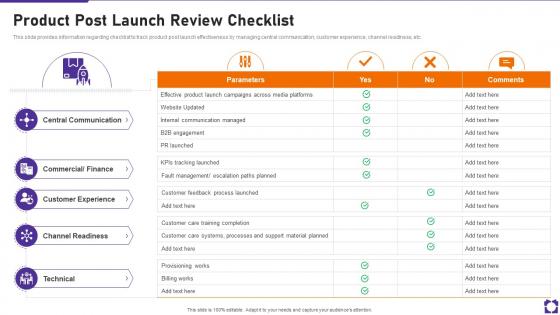
Product Post Launch Review Checklist Product Launch Playbook Ppt Graphics




Try Before you Buy Download Free Sample Product
 Impress Your
 Audience
 100%
100% Editable
 Save Hours
 of Time


This slide provides information regarding checklist to track product post launch effectiveness by managing central communication, customer experience, channel readiness, etc.
People who downloaded this PowerPoint presentation also viewed the following :
Product Post Launch Review Checklist Product Launch Playbook Ppt Graphics with all 6 slides:
Use our Product Post Launch Review Checklist Product Launch Playbook Ppt Graphics to effectively help you save your valuable time. They are readymade to fit into any presentation structure.





FAQs for Product Post Launch Review Checklist Product Launch
Key metrics to evaluate immediately after product launch include user adoption rates, customer acquisition costs, revenue performance, user engagement levels, and customer feedback scores. These indicators streamline decision-making by revealing market reception, operational efficiency, and customer satisfaction, with many organizations finding that early metric analysis enables rapid adjustments, ultimately delivering competitive advantage and sustainable growth.
Customer feedback can be effectively gathered through surveys, social media monitoring, customer support interactions, user analytics, and focus groups. These methods enable organizations to identify product performance gaps, understand user experiences, and prioritize improvements, with many companies finding that combining multiple feedback channels delivers comprehensive insights, ultimately enhancing product development cycles and competitive positioning.
Pre-launch expectations can be contrasted with actual post-launch performance by comparing projected metrics against real data through comprehensive analytics dashboards, customer feedback analysis, and sales performance tracking. This strategic evaluation enables organizations to identify gaps between forecasted and actual outcomes, refine future product development strategies, and optimize market positioning, ultimately delivering enhanced competitive advantage and more accurate launch planning.
Common pitfalls include focusing solely on metrics without customer feedback analysis, conducting reviews too early before sufficient data accumulation, ignoring cross-functional team input, and failing to establish clear success criteria beforehand. Many organizations find that rushing conclusions, overlooking market context changes, and neglecting competitive landscape shifts ultimately compromise strategic decision-making, while comprehensive reviews enable better product iteration and sustained competitive advantage.
Post-launch reviews should involve product managers, development teams, marketing professionals, sales representatives, customer support staff, and executive leadership. These diverse stakeholders deliver comprehensive insights by combining technical performance data, market feedback, customer experience observations, and strategic business outcomes, with many organizations finding that this collaborative approach identifies critical improvement opportunities while ensuring alignment between product evolution and broader business objectives.
Post-launch reviews inform future development by identifying performance gaps, user behavior patterns, market reception trends, and operational inefficiencies that guide strategic pivots. These comprehensive assessments enable organizations to refine product roadmaps, optimize resource allocation, and enhance competitive positioning, with many companies finding that systematic post-launch analysis accelerates innovation cycles and delivers stronger market fit.
Competitive analysis provides crucial market positioning insights by evaluating competitor responses, pricing strategies, feature comparisons, market share shifts, and customer perception changes following your product launch. This analysis enables organizations to identify strategic gaps, refine competitive advantages, and adjust positioning tactics, with many companies finding that systematic competitor monitoring ultimately delivers enhanced market differentiation and informed strategic pivots.
Product post-launch reviews should be conducted quarterly for the first year, then bi-annually, with critical reviews triggered by significant market changes, performance drops, or competitive shifts. This cadence enables organizations to identify optimization opportunities, address user feedback, and adapt strategies quickly, while many companies find that regular reviews ultimately deliver sustained market relevance and competitive advantage.
Tools for streamlining product post-launch reviews include analytics platforms, customer feedback management systems, performance dashboards, automated reporting software, and collaborative project management tools. These technologies enhance efficiency by centralizing data collection, automating performance tracking, and facilitating cross-functional collaboration, with many organizations finding that integrated toolsets significantly reduce review timelines while improving strategic decision-making capabilities.
Post-launch insights can be communicated through structured presentations, detailed documentation, cross-functional workshops, and regular team meetings that highlight key learnings and actionable recommendations. These communication methods enable organizations to transform individual project experiences into institutional knowledge, with many companies finding that systematic knowledge sharing across departments enhances future product development cycles, reduces repeated mistakes, and ultimately delivers stronger market performance.
A thorough post-launch review significantly enhances brand credibility by demonstrating accountability, transparency, and commitment to continuous improvement, while identifying opportunities to address customer concerns and strengthen market positioning. Organizations conducting comprehensive reviews often discover insights that inform future product development and marketing strategies, ultimately building stronger customer trust and competitive advantage in an increasingly crowded marketplace.
Budget adjustments should prioritize high-impact areas identified through performance metrics, customer feedback analysis, and revenue data, reallocating resources from underperforming initiatives to successful channels. Organizations typically reduce spending on ineffective marketing campaigns while increasing investment in proven acquisition strategies, customer support improvements, and feature development, ultimately optimizing ROI and accelerating market penetration.
Best practices for documenting post-launch review processes include creating standardized templates, maintaining detailed timeline records, capturing stakeholder feedback systematically, recording metrics and performance data, and establishing centralized documentation repositories. These comprehensive documentation strategies enable organizations to streamline future launches, enhance decision-making capabilities, and build institutional knowledge, with many companies finding that structured documentation ultimately delivers improved product outcomes and accelerated development cycles.
Post-launch review insights shape future marketing strategies by revealing audience preferences, channel effectiveness, messaging resonance, timing optimization, and budget allocation patterns. These findings enable marketers to refine targeting approaches, enhance content strategies, and streamline campaign execution, with many organizations finding that data-driven adjustments from previous launches ultimately deliver higher engagement rates and improved ROI.
Success stories from post-launch reviews provide sales teams with compelling, real-world proof points, customer testimonials, and specific ROI examples that resonate with prospects facing similar challenges. Meanwhile, documented challenges offer valuable objection-handling techniques and help salespeople proactively address concerns, with many organizations finding that this comprehensive approach enhances credibility and accelerates deal closure rates.
-
If you have visited their site and failed to find the products, try reaching the customer service because it will be the case that you didn't use the search bar well.
-
I looked at their huge selection of themes and designs. They appeared to be ideal for my profession. I'm sure I'll grab a few of them.