

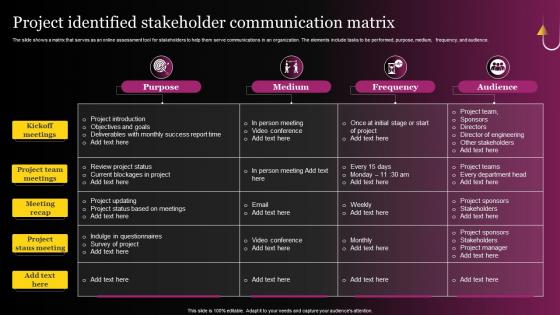
Project Identified Stakeholder Communication Matrix




Try Before you Buy Download Free Sample Product
 Impress Your
 Audience
 100%
100% Editable
 Save Hours
 of Time


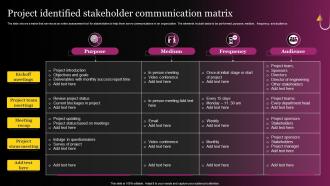
The slide shows a matrix that serves as an online assessment tool for stakeholders to help them serve communications in an organization. The elements include tasks to be performed, purpose, medium, frequency, and audience.
People who downloaded this PowerPoint presentation also viewed the following :
Project Identified Stakeholder Communication Matrix with all 6 slides:
Use our Project Identified Stakeholder Communication Matrix to effectively help you save your valuable time. They are readymade to fit into any presentation structure.





FAQs for Project Identified
Think of it as your cheat sheet for who gets what info and when. Map out each person - their preferred way to communicate, how often they want updates, what details they actually care about. Honestly, some executives just want the high-level stuff while your tech team needs the nitty-gritty. It prevents those "why didn't anyone tell me?" disasters that always happen mid-project. Without one, you're basically throwing information at people and hoping it sticks. Start by writing down your stakeholders first, then figure out what each person actually needs to know. Saves so much headache later.
So basically, a Stakeholder Communication Matrix is way more specific than regular comm plans. Regular plans are like "here's what we'll say and when" but the matrix actually breaks down which people need what info, how often, and through what channels. You're not just blasting everyone with the same updates - you're customizing it. Like, your CEO probably doesn't care about the technical details your dev team needs, right? Traditional plans tend to be pretty generic and timeline-heavy. The matrix approach is more like... creating individual recipes for each group. Oh, and start with your stakeholder list first, then figure out what each group actually wants to know.
Start with the basics - who are your stakeholders, how they like to communicate (email, calls, whatever), and how often they need updates. Map out their influence and interest levels so you know who needs the full story versus just highlights. Some people want weekly check-ins, others are fine with monthly summaries. Honestly, the timing thing trips up a lot of people - note if anyone has weird schedule requirements or deadlines. Oh, and think about urgent stuff versus routine updates. Different situations need different approaches. The whole thing falls apart if you make it too complicated though. Nobody's got time for a 50-column spreadsheet. Keep tweaking it as things change.
Build feedback loops right into your matrix - that's the key. Track response rates and engagement, plus whether people actually do what you're asking. Most matrices totally skip the "feedback method" column (rookie mistake!). Survey your top stakeholders quarterly about communication preferences. Monitor if you're hitting frequency targets and getting info to decision-makers on time. But honestly? The real test is just asking your top 5 stakeholders how it's working for them. Are they feeling informed and engaged? Start there - it's way more telling than fancy metrics.
Honestly, just start with a basic spreadsheet - Google Sheets or Excel work fine. Most people get fancy with Monday.com or Asana (which are solid), but then half the team forgets to update them anyway. You want something dead simple that tracks who needs what info and when. If you're feeling ambitious later, Stakeholder Circle is pretty decent for communication tracking. Some folks even use HubSpot if they already have it. But seriously, don't get caught up in the perfect tool - I've seen teams waste weeks debating software while their stakeholders are left hanging. Pick whatever everyone will actually use consistently.
Okay so first thing - figure out who actually cares about your project or has any say in it. I like to grab coffee for this part since it requires real brain power lol. Think internal people like your boss, teammates, other departments. Don't forget external ones too - customers, vendors, maybe some regulatory people if that applies. Once you've got your list, sort them by how much influence they have and how interested they are. High influence + high interest = talk to them constantly. Plot everyone on one of those power/interest grids to figure out who needs weekly updates versus who just gets the quarterly summary email.
Update it at big milestones and when people's roles shift. I check mine quarterly since communication needs change - someone might need more updates later, others less. Monthly calendar reminders work great too. Honestly, the worst thing is outdated contact info when you're trying to escalate something urgent. Such a mess. Also tweak it when people complain they're getting too many emails or feel out of the loop. Don't just create it once and forget about it. It's gotta be a living doc that actually reflects what's happening.
So basically, a Stakeholder Communication Matrix maps out who needs what info and when. Super helpful for catching conflicts before they blow up in your face. You'll spot communication gaps and see where different groups' priorities clash early on. Think of it as your cheat sheet for knowing who to talk to about what - saves tons of headaches later. Plus you can customize your message for different teams since engineers care about totally different stuff than finance people do. Oh, and actually update the thing regularly or it's useless.
Oh man, this is so much more complex than people realize! Different cultures have totally different expectations for communication - like some want super direct feedback while others need you to be way more diplomatic. Your matrix needs to account for preferred styles (formal docs vs casual check-ins), plus time zones and cultural holidays actually matter a ton. Also think about power dynamics - who's comfortable speaking up in meetings varies hugely by culture. Honestly, just ask your international stakeholders how they prefer to communicate instead of guessing. Map out not just who needs what info, but HOW they want it delivered.
Yeah, you can definitely tweak your communication matrix based on what phase you're in. Planning means tons of back-and-forth with your key people - they need to weigh in on everything. Once you hit execution though, it shifts more to status updates and flagging problems. Honestly, I always set up different columns for each phase because it makes life so much easier. High-influence stakeholders get the detailed stuff while others just need the highlights. Match your communication style to how involved each person actually is in the project. Oh, and map out what your current phase actually needs first - saves you from overthinking it later.
Honestly, the worst thing you can do is treat everyone like they want the same info in the same format - they really don't. Each stakeholder has totally different needs. Also, don't say "regular updates" because that's meaningless to people. Be specific about timing. Make sure someone's actually assigned to handle each type of communication too, or stuff just falls through the cracks. Oh and - I've seen this happen so many times - don't make your matrix super complicated just because you can. Test it with a few people first before you send it to the whole team.
Honestly, stakeholder management can totally make or break your timeline. I've watched projects completely fall apart because people didn't communicate properly - it's wild how fast things go sideways. Map out who needs what info and when they need it first. This prevents those awful last-minute scope changes that nobody wants to deal with. Getting approvals becomes way faster too. People actually prioritize your stuff when they know what's going on (shocking, right?). The key is making sure everyone understands their role and knows when you'll update them next. Trust me, spending time upfront on this saves you from so much drama later.
Yeah totally! Works great actually - way better than trying to wing it with all those moving parts. Just make it way more flexible than the usual corporate version. Map out who needs what info and when. Your dev team gets daily standups, stakeholders get sprint reviews, execs maybe need weekly summaries. The trick is keeping it simple and adjusting as you go - honestly, half the battle is just figuring out who actually wants updates vs. who just thinks they do. I'd start small with your main players for the next sprint. You can always add more people later once you get the rhythm down.
Look at NASA's Mars Rover stuff - they mapped out who talks to who and when. Engineering teams got different updates than Congress or the public. The London Olympics did something similar with a matrix showing daily updates for sponsors but weekly summaries for government people. (Those Olympic timelines were insane, but somehow they kept everyone in the loop.) Spotify actually shares their stakeholder matrices online, which is pretty cool - shows how they talk to users vs artists vs investors. Honestly, just grab a PMI template and steal one of these approaches. Way easier than building from scratch.
Just add a "feedback method" column to your matrix and set up regular check-ins. Quarterly surveys work for bigger groups, but monthly one-on-ones with your key people? Those are gold - way better than any survey. Document everything you hear and actually change your approach based on what they tell you. Here's the thing though - you've gotta close the loop. Show them how their feedback shaped your strategy, or they'll just start telling you what you want to hear. Trust me on this one.
-
I have been using SlideTeam for the past six months. Very happy and satisfied!
-
SlideTeam is very efficient when it comes to saving time. I am happy that I chose them for my presentation.