


Project Management Timeline With Network Design Plan




Try Before you Buy Download Free Sample Product
 Impress Your
 Audience
 100%
100% Editable
 Save Hours
 of Time


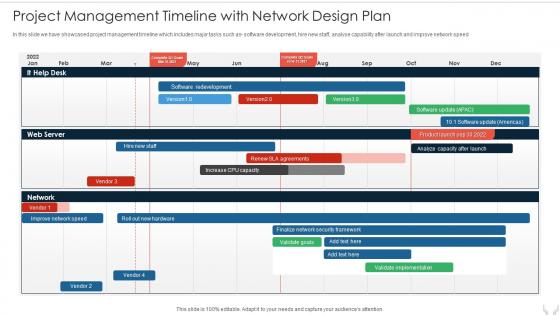
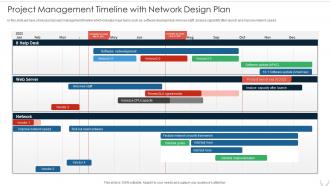
In this slide we have showcased project management timeline which includes major tasks such as software development, hire new staff, analyse capability after launch and improve network speed
People who downloaded this PowerPoint presentation also viewed the following :
Project Management Timeline With Network Design Plan with all 6 slides:
Use our Project Management Timeline With Network Design Plan to effectively help you save your valuable time. They are readymade to fit into any presentation structure.





FAQs for Project Management Timeline With
Key phases include project initiation, planning, execution, monitoring and control, and closure, each requiring clear milestones, deliverables, and resource allocation details. These phases can be effectively represented through Gantt charts, milestone timelines, and phase-gate diagrams, enabling stakeholders to visualize dependencies, track progress, and identify critical paths, ultimately delivering enhanced project transparency and improved decision-making capabilities.
Gantt charts visualize project timelines by displaying tasks, dependencies, milestones, and resource allocations in a clear chronological format, enabling stakeholders to quickly understand project progress and upcoming deliverables. These visual tools streamline communication by providing real-time updates, identifying potential bottlenecks, and facilitating better resource planning, with many organizations finding that enhanced transparency ultimately delivers improved project outcomes and stakeholder alignment.
Common timeline pitfalls include unrealistic deadlines, inadequate resource allocation, insufficient buffer time, poor task sequencing, and failing to account for dependencies. These issues can be avoided by conducting thorough scope analysis, building in contingency periods, validating resource availability upfront, and using proven estimation techniques, with many project managers finding that regular timeline reviews and stakeholder communication ultimately deliver more predictable outcomes.
The critical path represents the longest sequence of dependent tasks that determines your project's minimum completion time, identified by calculating each task's earliest start, latest finish, and total float time. This path is crucial because any delays directly impact your overall timeline, enabling project managers to prioritize resources strategically, anticipate bottlenecks proactively, and maintain stakeholder confidence through realistic delivery commitments.
Milestones serve as critical checkpoints in project management timelines, marking key deliverables, decision points, phase completions, and stakeholder approvals that keep projects on track. These strategic markers should be set at natural project breakpoints, with clear success criteria and regular tracking through project management tools, enabling teams to measure progress, identify potential delays early, and maintain momentum while ensuring stakeholders remain aligned throughout the project lifecycle.
Agile methodologies transform project management timelines by replacing rigid, linear schedules with iterative sprints, continuous feedback loops, and adaptive planning cycles. This approach enables teams to respond quickly to changing requirements, deliver incremental value through regular releases, and maintain strategic flexibility, with many organizations finding that agile timelines reduce project risks while accelerating time-to-market outcomes.
**INPUT**: What tools and software are most effective for creating and managing project timelines? **OUTPUT**: Effective project timeline tools include Microsoft Project, Gantt charts, Asana, Trello, Monday.com, and Smartsheet, each offering unique scheduling and collaboration capabilities. These platforms streamline project management by automating task dependencies, enabling real-time collaboration, and providing visual progress tracking, with many organizations finding that integrated timeline software ultimately delivers enhanced productivity and improved project outcomes.
Risk management integrates into project timelines through scheduled risk assessments, contingency planning, milestone reviews, and buffer allocation at critical phases. This strategic approach enables organizations to identify potential delays early, allocate resources proactively, and maintain project momentum, with many teams finding that embedded risk protocols ultimately deliver faster completion times and reduced costs.
**INPUT**: What strategies can be employed to ensure that a project stays on schedule as outlined in the timeline? **OUTPUT**: Effective schedule management strategies include regular milestone reviews, proactive risk assessment, resource optimization, stakeholder communication protocols, and adaptive planning mechanisms. These approaches streamline project execution by identifying potential delays early, reallocating resources strategically, and maintaining team alignment, with many organizations finding that consistent monitoring and flexible adjustment capabilities ultimately deliver improved project success rates and enhanced operational efficiency.
Resource allocation appears in project management timelines through color-coded task assignments, resource loading charts, capacity planning indicators, and parallel task scheduling based on team availability. This strategic approach enables project managers to identify bottlenecks, prevent resource conflicts, and optimize workflow sequences, with many organizations finding that visual resource mapping reduces project delays and enhances overall operational efficiency.
Effective timeline communication methods include real-time dashboards, automated notifications, visual timeline updates, stakeholder-specific reports, and structured change documentation. These approaches streamline information flow by providing immediate visibility, contextualizing impacts across departments, and maintaining transparency, with many organizations finding that proactive communication reduces project friction and enhances stakeholder confidence.
Inclusion of team roles and responsibilities enhances timeline clarity by establishing accountability, eliminating confusion about task ownership, and creating transparent workflows throughout project phases. This strategic combination enables project managers to identify bottlenecks quickly, streamline resource allocation, and maintain momentum, with many organizations finding that clear role definition ultimately reduces project delays and enhances team coordination.
**INPUT**: What are the best practices for updating and maintaining a project timeline throughout the project lifecycle? **OUTPUT**: Best practices include regular milestone reviews, stakeholder communication protocols, buffer time allocation, risk assessment integration, and progress tracking mechanisms. These approaches streamline project delivery by enabling proactive adjustments, maintaining team alignment, and ensuring resource optimization, with many organizations finding that consistent timeline maintenance ultimately delivers improved project outcomes and enhanced operational efficiency.
Historical project data informs future timelines by analyzing past completion rates, identifying bottlenecks, and revealing patterns in resource allocation and task dependencies. Through data analytics, project managers can benchmark similar projects, adjust for seasonal variations, and account for team performance trends, ultimately delivering more accurate estimates and reducing planning risks across organizations.
Key metrics include schedule variance, milestone adherence rates, resource utilization efficiency, budget performance against timeline phases, and stakeholder satisfaction scores. Through comprehensive post-project analysis, organizations can identify bottlenecks, optimize future planning processes, and enhance predictive accuracy, with many project teams finding that these insights significantly improve timeline reliability and resource allocation strategies.
-
I have just started downloading templates for my presentations and I must say this is a great design. It helped accelerate my presentation design process and made it more visually appealing.
-
SlideTeam just saved my project! Thank you so much. The variety of templates helped me showcase multiple perspectives easily.