

Quality Assurance Process Flow Chart For Agile Development




Try Before you Buy Download Free Sample Product
 Impress Your
 Audience
 100%
100% Editable
 Save Hours
 of Time


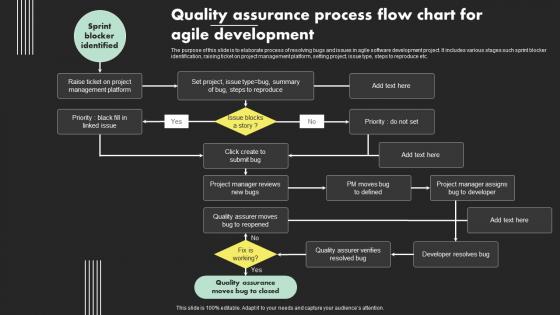
The purpose of this slide is to elaborate process of resolving bugs and issues in agile software development project. It includes various stages such sprint blocker identification, raising ticket on project management platform, setting project, issue type, steps to reproduce etc.
People who downloaded this PowerPoint presentation also viewed the following :
Quality Assurance Process Flow Chart For Agile Development with all 9 slides:
Use our Quality Assurance Process Flow Chart For Agile Development to effectively help you save your valuable time. They are readymade to fit into any presentation structure.








FAQs for Quality Assurance Process Flow Chart
So the big thing with Agile QA is testing way earlier - like, don't wait till the end of sprints to catch stuff. Get everyone involved, not just QA people. Automate whatever makes sense (saves you so much headache later). Work directly with devs instead of throwing issues over the fence. Honestly, I was skeptical at first but it's actually less chaotic than waterfall once you find your rhythm. Short feedback loops are your friend. Quality becomes this shared thing the whole team cares about. Just pick one thing to automate this sprint and go from there.
So in Agile you're basically part of the dev team from the start instead of waiting until the end to test everything. You help write user stories, figure out acceptance criteria, and test stuff as it gets built each sprint. Way better than the old days honestly - no more "here's a giant pile of code, good luck finding bugs." Now you're preventing issues instead of just hunting them down later. Less boring documentation, more exploratory testing and automation. Oh and you catch problems when they're actually fixable, not when everyone's already moved on to the next thing.
Most teams I know use Jira for tracking bugs and managing tests. Selenium's the go-to for automated testing, Jenkins handles CI stuff. TestRail is solid for organizing test cases - way better than those messy spreadsheets everyone starts with. Postman's basically standard for API testing now. Cucumber works great if you're doing behavior-driven testing, though honestly not every team needs it. Docker keeps testing environments consistent across different machines. The real trick is finding tools that actually play nice together instead of making your devs constantly switch between apps.
So CI/CD runs your tests automatically every time someone commits code - unit tests, integration stuff, all of it. You catch bugs super early instead of finding them at the end of sprints. Honestly, the instant feedback alone makes it worth setting up. Small deployments happen way more often too, which sounds scary but actually reduces risk since rollbacks are easier. I spent way too much time doing manual regression testing before I got this working properly. Set up those automated QA checks and you'll thank yourself later.
TDD basically makes you write tests before any actual code, which feels backwards at first but totally works. Your devs start thinking about quality from day one instead of scrambling later. Bugs get caught super early in sprints, and you end up with way more reliable code that's easier to change. The automated test suite becomes this constant safety check running in the background. Honestly, some developers hate it initially - I get it, it slows you down at first. But once your team gets the hang of it? Game changer. Just start with one test per feature and build from there.
Honestly, you've gotta bake automated testing right into your sprint planning from the start. Don't try to slap it on later - that never works well. Unit tests are your best friend here since devs can write them as they code. Then slowly add integration and UI stuff once your pipeline gets more solid. Make it part of your definition of done, seriously. I've watched teams skip this step and they always end up kicking themselves. Run everything continuously through CI/CD so you catch problems early. Oh, and focus on automating your most critical user flows first - you can expand from there each sprint.
Honestly, get your devs and QA pairing up early - those programming sessions are gold. Daily standups should mix both teams, not keep them siloed. I've watched teams burn entire weeks because QA caught stuff that should've been spotted way back in design (so frustrating). Build a shared Definition of Done so nobody's guessing what "finished" means. Bring QA into sprint planning from the start and do collaborative test reviews. Oh, and create a culture where finding bugs gets celebrated instead of blamed. Pick just one thing to try next sprint - don't overwhelm yourself.
Honestly, agile testing is all about rolling with the punches when requirements change constantly. Work tight with your devs and product folks during sprints - they'll usually give you a heads up before things shift. Don't waste time on huge upfront test plans (learned that the hard way). Focus on iterative testing instead. Automated regression tests will catch the obvious breaks while exploratory testing helps you find weird edge cases that pop up. The trick is expecting change rather than dreading it. Oh, and definitely build better relationships with your product team - makes everything smoother.
Oh man, the time crunch is brutal - you're always scrambling to hit sprint deadlines while trying to actually test things properly. Requirements keep changing mid-sprint too, which means rewriting test cases over and over (super fun, right?). Code gets pushed last minute and you're constantly playing catch-up. What's helped me is getting into those daily standups and reviewing code early instead of waiting till the end. Automate whatever you can. Also, make sure quality checks are baked into your definition of done - otherwise you'll just keep fighting the same battles.
Honestly, just speed everything up - cut that lag time between when devs write code and when they hear if it's broken. Automated tests should run every single commit, no exceptions. Your daily standups need QA voices too, not just "I worked on the login feature yesterday" stuff. I swear, some teams I've worked with still do weekly feedback cycles and wonder why they're always playing catch-up. Skip the manager middleman - let testers talk directly to developers. If someone finds a bug at 2pm and the dev doesn't know until tomorrow morning, you're already screwed.
Honestly, start with velocity, defect escape rate, and cycle time - those three will tell you the most. Test coverage and automated pass rates are solid too for keeping things clean. Customer satisfaction is huge but yeah, way harder to track consistently. My last team got so caught up in metrics they barely had time to actually code lol. Pick maybe 3-4 that actually help you decide stuff, not just make pretty charts. The key is finding ones that match what your team's trying to accomplish. Don't overthink it.
Write your user stories like "As a [user], I want [goal] so that [benefit]" but honestly, the magic happens in the acceptance criteria. Get super specific about what "done" looks like - happy path, edge cases, error scenarios, all of it. Don't let edge cases become afterthoughts because that's where bugs love to hide. Performance expectations? Include those too. I've learned QA should be in your refinement sessions from day one. They'll catch gaps developers miss every time. When QA can start writing test cases early instead of guessing what you meant, everything moves smoother. Way less back-and-forth later.
Communication is everything when you're remote - those daily standups become way more important. For tricky bugs, just hop on a video call and screen share instead of trying to explain it over Slack (trust me on this one). Document your test cases like your life depends on it since you can't just show someone what's broken anymore. Set up shared testing environments everyone can actually access without a headache. Over-communicating beats the alternative when you can't walk over to someone's desk. Oh, and make sure dev and QA have super clear handoff protocols - async work means your acceptance criteria better be bulletproof.
So automation's great for catching the obvious stuff that'd normally drive you crazy - like making sure login still works after updates. Run those tests all the time. But honestly? Real users do the weirdest things you'd never think to script. That's where exploratory testing comes in handy. You're basically poking around manually, trying random scenarios and seeing what breaks. I always do exploratory sessions on new features or anywhere the automated coverage feels sketchy. Both together work way better than either one alone.
Oh totally - QA can make or break team morale if you do it right. Instead of saving all the testing for the end (which is honestly a nightmare), weave it throughout your sprints. Developers actually love working with QA during planning because they catch stuff early. No more 3am panic fixes before releases. Your feedback loops get tighter, and everyone's way less stressed about shipping. The trick is making QA feel like teammates, not the fun police who just point out what's broken. Start having your QA people sit in on story planning - game changer.
-
Their designing team is so expert in making tailored templates. They craft the exact thing I have in my mind…..really happy.
-
Great experience, I would definitely use your services further.