

Requirement Engineering Process Flowchart For Quality Improvement




Try Before you Buy Download Free Sample Product
 Impress Your
 Audience
 100%
100% Editable
 Save Hours
 of Time


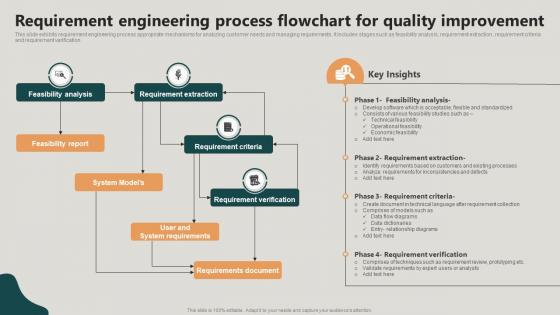
This slide exhibits requirement engineering process appropriate mechanisms for analyzing customer needs and managing requirements. It includes stages such as feasibility analysis, requirement extraction, requirement criteria and requirement verification.
People who downloaded this PowerPoint presentation also viewed the following :
Requirement Engineering Process Flowchart For Quality Improvement with all 9 slides:
Use our Requirement Engineering Process Flowchart For Quality Improvement to effectively help you save your valuable time. They are readymade to fit into any presentation structure.








FAQs for Requirement Engineering Process Flowchart
So there's five main stages you'll hit: elicitation, analysis, specification, validation, and management. First up is gathering requirements from stakeholders - honestly, this is where I'd spend most of your time upfront. Way better to catch missing stuff now than when developers are already deep in code. Then analyze everything for conflicts or weird gaps. Documentation comes next, and wow can this get messy fast if you're not organized. After that, validate with stakeholders to double-check you actually understood what they wanted. Oh, and requirements management never really ends since people always change their minds mid-project.
So functional requirements are basically what your system does - like "user can log in" or "generates reports." Non-functional is more about how well it performs those tasks. Performance, security, that kind of stuff. Here's how I think about it: functional = "what" and non-functional = "how well." Quick test - can you check it with yes/no? (Does login work?) That's functional. Need actual metrics to measure it? (Loads under 2 seconds) Non-functional. I still mix these up sometimes honestly, but this trick helps. You'll want both types documented early since they totally drive different design choices.
Honestly, it depends on who you're dealing with. One-on-one interviews are gold for getting real insights from your main users. Workshops work well when you need a bunch of people hashing out requirements together. For big groups, surveys can help - just don't make them crazy long because people will bail halfway through. Here's the thing though: watching people actually work (job shadowing) tells you way more than what they'll admit in meetings. Sometimes I'll throw together a quick prototype too since showing beats telling. Mix maybe 2-3 approaches and you'll be solid.
Ugh, requirement changes are honestly the worst - they'll torpedo your timeline and budget faster than anything else. You end up redoing work that's already finished, plus dealing with scope creep that never seems to stop. Late changes are particularly painful because they mess with testing, docs, all of it really. The ripple effects just keep going. Spend extra time at the beginning nailing down what stakeholders actually want (easier said than done, I know). Get them to commit properly instead of the usual wishy-washy responses. Then set up some kind of formal process for changes so you can show the real costs before agreeing to their "simple" requests.
Honestly, prototyping is like a sanity check for your requirements. Instead of people just reading boring specs, they can actually click around and see what you're building. Catches all those "oh wait, that's not what I meant" moments early when fixes are still cheap. Can't tell you how many times I've watched someone go through a prototype and suddenly realize they hate something they swore they wanted. UI stuff especially - trying to describe user flows in writing is basically impossible. Just start simple though. Wireframes or basic mockups work fine. Don't overthink it.
Look, get your traceability links set up right from the start and actually keep them updated - I can't stress this enough. Link requirements back to where they came from (stakeholder stuff, business goals, whatever), then connect them forward to your design, code, and tests. Spreadsheets are a nightmare for this, so grab a proper requirements tool. When requirements change (and oh boy, they will), update those links immediately. I've seen too many projects crash because someone skipped this step. Make it part of your regular change process, not something you remember at 2am before a deadline. Run coverage reports to spot gaps early.
Honestly, ditch Excel and grab something like Jira or Azure DevOps. You can track requirements, manage changes, and see how everything connects - way better than drowning in spreadsheets. Confluence's good for documentation too. The collaboration part is where it gets really useful though. Stakeholders can comment and approve stuff in real-time instead of endless email threads. You'll actually know who owns what and can link requirements to test cases. IBM DOORS is solid but maybe overkill if you're just starting out. Version control alone makes it worth switching.
Oh man, cultural differences can absolutely mess up your requirements gathering if you're not careful. Some cultures are brutally direct, others dance around issues instead of just saying what's wrong. I've seen projects where junior people stay silent in meetings because their culture values hierarchy too much - even when they know the requirements are total garbage. Time stuff varies wildly too (Germany vs Brazil taught me that lesson). Your documentation style, meetings, decision-making - all of it needs tweaking based on who you're working with. My advice? Do your homework on each stakeholder's background first, then adapt your approach accordingly.
Figure out who the right people are first - don't just grab whoever's free that day. Mix up how you gather info: workshops, one-on-ones, maybe some quick prototypes. People communicate totally differently. Some stakeholders will absolutely try to hijack every meeting, so you gotta manage that without being rude about it. Write everything down and circle back with them regularly so they know you're not just nodding along. Oh, and be super upfront about timelines from the start. Nobody likes surprise delays later.
First thing - figure out who actually makes decisions vs who just complains loudly. MoSCoW method is solid for sorting must-haves from wishlist items. Value vs effort grids help too, though honestly they can get a bit tedious. What really works is forcing stakeholders into a room together to hash it out themselves. Make them trade off against each other instead of just sending you their individual demands. Way better than trying to play referee later. Keep the whole process visible so nobody feels like decisions happened behind closed doors.
Ugh, the worst part is when stakeholders can't decide what they actually want. Requirements change every week! Document everything - seriously, write it all down or they'll claim they never said that. Set up regular check-ins so you catch problems early. Also get a proper change control process going, otherwise scope creep will destroy your deadlines. I learned this the hard way on my last project. Make everyone agree on priorities upfront before you start coding. Trust me, it's way easier than trying to fix miscommunication later when you're already behind schedule.
Honestly, user stories are a game changer for requirements. Instead of drowning in technical details, you're always thinking about who actually needs this feature and why. Your stakeholders will thank you too - way better than making them slog through some massive spec document. The format itself catches problems early since you have to spell out the user, what they want, and the benefit. I've found gaps in logic that would've been expensive fixes later. Try converting your next batch of requirements and watch how much smoother your team discussions get. You'll be surprised at the difference.
Look at completeness first - did you actually capture everything? Then check if requirements contradict each other (happens more than you'd think). Clarity's obvious but worth mentioning since vague language kills projects. Here's the thing though - if you can't test it, it's garbage. Seriously. Testability separates good requirements from wishful thinking. Traceability matters too since you'll need to track stuff from initial request all the way through development. But honestly? Most issues I've seen come down to ambiguous wording that everyone interprets differently. Quick review during sprint planning catches this early before it becomes a headache later.
Dude, agile basically throws the old "plan everything upfront" approach out the window. Instead of those monster requirement docs, you work with user stories and build things iteratively. Way better than waterfall IMO - requirements actually evolve as you figure out what people really want. Backlog gets prioritized, then you refine stuff right before each sprint. The whole point is staying flexible when things change (and they always do). Just start with some basic user stories, get feedback fast, and keep iterating. Oh and don't stress if your first stories suck - they usually do.
Honestly, stop trying to be the middleman for everyone. Get these people in a room together and make them hash it out face-to-face - you'd be shocked how fast the BS evaporates when they can't just complain to you separately. Use something like MoSCoW prioritization so decisions aren't just based on whoever yells loudest. Write everything down and get signatures on compromises. If people won't budge, escalate to their boss. The key is making conflicts visible early instead of secretly juggling everyone's demands. Trust me, collaborative decisions beat trying to please everyone behind closed doors.
-
“I required a slide for a board meeting and was so satisfied with the final result !! So much went into designing the slide and the communication was amazing! Can’t wait to have my next slide!”
-
Excellent template with unique design.