


Quick wins framework powerpoint slides




Try Before you Buy Download Free Sample Product
 Impress Your
 Audience
 100%
100% Editable
 Save Hours
 of Time


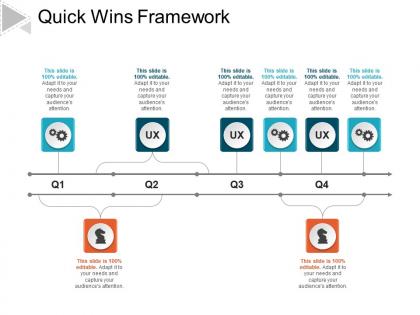
Make a positive impact on your organization by employing Quick Wins Framework PowerPoint Slides. Evaluate and monitor various activities within your organization by using Quick Wins In Process Management PowerPoint Themes. Highlight key steps to identify and implement quick wins in order to evaluate the progress of your organization. Make your team analyze and understand the benefits of quick wins and help to form viable projects. There are various functions like planning, organizing, staffing, leading, and controlling which you can showcase in this quick wins in business process management PPT slideshow. Also, include the top 5 marketing quick wins that will help you to generate more leads and refresh your inbound efforts. Boost your leadership by discussing the short term goals like revenue, employee appreciation, customer service, and website traffic goals using this small wins PPT infographic. Thus, download this ready to use PowerPoint presentation and help your organization to deliver faster results.
People who downloaded this PowerPoint presentation also viewed the following :
Quick wins framework powerpoint slides with all 5 slides:
Adorn your thoughts with our Quick Wins Framework Powerpoint Slides. They will add all the frills.
FAQs for Quick wins
So the Quick Wins Framework breaks down into four things: impact, effort, timeline, and resources. Basically you want high-impact stuff that doesn't take forever or drain your team. Picture a matrix where you plot impact vs effort - the magic happens in that top-left corner where big results meet low effort. I usually start by dumping every idea on paper first (even the ridiculous ones). Then comes the fun part: being ruthless about what actually qualifies. Honestly, real quick wins are rarer than you'd think, but when you find them it's pretty satisfying.
Okay so Quick Wins Framework is basically about knocking out easy, high-impact stuff first to get momentum going. Like, why struggle with the hardest parts when you can build confidence with some early victories? Your team feels good, leadership sees results, and suddenly everyone's bought in. Those wins also clear obstacles for the trickier work later - which honestly makes way more sense than diving headfirst into chaos. I'd start by brainstorming what you could realistically finish fast that'll actually move the needle. Then just rank them by effort vs. impact and go for it.
Honestly, the worst mistake is calling something a "quick win" when it'll actually take forever - nothing kills momentum like a 3-month "quick" project. Pick 2-3 things max that you can genuinely finish in a few weeks. Don't choose stuff that helps one team but pisses off everyone else (been there, not fun). Even if something seems super obvious, you still need people on board first. And definitely celebrate when you're done! Otherwise what's the point? Short sentences work better than trying to fix everything at once.
Honestly, start with the stuff that looks impressive but doesn't actually take forever. I always think "what would make people notice progress in like two weeks?" - that's your sweet spot. Quick process fixes, easy bug squashes, anything that unblocks someone else's work. The trick is being real about how long things actually take though. Don't lie to yourself that the complicated project is somehow gonna be quick. List out maybe 10 possibilities, then be brutal and pick your top 3. Those high-impact, low-effort wins are basically free points.
Yeah totally! Quick Wins work everywhere - I've seen it in healthcare, tech, retail, whatever. The basic concept is the same but you just tweak it for your industry. Like what counts as "quick" for a hospital is probably different than for a startup, you know? First thing is figuring out what those words even mean for your team. Then make a list of possible stuff you could do and rank them on effort versus impact. Honestly, the framework is pretty simple once you get the hang of it. Just find those sweet spot opportunities where you don't have to kill yourself but still get solid results.
Track the obvious stuff first - time saved, money cut, processes that actually work better now. But here's the thing: the soft metrics are honestly just as important. Check if people are more engaged, if stakeholders are buying in, how many new projects got approved after your win. This might sound random, but I track weird indicators too - like meeting attendance or email response times. Tells you a lot about momentum. Just throw together a basic dashboard with maybe 4-5 things you care about. Check it weekly so you don't lose steam.
Dude, team dynamics literally make or break these Quick Wins things. Good communication and trust? You'll spot opportunities fast and actually get stuff done. Dysfunctional team though? Even the simplest wins turn into total nightmares - I've watched it destroy so many projects. The whole approach needs people willing to share ideas and make quick calls. Nobody speaks up about problems if they don't feel safe, you know? Oh, and definitely check how healthy your team dynamic is before jumping into any of this stuff. Trust me on that one.
Dude, quick wins are like magic for keeping stakeholders hooked. People get excited when they see stuff actually happening - there's nothing quite like that momentum. I'd set up weekly check-ins where you show off one thing you've knocked out. Gets everyone pumped and proves this isn't just another framework that'll die in a drawer somewhere. The trick is picking wins that fix what's bugging them most. Share updates regularly, celebrate the small stuff publicly, and honestly? Let them help choose what to tackle first. Keeps them invested and you'll be surprised how much energy it creates.
Dude, you've gotta make noise about those wins! People forget success way faster than you'd think - honestly it's kind of depressing how quickly good news gets buried. So when your team nails something, broadcast it. Slack messages, team meetings, random shout-outs during standup, whatever works. Don't just assume people will notice or remember on their own because they won't. Make it a habit to celebrate the small stuff regularly. Those quick wins only build momentum if everyone actually sees them happening, you know?
I'd check those quick wins every 2-4 weeks if I were you. Weekly reviews make me feel like a crazy person, but waiting a whole month? Too risky if something's bombing. During each check-in, see if they're still hitting your main goals and actually making progress. Don't get attached though - if a win isn't working after 2-3 weeks, just drop it. I learned that the hard way on a project last year. Set up a calendar reminder right now or you'll totally forget. Trust me on that one.
Honestly, I'd just start with whatever tool you're already using - probably a spreadsheet if you're like most people. Asana and Monday are solid for dashboards that auto-track your quick wins, but sometimes they're way too much. Filter for tasks under 2-3 days with high impact and you're golden. Analytics stuff can show you patterns later (like which wins actually matter), but don't overthink it at first. The real trick? Pick one system and stick with it instead of bouncing around. I've seen too many teams get distracted by shiny new tools when a simple setup would've worked fine.
Honestly, quick wins aren't just separate tasks - they're your stepping stones to bigger goals. You nail a few small victories first, then boom, you've got the credibility and momentum for those massive projects. I've watched too many teams dive headfirst into 18-month initiatives and completely flame out halfway through (it's brutal). Way better to use those small wins to prove your approach works and show stakeholders you're worth betting on. Find quick wins that actually connect to your long-term strategy. That way you're building toward something real, not just checking boxes.
Honestly, quick wins are like momentum builders for your team. You tackle small, doable improvements and people start getting addicted to that success feeling. Instead of just accepting broken stuff, they'll actually hunt for problems to fix. Here's what I've noticed - people get so tired of their ideas vanishing into committee hell, so when something gets implemented fast? Game changer. Each little victory teaches you what actually works in your specific situation (not just theory). My advice? Make a big deal about celebrating these wins publicly. Sounds cheesy but it totally works - suddenly everyone's pitching ideas.
Just use whatever your team's already comfortable with - Trello, Asana, or honestly even Google Sheets works fine. The main thing is picking something people will actually stick with (we've all been there with those ghost-town Notion pages). Set up basic columns like "Quick Wins," "Working On," and "Done" for tracking your short-term stuff. Miro's pretty solid for brainstorming sessions when you're hunting for opportunities. But seriously, don't get caught up in finding the "perfect" tool. Start simple and switch later if you need to. Half the battle is just getting started rather than spending weeks debating platforms.
Honestly, quick wins and agile are like peanut butter and jelly. You're already chopping work into short sprints anyway, so spotting quick wins within each one keeps everyone energized and your stakeholders from breathing down your neck. The feedback loops happen faster too. Just don't fall into the trap of picking busy work that feels productive but doesn't actually push your project forward - been there, done that. I'd shoot for maybe 20-30% of each sprint focused on these opportunities while you tackle your main features.
-
Graphics are very appealing to eyes.
-
Awesome presentation, really professional and easy to edit.