


Real World Applications Of Deep Learning Training Ppt




Try Before you Buy Download Free Sample Product
 Impress Your
 Audience
 100%
100% Editable
 Save Hours
 of Time


These slides discuss real-world applications of Deep Learning. These include detecting Developmental Delay in Children, Colorization of Black and White Images, Adding Sound to Silent Movies, Pixel Restoration, Sequence Generation or Hallucination, Toxicity Testing of Chemical Structures, Radiology, Detection of Mitosis, and Market Prediction.
People who downloaded this PowerPoint presentation also viewed the following :
Content of this Powerpoint Presentation
Slide 1
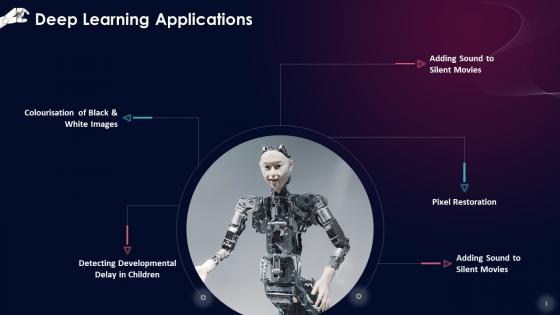
This slide lists applications of Deep Learning in the real world. These include detecting developmental delay in children, colourisation of black & white images, adding sound to silent movies, pixel restoration, and Sequence Generation or Hallucination.
Slide 2
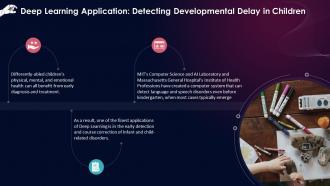
This slide states that one of the finest applications of Deep Learning is in the early detection and course correction of infant and child-related developmental disorders. MIT's Computer Science and AI Laboratory and Massachusetts General Hospital's Institute of Health Professions have created a computer system that can detect language and speech disorders even before kindergarten, when most cases typically emerge.
Slide 3
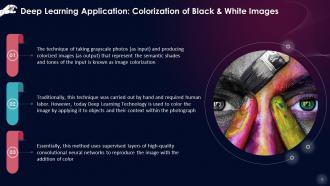
This slide describes image colorization i.e. the technique of taking grayscale photos and producing colorized images that represent the semantic shades and tones of the input. Traditionally, this technique was carried out by hand and required human labor. Today, however, Deep Learning Technology is used to color the image by applying it to objects and their context within the photograph.
Slide 4
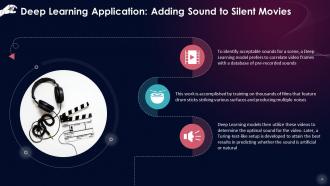
This slide states that to identify acceptable sounds for a scene, a Deep Learning model prefers to correlate video frames with a database of pre-recorded sounds. Deep Learning models then use these videos to determine the optimal sound for the video.
Slide 5
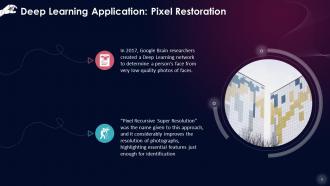
This slide discusses that in 2017, Google Brain researchers created a Deep Learning network to determine a person's face from very low-quality photos of faces. “Pixel Recursive Super Resolution” was the name given to this approach, and it considerably improves the resolution of photographs, highlighting essential features just enough for identification.
Slide 6
This slide showcases that sequence generation or hallucination works by creating unique footage by seeing other video games, understanding how they function, and replicating them using Deep Learning techniques like recurrent neural networks. Deep Learning hallucinations can produce high-resolution visuals from low-resolution photos. This technique is also used to restore historical data from low-resolution quality photographs to high-resolution images.
Slide 7
This slide describes that the Deep Learning approach is incredibly efficient for toxicity testing for chemical structures; specialists used to take decades to establish the toxicity of a particular structure, but with a deep learning model, toxicity can be determined quickly (could be hours or days, depending on complexity).
Slide 8
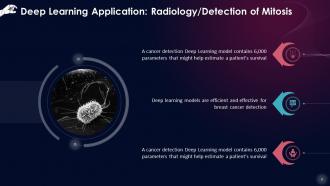
This slide showcases that a cancer detection Deep Learning model contains 6,000 parameters that might help estimate a patient's survival. Deep learning models are efficient and effective for breast cancer detection. The Deep Learning CNN model can now identify and categorize mitosis in patients. Deep neural networks aid in the study of the cell life cycle.
Slide 9
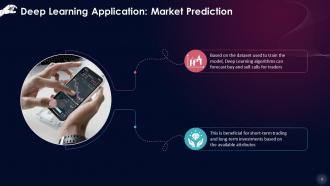
This slide states that based on the dataset used to train the model, Deep Learning algorithms can forecast buy and sell calls for traders. This is beneficial for short-term trading and long-term investments based on the available attributes.
Slide 10
This slide describes that Deep Learning algorithms classify consumers based on prior purchases and browsing behavior and offer relevant and tailored adverts in real-time. We can see this in action: If you search for a particular product on a search engine, you will be shown relevant content of allied categories in your news feed also.
Slide 11
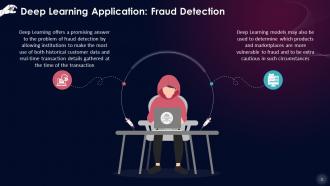
This slide showcases that Deep Learning offers a promising answer to the problem of fraud detection by allowing institutions to make the most use of both historical customer data and real-time transaction details gathered at the moment of the transaction. Deep Learning models may also be used to determine which products and marketplaces are more vulnerable to fraud and to be extra cautious in such circumstances.
Slide 12
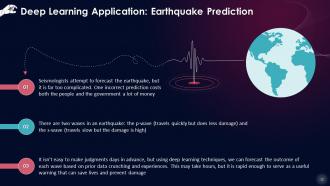
This slide states that seismologists attempt to forecast the earthquake, but it is far too complicated. One incorrect prediction costs both the people and the government a lot of money. There are two waves in an earthquake: the p-wave (travels quickly but does less damage) and the s-wave (travels slow but the damage is high). It isn't easy to make judgments days in advance, but using deep learning techniques, we can forecast the outcome of each wave based on prior data crunching and experiences. This may take hours, but it is rapid enough to serve as a useful warning that can save lives and prevent damage.
Slide 13
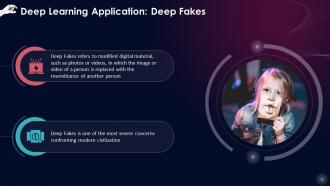
This slide gives an overview of Deep Fakes, which refers to modified digital material, such as photos or videos, in which the image or video of a person is replaced with the resemblance of another person. Deep Fake is one of the most severe concerns confronting modern civilization.
Instructor Notes:
In 2018, a spoof clip of Barack Obama was made, using phrases he never spoke. Furthermore, Deep Fakes have already been used to distort Joe Biden's footage showing his tongue out in the US 2020 election. These detrimental applications of deepfakes can significantly influence society and result in the spreading of false information, particularly on social media.
Real World Applications Of Deep Learning Training Ppt with all 29 slides:
Use our Real World Applications Of Deep Learning Training Ppt to effectively help you save your valuable time. They are readymade to fit into any presentation structure.






FAQs for Real World Applications Of Deep
Healthcare and finance are crushing it with deep learning right now. Diagnostic AI can catch cancer better than doctors sometimes, which is honestly kind of scary but amazing. Finance companies are making bank with fraud detection and trading algorithms. Obviously tech dominates with all the recommendation stuff we see daily. Automotive's interesting too - they're dumping crazy money into self-driving cars. If you're thinking career change, these sectors are hiring like crazy and actually making real money from AI, not just burning through VC funding like some industries.
So deep learning changed everything for image recognition - it finds visual patterns that old algorithms completely missed. Neural networks figure out their own features instead of you coding them manually. They start with basic edges, then build up to complex shapes and full objects. I tried explaining this to my mom last week and her eyes glazed over lol. But seriously, the results are insane compared to traditional methods. Medical imaging, self-driving cars - it's everywhere now. Just grab a pre-trained model like ResNet and mess around with it. You'll see what I mean instantly.
Deep learning totally changed how machines understand language. Remember when Google Translate was basically useless? Now it's actually pretty decent - though still makes me laugh sometimes. Models like BERT and GPT can pick up on context and subtle meanings that older systems completely missed. You'll see this everywhere: ChatGPT, Siri, sentiment analysis stuff. These models handle crazy complex tasks now - summarization, creative writing, Q&A. Short version: if you're dealing with text data, just use pre-trained models. Don't build from scratch. You'll thank me later.
So basically, deep learning runs the whole show for self-driving cars. Neural networks process all those camera feeds and spot pedestrians, read signs, figure out what other drivers might do. The real-time visual stuff is honestly insane when you think about it. These systems actually learn from millions of driving miles, which makes them smarter over time. Oh and if you want to dig into the tech side - check out YOLO for object detection first. That's where things get interesting. It's wild how much computing power is just sitting in these cars now.
So basically, deep learning is revolutionizing healthcare by spotting diseases super early. You know how AI can detect cancer in scans now? Same tech is predicting heart attacks and finding diabetic issues just from eye photos. There's even some crazy research on voice analysis for Parkinson's - though that one seems pretty futuristic to me. The real game-changer is these systems work around the clock, processing way more data than any human could handle. They're getting scary good at catching stuff doctors miss. Google's DeepMind has some interesting health projects if you want to dive deeper into examples.
Honestly, regulatory stuff will be your biggest headache - finance is so regulated that every model needs to be totally transparent and auditable. Data's a mess too since it's usually scattered across different systems or locked down by privacy rules. Black box models? Forget it. Regulators want to see exactly how you're making decisions. The pressure is insane because one wrong prediction could literally cost millions. Plus you've got people actively trying to hack or manipulate your systems. My advice? Start with small pilot projects first - way easier to prove it works before going big.
Basically, deep learning studies how your customers browse and what they've bought before to make everything super personalized. The recommendation engines get weirdly accurate - like, sometimes creepily so. Your email campaigns become way more targeted, and the website actually changes layouts based on who's looking at it. Dynamic pricing happens automatically too, which is pretty cool. The algorithms honestly predict what people want better than the customers do half the time. You just need to keep feeding it good data so it gets smarter. Oh, and it handles inventory stuff based on different customer groups.
So deep learning is totally changing how cybersecurity works. Instead of just looking for known attack signatures, these ML systems actually learn from huge datasets to spot weird patterns and catch zero-day attacks that would slip right past old-school security tools. Your systems can adapt on the fly now, analyze user behavior to catch insider threats, even predict vulnerabilities before hackers find them. Pretty crazy stuff honestly. Downside is attackers are using this tech too - bit of an arms race situation. I'd definitely check out some ML-powered SIEM solutions for your current setup though.
Oh totally! Computer vision stuff is already doing crazy good work with crop monitoring - like analyzing satellite images for pest problems and yield predictions. John Deere's been rolling out ML systems for irrigation timing and even robotic harvesters. The accuracy is honestly way better than I expected. Smaller agtech companies are jumping in too. Machine learning handles planting schedules pretty well now. I'd mess around with some open agricultural datasets first if you want to try crop classification - that's probably the easiest entry point. It's moving fast though, so there's definitely room to experiment.
Honestly, the big three are bias, transparency, and accountability. Your models can easily amplify whatever biases exist in training data - pretty scary stuff when it hurts certain groups. Then there's the whole "black box" issue where you literally can't explain why it made a decision. I mean, imagine that in healthcare or hiring decisions. Accountability gets messy too - who's actually responsible when things go wrong? My advice? Audit your data for bias upfront. Use explainable AI techniques when you can. Set up clear responsibility chains before launching anything.
So deep learning is totally changing climate stuff right now. Neural networks can crunch insane amounts of data from satellites and weather stations way better than old-school models. Your local weather forecast? Way more accurate these days. It's honestly crazy how much progress happened recently - like, just in the past couple years. For sustainability projects, AI helps optimize power grids and predict solar/wind output. Oh, and they're tracking deforestation in real-time now with satellite images, which is pretty cool. If you're doing environmental work, definitely look into how AI could help analyze your data better.
Transformer models like Whisper and Wav2Vec 2.0 totally changed the game - they're way better at handling different accents and noisy environments. The old multi-step pipeline systems were such a pain, but now everything runs end-to-end in one neural network. Way cleaner. You'll definitely want to try OpenAI's Whisper API if you're building anything speech-related. It works surprisingly well for real stuff and handles multiple languages without extra setup. Honestly, the jump in accuracy for conversational speech has been pretty crazy compared to what we had just a few years ago.
So basically, deep learning crushes those old rule-based fraud systems. Your algorithms can process crazy amounts of transaction data instantly - way beyond just "flag anything over $500" which is honestly pretty dumb. They're looking at like hundreds of factors: where you are, what time it is, merchant patterns, how fast you're spending, device info, all that stuff. The cool part? They actually learn and get better at catching new scams over time. Oh and definitely prioritize cutting down false positives first - customers lose their minds when legit purchases get declined. Nothing worse than your card getting blocked at dinner.
Dude, the multimodal stuff is insane right now - like ChatGPT but it can actually see things. Edge AI is getting huge too since it runs directly on your phone instead of needing servers. Foundation models are adapting to basically any industry you throw at them. Code generation is already flipping software development on its head, and these AI agents are starting to run entire workflows by themselves. Healthcare and finance are getting hit the hardest with changes. Oh, and manufacturing obviously. You should definitely check what your competitors are testing because the early movers are crushing it right now. The whole pace is just... yeah, it's pretty wild honestly.
You can use deep learning to tackle tons of urban problems - traffic prediction, public transit scheduling, air quality monitoring, waste routes. There's honestly so much city data floating around now, it's kinda crazy. Real-time optimization is where it gets interesting though. Population density analysis helps with urban planning too, plus figuring out where to put new developments. Oh, and predicting what infrastructure you'll actually need down the road. My advice? Don't try to solve everything at once. Pick one specific problem first and go deep on that.
-
A big thanks to SlideTeam! An incredible and diverse library of templates helped me with my business project presentation.
-
SlideTeam is my one-stop solution for all the presentation needs. Their templates have beautiful designs that are worth every penny!