


Review customer journey map the complete guide to customer lifecycle marketing




Try Before you Buy Download Free Sample Product
 Impress Your
Audience
 100%
Editable
 Save Hours
of Time


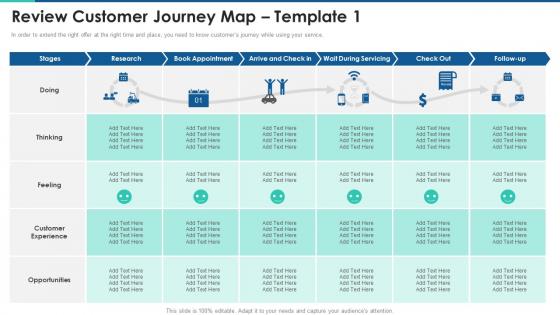
In order to extend the right offer at the right time and place, you need to know customers journey while using your service.
People who downloaded this PowerPoint presentation also viewed the following :
Review customer journey map the complete guide to customer lifecycle marketing with all 6 slides:
Use our Review Customer Journey Map The Complete Guide To Customer Lifecycle Marketing to effectively help you save your valuable time. They are readymade to fit into any presentation structure.






FAQs for Review customer journey map the complete guide to
Customer journey maps typically include awareness, consideration, purchase, onboarding, usage, support, and retention stages, each representing critical touchpoints that shape customer perceptions. These stages streamline experience optimization by identifying pain points, revealing engagement opportunities, and highlighting moments of truth, with many organizations finding that mapping these interconnections ultimately delivers improved satisfaction rates and stronger customer loyalty.
Businesses can effectively gather data through customer surveys, website analytics, social media monitoring, sales team insights, and direct customer interviews. These methods enable organizations to understand touchpoints, pain points, and decision-making processes across industries like retail, healthcare, and financial services, ultimately delivering more personalized experiences and competitive advantage.
**INPUT**: What tools or software are recommended for designing customer journey maps? **OUTPUT**: Recommended tools include Miro, Lucidchart, Adobe XD, Microsoft Visio, and Smaply, each offering templates, collaboration features, and visual mapping capabilities. These platforms streamline the mapping process by enabling real-time collaboration, data integration, and interactive visualizations, with many organizations finding that dedicated journey mapping software ultimately delivers more comprehensive insights than basic design tools. **Word count: 60 words**
Personas enhance customer journey mapping by providing detailed demographic, behavioral, and motivational insights that create more targeted, realistic journey scenarios. These detailed customer profiles enable organizations to identify specific pain points, customize touchpoint experiences, and prioritize improvements based on actual user needs, ultimately delivering more personalized customer experiences and stronger business outcomes.
Customer feedback serves as the primary validation and refinement tool for journey maps, revealing actual pain points, emotional responses, and unmet needs that assumptions may have missed. Through surveys, interviews, and behavioral analytics, organizations can identify gaps between perceived and actual customer experiences, enabling them to update touchpoints, streamline processes, and enhance satisfaction at critical moments throughout the journey.
Companies use journey maps to visualize each customer touchpoint, revealing friction areas like lengthy checkout processes, poor communication, or confusing navigation that create dissatisfaction. By mapping these interactions across departments like sales, support, and fulfillment, organizations can systematically address bottlenecks, streamline workflows, and enhance service delivery, ultimately reducing customer churn while improving satisfaction scores.
Key metrics include conversion rates at each touchpoint, customer satisfaction scores, time-to-resolution, abandonment rates, and customer lifetime value across journey stages. These measurements enable organizations to identify friction points, optimize experiences, and enhance operational efficiency, with many businesses finding that tracking these metrics delivers improved customer retention, reduced service costs, and ultimately stronger competitive advantage in their markets.
Businesses should update customer journey maps quarterly or biannually, with additional reviews triggered by major market shifts, new technology implementations, or significant customer behavior changes. Through regular assessment cycles, organizations can identify evolving touchpoints, emerging pain points, and shifting customer expectations, ultimately maintaining competitive advantage and delivering relevant experiences in an increasingly dynamic marketplace.
Common mistakes include insufficient customer research, focusing only on positive touchpoints, creating maps in isolation without cross-departmental input, overlooking emotional aspects of the journey, and failing to update maps regularly. Many organizations find that these oversights lead to incomplete understanding of customer experiences, with successful mapping requiring diverse stakeholder involvement, honest assessment of pain points, and continuous refinement to maintain accuracy and relevance.
Mapping the customer journey identifies pain points, touchpoint gaps, and emotional friction that drive churn, enabling businesses to streamline experiences, personalize interactions, and proactively address concerns. Through targeted improvements at critical moments, companies deliver more seamless experiences while building deeper emotional connections, ultimately reducing customer acquisition costs and increasing lifetime value across their customer base.
Linear customer journey maps follow a sequential, step-by-step progression from awareness through purchase to loyalty, representing traditional funnel-based purchasing behaviors. Nonlinear maps acknowledge that modern customers move fluidly between touchpoints, often skipping stages or returning to earlier phases, with many retail and financial services organizations finding that nonlinear approaches better capture today's omnichannel customer behaviors and deliver more accurate insights.
Visual storytelling enhances customer journey maps by transforming complex data into compelling narratives through icons, color coding, emotional indicators, and sequential flow elements that audiences can easily follow. This approach enables presenters to highlight pain points, moments of delight, and strategic opportunities more effectively, with many organizations finding that visual narratives drive stakeholder engagement and actionable insights.
Cross-departmental collaboration improves customer journey mapping accuracy by combining sales insights, marketing data, customer service feedback, product development perspectives, and operational analytics into comprehensive touchpoint analysis. When departments like IT, fulfillment, and support share their customer interaction data, organizations create more realistic journey maps that reflect actual customer experiences rather than assumptions, ultimately enabling targeted improvements and enhanced customer satisfaction.
Customer journey maps enable targeted marketing strategies by identifying specific touchpoints, pain points, and decision-making moments throughout the customer experience, allowing marketers to craft personalized messaging and select optimal channels for each stage. Through detailed journey analysis, companies can develop stage-specific campaigns, time interventions precisely, and allocate resources more effectively, with retail and financial services organizations finding that this approach significantly improves conversion rates and customer engagement.
Comparing customer journey maps across demographics reveals varying pain points, preferred touchpoints, communication preferences, decision-making timelines, and engagement patterns between different customer segments. These insights enable businesses to tailor marketing strategies, customize service delivery, and optimize resource allocation for each demographic, ultimately delivering more personalized experiences and competitive advantage in an increasingly diverse marketplace.
-
Great product with highly impressive and engaging designs.
-
Design layout is very impressive.