

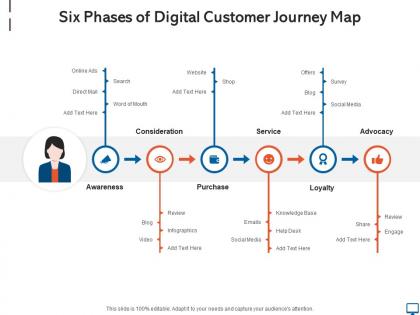
Six phases of digital customer journey map




Try Before you Buy Download Free Sample Product
 Impress Your
 Audience
 100%
100% Editable
 Save Hours
 of Time


Our Six Phases Of Digital Customer Journey Map are topically designed to provide an attractive backdrop to any subject. Use them to look like a presentation pro.
People who downloaded this PowerPoint presentation also viewed the following :
Six phases of digital customer journey map with all 2 slides:
Use our Six Phases Of Digital Customer Journey Map to effectively help you save your valuable time. They are readymade to fit into any presentation structure.
FAQs for Six phases of digital
So the digital customer journey has the same five stages as before - awareness, consideration, purchase, retention, advocacy. But honestly? It's a total mess compared to the old days. People bounce around like crazy now - they'll see your ad on Instagram, check reviews on your site, price shop on their phone during lunch, then maybe buy in-store weeks later. Traditional journeys were straightforward. This new stuff is all over the place. Customers jump backward and forward between stages constantly. The tricky part is they want everything to feel connected across every platform. I'd start by actually tracking where people interact with you digitally - you'll be shocked at the weird gaps.
First, figure out everywhere customers find you - your website, social media, emails, ads, whatever. Use tools like Google Analytics to see how people actually move around (they bounce between channels way more than you'd expect, honestly). Ask your customers directly about what sucks at each step. Don't forget the emotional stuff - where are they getting pissed off or excited? The hard part is connecting everything since people jump around so much. Keep updating this regularly because digital habits change constantly. Once you've got it mapped out, just pick one broken thing and fix that first instead of trying to tackle everything.
Think of data analytics like your GPS for customer behavior - it shows you exactly where people are getting stuck or bouncing off your site. You can track which pages are total disasters (usually the slow-loading ones, obviously) and what content actually gets people to convert. The cool part is combining that behavioral stuff with customer feedback to catch patterns you'd miss otherwise. Oh, and don't just hoard data for no reason - actually use those insights to test real changes. That's where you'll see results.
Honestly, personalization works because people want to feel understood. Netflix nails this - they show you stuff you'll actually binge, not random garbage. Track what your customers click on and buy, then use that data to customize everything. Email subject lines, product recommendations, even your homepage. I'd start with something simple like dynamic email content first though. When someone feels like you "get" their specific needs instead of blasting generic stuff at everyone, they're way more likely to convert. It's basically the difference between talking to a friend versus getting a mass flyer in your mailbox.
Honestly, start with Google Analytics and maybe Hotjar for heat maps - that combo shows you what people actually do on your site. For email stuff, Mailchimp's pretty solid for tracking opens and clicks. Then you've got your CRM options like HubSpot or Salesforce for the bigger picture. Don't sleep on social media analytics either, that data's gold. Oh, and if you're doing customer support, Zendesk tracks all those interactions too. The tricky part is making everything talk to each other - scattered data sucks. I'd pick two tools that play nice together first, then expand from there.
Your customers jump around between different touchpoints - social media gets them interested, your website does the heavy lifting to convince them, and email keeps the relationship going. But here's the thing that drives me crazy: people don't shop in straight lines anymore. They'll see your Instagram post, check out your site on mobile, then maybe come back through email weeks later. One bad experience on mobile can totally wreck all that good social media work you did. You've got to map out how people actually move through your stuff and make sure each step builds on the last one.
Honestly, social media is where your customers are living these days. They're scrolling Instagram to find new brands, jumping into Facebook groups to ask "has anyone tried this?", and you know they're stalking your reviews before buying anything. The cool part is it's not just one-and-done like old advertising - people actually expect you to respond and have real conversations. I've noticed brands that ignore comments basically shoot themselves in the foot. You've got to figure out where your people hang out most and actually engage back when they comment or message you. Just posting pretty pictures isn't enough anymore.
Honestly, start with mobile since that's where everyone lives now. Map out how your customers actually bounce around - website to app to calling the store (it's way more chaotic than you'd expect). The biggest thing? Make sure their info carries over when they switch channels. Nobody wants to explain their problem twice. Fast loading times are non-negotiable, and keep navigation simple. I'd test the whole journey yourself pretty regularly - you'll catch weird gaps where the experience just... breaks. Oh, and responsive design isn't optional anymore if you want people to actually stick around.
Honestly, the worst part is when your data lives in like 5 different places and nothing connects. Customers hop between your app, website, email - but you can't see the full picture, which is super frustrating. Attribution becomes impossible because who knows what actually made them buy? Plus everyone wants personalized stuff now but most companies can't handle real-time data anyway. ROI measurement across the whole journey instead of just individual campaigns? Good luck with that. My advice - fix your data integration first. Seriously, nail that foundation before you even think about the fancy features. Everything else builds from there.
Honestly, UX can make or break everything. Bad design = people bouncing before they even see what you're selling. Good UX though? Users just glide through your site naturally, from browsing to buying. Nobody sticks around for confusing menus or pages that take forever to load - I swear people's attention spans get shorter every year. When everything flows smoothly, you'll see way fewer drop-offs and more actual conversions. My advice? Map out where users currently go on your site. Find the spots where they're clearly getting frustrated or leaving. Those are your biggest wins waiting to happen.
Honestly, just embed feedback requests right where people are already engaged - after they buy something, when they're using your app, or right after talking to support. Don't be that company with random annoying pop-ups though. Automate follow-ups based on what people actually do, like downloading stuff or making purchases. Here's the thing most companies mess up - you've gotta show customers how their feedback actually changed things. Otherwise why would they bother next time? It's like asking for advice then ignoring it completely.
Think of content marketing like leaving a trail for customers to follow. At each stage, you're answering their specific questions - awareness stuff gets them hooked, consideration content helps them weigh options, and decision pieces seal the deal. Honestly, most people just throw random blog posts out there and wonder why nothing happens. Map your content to where people actually are in their buying journey first. Oh, and definitely audit what content gaps you have at each stage - that's where you'll find the biggest wins.
So you want your customers to move between channels without losing their minds, right? Like they browse on mobile, pop into your store for help, then finish buying online later. Your systems need to talk to each other first - that's honestly the hardest part. Train your staff to pick up where digital conversations left off. Nobody wants to explain their whole situation twice. Oh and the data flow thing is huge for conversion rates. Think of it like being that friend who actually remembers what you talked about last time instead of making you start over.
Yeah AI and VR are the obvious ones, but voice commerce is getting crazy too. Chatbots that actually get what you're saying, recommendations that don't feel random - that's where things are headed. AR troubleshooting will be wild once it catches on. The metaverse still sounds like marketing BS to me honestly, but I guess spatial computing will matter someday. Oh, and everything's gonna be personalized in real-time which is kinda scary but whatever. You should mess around with basic AI personalization stuff now though. Once everyone's doing it you'll be behind.
Look, personas are like your cheat sheet for mapping the whole customer journey. They show you which touchpoints actually matter and what messaging won't make people cringe. Without them, you're basically designing blind. Different personas have totally different pain points and preferred channels - your tech person wants self-service everything while grandma still calls customer support for simple stuff. Map each persona to your journey stages first. Then you'll see exactly where things are falling apart. Honestly, most companies skip this step and wonder why their conversion rates suck.
-
The content is very helpful from business point of view.