


Sample A3 Problem Solving Report Collection Of Quality Control Templates Ppt Diagrams




Try Before you Buy Download Free Sample Product
 Impress Your
 Audience
 100%
100% Editable
 Save Hours
 of Time


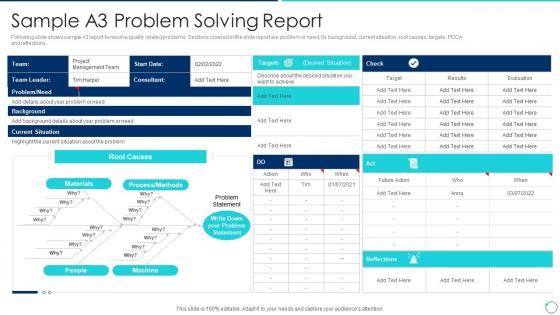
Following slide shows sample A3 report to resolve quality related problems. Sections covered in the slide report are problem or need, its background, current situation, root causes, targets, PDCA and reflections.
People who downloaded this PowerPoint presentation also viewed the following :
Sample A3 Problem Solving Report Collection Of Quality Control Templates Ppt Diagrams with all 6 slides:
Use our Sample A3 Problem Solving Report Collection Of Quality Control Templates Ppt Diagrams to effectively help you save your valuable time. They are readymade to fit into any presentation structure.





FAQs for Sample A3 Problem Solving Report Collection Of Quality Control
So you'll want four key things: quality standards everyone actually gets, checkpoints for regular inspections, decent documentation (yeah I know, boring but necessary), and some way to keep improving based on what goes wrong. Most people mess up the documentation part - it's tedious but you need it. Train your team to spot problems early instead of catching everything at the end. Oh, and have a plan for when stuff inevitably breaks. I'd start by looking at your current setup and figuring out where defects usually sneak through. That'll show you the weak spots pretty quick.
So SPC lets you catch problems while they're happening instead of finding out later that your whole batch is screwed. You're basically watching your process with control charts and stats - way better than just checking finished stuff. Once you figure it out, it's pretty sweet honestly. When something starts going off track, you can fix it right away rather than playing cleanup crew. Oh, and don't try to monitor everything at once - that's a nightmare. Pick one important parameter first, set your control limits, then add more later. Trust me on that one.
So QA is more about preventing problems upfront instead of catching them after the fact. You're setting up processes and standards from the beginning to avoid defects. QC comes later - that's your testing and inspection stuff. Way better to build quality into your workflow than stress about fixing things later (learned this the hard way lol). Training and documentation fall under QA too. Oh, and continuous improvement initiatives. You really need both working together though - QA creates your foundation, then QC double-checks everything's actually working right.
Start with training your Green and Black Belts - they're gonna be the ones actually running projects. Focus on processes that are bleeding money or pissing off customers first. DMAIC is your basic roadmap (Define, Measure, Analyze, Improve, Control). Data collection is honestly boring as hell, but that's where you find the real problems. Get your leadership on board early because changing company culture is way harder than the technical side. Oh, and definitely pilot a few small projects first to show some wins before you go all-in. Builds credibility.
So the main stuff you'll run into everywhere - SPC charts, basic checklists, Pareto analysis for tracking what's breaking. Most places do some kind of sampling inspection too since checking literally everything would take forever. When stuff goes sideways, fishbone diagrams are clutch for root cause analysis. Control charts honestly save your ass by catching problems before they get expensive. Oh, and if you're new to this whole QC thing? Start simple with checklists first. Your team won't hate you for it. Add the fancy SPC charts later once everyone's got the hang of things.
Honestly, it's all about timing. With products, you can test stuff before customers ever see it - catch problems early, do quality checks, whatever. But services? That's happening live while you're interacting with the customer. Can't exactly recall a crappy dining experience like you would a broken phone, you know? Services are way trickier since they're intangible and everything happens at once. Your best bet is really investing in good team training and setting up solid feedback systems. That way you'll spot issues fast instead of letting them snowball. Products give you that luxury of multiple inspection points - services don't.
Honestly, I'd start with defect rates and customer complaints - those two will tell you everything you need to know right off the bat. First-pass yield is clutch too since it shows if you're nailing it on the first try. Don't forget about tracking your supplier quality scores and how long corrective actions take (because seriously, nobody wants those dragging on). Customer satisfaction and warranty claims are solid indicators as well. My old manager used to say pick 4-6 metrics max that actually move the needle for your business. Otherwise you'll drown in data and miss what really matters. Rework costs are worth watching too if you've got the bandwidth.
Dude, automation is a game changer for quality control. Sensors and cameras catch defects way faster than people can - and they don't get tired or distracted like we do. The real-time monitoring thing is pretty sweet too. Your team stops doing boring inspection work and can actually solve bigger problems instead. Plus all that automated data collection helps you spot patterns you'd totally miss otherwise. I'd say start with whatever process is giving you the biggest headaches right now. Don't try to automate everything at once though - that's just asking for trouble.
Dude, skipping quality control is like shooting yourself in the foot. Defects pile up, customers get pissed, and returns eat into your profits. Honestly, I've seen companies tank their reputation over this stuff - and good luck getting that trust back once it's gone. Then there's all the legal drama and regulatory nonsense you'll deal with. Your employees get demoralized too when they're constantly firefighting problems. Oh, and don't get me started on how suppliers start treating you differently. Look, just spend the money upfront on proper QC. Trust me, it's way cheaper than cleaning up the mess later.
Dude, training your team is huge for quality control. People catch way more issues when they actually know what red flags to watch for. Your processes might be solid, but if nobody knows how to use them right, you're still screwed. Plus when employees get how their piece fits into the whole quality puzzle, they care more about doing it well. Oh and here's what worked for me - figure out where you're bleeding the most quality-wise first. Then build your training around fixing those specific problem areas. Makes way more sense than some generic approach.
Dude, this stuff is actually changing everything in quality control. Computer vision can spot defects way faster than any human - honestly it's kind of scary how good it is. You've got predictive analytics that catch problems before they even happen, which beats the old "oops we found it too late" approach. IoT sensors give you live data from your whole production line (though sometimes I wonder if we really need THAT much data). Digital twins let you test scenarios virtually first. The real game-changer? Going from always reacting to problems to preventing them. I'd start with whichever tech fits your budget and processes best.
Honestly, the best way is setting up regular surveys and actually reading through reviews/complaints - then get that info straight to your quality teams. Pick one feedback source first, maybe customer emails or whatever you're already getting. Build a weekly thing where someone reviews it all. Use what you learn to tweak your testing and catch stuff your internal team might be missing. I've seen companies totally ignore this and it's such a waste - customers basically tell you exactly what's broken for free. The trick is making it consistent, not just doing it once when there's a crisis.
Oof, global suppliers are tough. Distance kills you - can't just drive over when shit hits the fan. Time zones make everything worse too. Different countries have completely different rules, and cultural stuff gets lost in translation all the time. Quality standards? Good luck explaining those clearly. Here's what actually works though: hire local auditors to be your eyes on the ground. Document everything with pictures - like, way more than you think you need. Oh and always build extra time into deadlines because something will definitely go wrong. Trust me on that one.
Look, prevention beats detection every time - way cheaper than fixing stuff after it's already screwed up. Figure out where problems usually pop up in your process and dump your QC resources there instead of everywhere. Risk-based sampling is clutch too - hammer the sketchy batches hard, go easy on the safe ones. That whole "inspect quality in" thing? Total waste of time honestly. Build it right from the start. Oh and track your quality costs regularly so you actually know what's working. Sounds obvious but most people skip that part for some reason.
Honestly, just weave improvement into what you're already doing instead of making it this big separate thing. Get feedback loops going - check your numbers regularly, ask your team what's up, and actually pay attention when customers complain (seriously, they tell you everything you need to know). Cross-functional teams work great for tackling problems from different sides. Oh, and benchmark against what others in your industry are doing. The real trick is getting everyone to feel like they can actually speak up about issues. Start small with pilot programs though - way easier to fix things when they inevitably go sideways.
-
Unique and attractive product design.
-
Helpful product design for delivering presentation.