


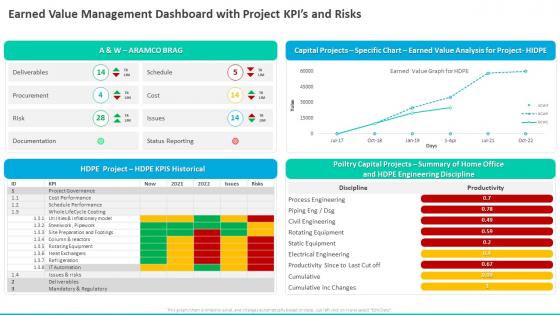
Earned Value Management Dashboard With Project KPIs And Risks




Try Before you Buy Download Free Sample Product
 Impress Your
 Audience
 100%
100% Editable
 Save Hours
 of Time


Our Earned Value Management Dashboard With Project KPIs And Risks are topically designed to provide an attractive backdrop to any subject. Use them to look like a presentation pro.
People who downloaded this PowerPoint presentation also viewed the following :
Earned Value Management Dashboard With Project KPIs And Risks with all 7 slides:
Use our Earned Value Management Dashboard With Project KPIs And Risks to effectively help you save your valuable time. They are readymade to fit into any presentation structure.





FAQs for Earned Value Management Dashboard With Project
Okay so there's three main things you gotta track: Planned Value (what you budgeted to spend by now), Earned Value (budgeted value of stuff you actually finished), and Actual Cost (what you really spent). Honestly, the names are kinda confusing at first but whatever. It's like planning a vacation budget vs what you end up blowing money on, you know? These numbers let you figure out if you're behind schedule or over budget. Don't worry about the complex calculations yet - just get solid data on these three basics first and you'll be good.
Dude, EVM is seriously helpful once you wrap your head around it. Basically it combines your schedule and budget into these ratios - CPI and SPI - so you're not just checking if you're on time OR under budget separately. You get the full picture of what's actually happening. The cool part? You can catch problems super early by comparing what you planned vs. what you've earned vs. what you spent. I know it sounds like extra work, but trust me - run those calculations weekly and you'll spot issues way before they blow up into major headaches.
So you've got three main metrics to track: PV (what you planned to spend), AC (what you actually spent), and EV (budgeted cost of completed work). Pretty straightforward stuff. From those you calculate CPI and SPI - these tell you if you're over budget or behind schedule. The acronym soup is annoying at first, I'll admit that. But once you memorize them it clicks. CPI and SPI are your main indicators to watch. If either drops below 1.0, that's when you know something's going wrong and you need to figure out why fast.
Yeah, you can totally make EVM work with Agile - just swap out the traditional baseline for story points per sprint. Track your planned value against what you actually complete each iteration. The scope changes are honestly a pain (PMOs hate this part), but treat each sprint like its own mini-project with separate EV calculations. Burn-up charts work great alongside the usual EVM curves. I'd start simple though - just calculate your schedule performance index after each sprint to see if you're on track. Way easier than trying to boil the ocean from day one.
Dude, most teams just dive in without proper planning - it's a mess. They don't define work packages clearly or get stakeholders on board first. Training is huge too. If your PMs don't actually understand EVM, they'll just pump out useless reports that nobody reads. Oh, and people love overcomplicating the whole measurement thing instead of keeping it simple. The data becomes worthless when folks don't even know what they're supposed to be tracking. My advice? Start basic, train everyone properly, and make sure your baseline isn't complete fantasy.
So EVM has these three formulas that'll predict where your project's actually going. There's Estimate at Completion (EAC) - that uses your current cost performance to forecast the end. Then Estimate to Complete shows remaining work. Schedule Performance Index? That one tells you if deadlines are realistic. I swear the SPI saved my butt last month when everything was falling behind. The cool thing is these aren't just wild guesses - they're based on real math comparing what you've done versus planned budgets and timelines. Track them weekly though, or you'll miss the warning signs until it's too late.
Dude, you absolutely can't mess around with your baseline - it's what makes EVM actually work. Get your scope, schedule, and budget locked down first and make sure everyone agrees before you start measuring anything. I've watched projects completely fall apart because people kept tweaking the baseline halfway through. Those earned value numbers become totally useless when you're constantly moving the goalposts. Honestly, some PMs treat baselines like rough suggestions instead of... well, baselines. Spend the time upfront to make it realistic and detailed, then don't touch it.
Honestly, EVM works for pretty much anything with clear deliverables. Software dev, marketing campaigns, research stuff - whatever. You just measure code completion instead of concrete pours, right? Break your work into chunks you can budget and timeline. Product launches are where I've seen it shine - teams track design mockups, user testing, all that. One caveat though: make sure everyone gets the metrics upfront. Otherwise you'll be stuck explaining charts instead of actually running the project. Trust me on that one.
For EVM tracking, Microsoft Project's your safest choice - has all the earned value stuff built in and most people don't need training on it. If you're dealing with huge complex projects, Primavera P6 is the gold standard but honestly overkill for most situations. Oracle's Primavera Cloud and Smartsheet work great for remote teams. I've watched people torture Excel into doing EVM too, though that gets ugly real fast. Main thing is finding something that auto-calculates CPI and SPI - trust me, you don't want to be doing that math by hand every week.
So with EVM, you've got three solid numbers to show stakeholders where things actually stand. Cost variance and schedule variance are perfect - they're just hard data showing if you're over budget or running late. The performance indexes work like report cards that anyone can grasp quickly, even if they don't know project management stuff. What I really like is how earned value shows real work done, not just cash burned. Saves you from those brutal meetings where you're explaining why 80% of the budget disappeared but only 40% got finished. Honestly, just lead with these metrics in your updates, then get into the weeds after.
Look, EVM is basically your early warning system for when projects start falling apart. I've seen too many PMs miss the obvious signs. Weekly variance tracking will catch cost and schedule issues while you can still fix them - way better than scrambling later. The performance indices actually predict future problems, which is pretty cool. Instead of going to your boss like "something feels off," you'll have real data backing you up. Set up alerts when variances hit certain levels so you're not constantly monitoring. Honestly saved my butt more times than I can count.
Yeah, totally doable! Just strip it way down to the basics. Skip the crazy detailed work breakdowns - use bigger chunks that actually make sense for how your team works. Weekly check-ins are plenty (daily tracking is honestly just annoying busywork for small teams). Stick with simple spreadsheets instead of those expensive enterprise tools. The three main numbers - PV, EV, AC - plus maybe CPI and SPI are all you really need. I'd probably test it on one project first, see how it goes. Once you get the hang of it, you can roll it out more. Way less overwhelming than the full corporate version.
Start with basic project management stuff - scope, schedule, cost baselines. The EVM metrics like CPI and SPI seem scary at first but you pick them up fast. Your team really needs to nail progress reporting and work breakdown structures though, because bad data in means useless numbers out. Honestly, I'd grab PMI's EVM cert or find a workshop with real examples to practice on. Oh, and definitely pilot it on something small first - way less stressful than trying to roll it out everywhere at once. Trust me on that one.
Honestly, EVM works with pretty much any PM methodology you're already using. It's more like a measurement layer than something that competes with Waterfall or Agile. You can just throw it on top of whatever approach you've got going. The cool thing is it gives you actual objective data no matter how your project's structured. Agile teams might track it by sprint or epic. Traditional projects usually do it by phase. I've found it's one of the more flexible tools out there - just make sure your work breakdown actually supports decent earned value calculations. Otherwise you're kinda shooting in the dark.
ANSI/EIA-748 is what you want to focus on - it's got 32 guidelines for EVM systems and honestly, most places just follow this one. Government contracts definitely require it for compliance stuff. PMI has their own Practice Standard for Earned Value Management too, which is actually pretty good for figuring out how to implement everything. There's also ISO 21508 but I haven't seen it used much. Oh, and if you're doing any gov work, start with ANSI/EIA-748 since that's basically what they always ask for anyway.
-
I came across many PowerPoint presentations with excellent creatives and I believe they would be beneficial to my work.
-
SlideTeam never fails to surprise me with its amazing PPT designs. Thanks team for providing me with your constant support!