


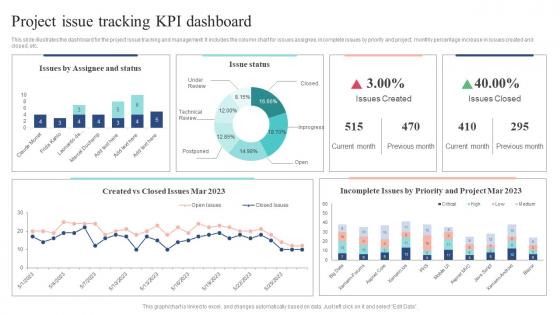
Project Issue Tracking KPI Dashboard




Try Before you Buy Download Free Sample Product
 Impress Your
 Audience
 100%
100% Editable
 Save Hours
 of Time


This slide illustrates the dashboard for the project issue tracking and management. It includes the column chart for issues assignee, incomplete issues by priority and project, monthly percentage increase in issues created and closed, etc.
People who downloaded this PowerPoint presentation also viewed the following :
Project Issue Tracking KPI Dashboard with all 7 slides:
Use our Project Issue Tracking KPI Dashboard to effectively help you save your valuable time. They are readymade to fit into any presentation structure.






FAQs for Project Issue
So basically, traditional project management is like following a recipe step-by-step - you plan everything first, then execute in order. Agile is more like improvising as you cook, working in short bursts and adjusting based on how things taste. I'll be honest, I thought Agile was just corporate BS at first. But it actually works way better when you're dealing with stuff that might change. Traditional's perfect for predictable projects like building a house. Agile's your friend when requirements are fuzzy or you're building software. Just match the approach to how certain you are about what you're building.
Look, you gotta set up change control from day one and actually stick to it. Document every request that comes your way. Before saying yes to anything, figure out how it'll mess with your timeline and budget. Get proper approval first! I swear, so many PMs think they're being nice by agreeing to "quick little changes" - huge mistake. Your stakeholders need to learn that changes aren't free. Set up regular review meetings and keep a change log where everyone can see it. Oh, and make sure changes are intentional decisions, not just random stuff that happens. Trust me on this one.
Okay so first grab Asana or Trello for tracking tasks, then Slack for team chat, plus Google Drive or Office 365 for sharing files. That's your foundation right there. The hardest part? Actually getting people to stick with whatever you choose - I swear some teams love switching tools every month lol. After that you can add Gantt charts if you need timelines, maybe Toggl for time tracking. Don't go crazy though. Pick like 3-4 max and commit to them. I'd rather have basic tools everyone uses than fancy ones sitting empty.
Don't wait until stuff hits the fan - build risk planning into your project from the start. During initial scoping, map out what could go wrong: resource issues, tech problems, stakeholder drama (there's always stakeholder drama). Build your mitigation plans right into the timeline and budget. Honestly, I've watched so many PMs get burned by skipping this part. Make contingency plans for your biggest risks and get someone to own each one. Then - and this is crucial - review risks in every team meeting. You'll catch problems early instead of scrambling later.
Honestly? Communication can totally make or break your project. I've watched solid plans completely fall apart just because people felt out of the loop. Nobody likes surprises when it comes to decisions that affect them. First thing - figure out who needs what info and how often they want it. Then actually stick to those check-ins (this is where most people mess up). Being upfront about problems early builds way more trust than trying to hide stuff until it's a crisis. Regular updates keep everyone bought in instead of working against you. Set those communication rhythms from day one.
Dude, cultural stuff will absolutely tank your project if you're not careful. Communication styles are huge - some people are blunt as hell, others dance around problems for days. Don't even get me started on time zones and "flexible" deadlines (seriously, what does that even mean?). Decision-making processes are totally different too. Some teams need consensus from everyone and their mom, others just go for it. My advice? Research each team's vibe beforehand and set super clear communication rules. Build in extra time because alignment takes forever across cultures. Honestly, just being aware of these differences saves you so much headache later.
Definitely track delivery stuff first - budget, timeline, scope changes. Quality matters just as much though. Customer satisfaction, defect rates, that kind of thing. Team health is huge too and people forget about it. Are they burning out? What's their velocity like? Honestly, I'd probably focus on maybe 4 key metrics max that actually relate to your project's goals. Better to track a few things well than get overwhelmed with data you won't use. The classics are fine but they don't tell you if you're actually succeeding.
Man, you really gotta be deliberate about this stuff now. Start meetings with like 5 minutes of random chit-chat, or do virtual coffee breaks - anything to replace those hallway moments. Miro and Figma are great for actual collaboration, not just screen sharing. Oh, and definitely make some Slack channels for non-work stuff too. I'd honestly rather overcommunicate than have people feeling isolated. One thing that's huge though - rotate your meeting times so it's not always the same person dealing with 6am calls. People remember when you do that.
Three things really work: recognition, clear communication, and giving people room to grow. Celebrate the small wins publicly - honestly, those matter way more than people realize. Be transparent about what you're trying to achieve and what's going wrong, so your team doesn't feel left out. Let people learn new stuff or own different pieces of the work. Oh, and do regular check-ins. You'll catch motivation problems before they explode into bigger issues. But here's the real key - just ask each person what actually motivates them. Don't guess what they want.
Honestly, time management can make or break your whole project. Hit your deadlines and everyone's happy - miss them and you'll be dealing with angry stakeholders and blown budgets. I've seen teams completely fall apart when timelines go sideways. People get stressed, work gets sloppy, and suddenly you're paying overtime costs that could've been avoided. The trick is being realistic about timelines from day one (easier said than done, I know). Track your progress every week instead of crossing your fingers and hoping it'll work out. Trust me, hope isn't a strategy.
Honestly, start with your critical path - that's where everything can fall apart if you're not careful. Map out who's actually good at what (skills matrix saves your life here). I always put my strongest people on the riskiest stuff first, but don't just randomly assign bodies to tasks. Build in extra time - like 15-20% buffer - because trust me, something weird always happens. Oh, and check your team's workload weekly so you catch problems before they explode. Learned this one the hard way! Balance skills with who's actually available.
So basically, feedback loops help you spot problems before they become disasters. Set up regular check-ins - could be weekly retros, client calls, whatever works for your team. Daily standups are good too, though honestly those can drag if people ramble. The real trick isn't just collecting feedback, it's actually doing something with it. Don't be that team that nods along then changes nothing. Start with one simple thing and stick to it for a full sprint. Trust me, you'll notice the difference right away when things stop falling apart at the last minute.
Dude, so many things can tank a project. Scope creep is probably the worst - stakeholders just keep adding stuff halfway through. Also seen tons fail because nobody actually owns the damn thing or timelines are completely unrealistic. Oh, and communication breakdowns happen constantly. Here's what works: Get everything in writing upfront, like what you're actually delivering. Build extra time into schedules because stuff always breaks. I learned this the hard way on my last project when our vendor disappeared for two weeks. Set up regular check-ins and don't let problems sit there rotting. Better to overcommunicate than have everyone confused.
Think of the project life cycle as your game plan for knowing when to plan hard vs. when to just do the work. You start with big-picture stuff in initiation - who's involved, rough timeline, basic scope. Then you get into the weeds during planning phase, mapping out every single task and dependency. Execution is where things get messy though - you're constantly tweaking plans because reality never matches what you thought would happen. The life cycle basically tells you when to switch gears from "planning mode" to "execution mode." One thing I've learned the hard way: don't let stakeholders pressure you into skipping proper planning. They'll thank you later when stuff doesn't fall apart.
Honestly, your leadership style pretty much dictates everything about team dynamics. When you're open and collaborative, people actually talk to each other and have each other's backs. But go full dictator mode? Everyone just clocks in and out mentally - terrible when you're up against tight deadlines. I've noticed democratic leaders get way more creative solutions and team buy-in. Hands-off works amazingly with seasoned people, though newbies will be completely lost without guidance. Really just comes down to reading your team and matching what the situation actually needs.
-
I’m not a design person, so I couldn’t make a presentation to save my life. Thankfully, they have all kinds of templates that I regularly use for my work.
-
Unique research projects to present in meeting.