


Sample B2B Value Proposition Canvas Guide To Build And Measure Brand Value




Try Before you Buy Download Free Sample Product
 Impress Your
 Audience
 100%
100% Editable
 Save Hours
 of Time


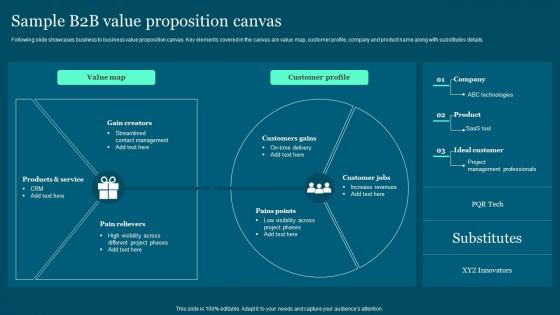
Following slide showcases business to business value proposition canvas. Key elements covered in the canvas are value map, customer profile, company and product name along with substitutes details.
People who downloaded this PowerPoint presentation also viewed the following :
Sample B2B Value Proposition Canvas Guide To Build And Measure Brand Value with all 6 slides:
Use our Sample B2B Value Proposition Canvas Guide To Build And Measure Brand Value to effectively help you save your valuable time. They are readymade to fit into any presentation structure.





FAQs for Sample B2B Value Proposition Canvas Guide To Build And
The key components of a B2B Value Proposition Canvas include customer jobs, pains, gains, products and services, pain relievers, and gain creators. These elements work together by mapping client needs against business solutions, identifying value gaps, and aligning offerings with customer priorities, with many organizations finding that this strategic approach streamlines product development and enhances competitive positioning.
Businesses can effectively identify customer segments using the Value Proposition Canvas by analyzing customer jobs, pains, and gains across different demographics, industries, and use cases. Through systematic mapping of these elements, companies can discover distinct patterns among groups like enterprise clients versus SMBs, ultimately enabling targeted value propositions that resonate with specific segment needs and drive higher conversion rates.
Customer feedback plays a crucial role in validating assumptions, identifying pain point gaps, and ensuring value propositions truly resonate with target segments within the B2B Value Proposition Canvas. Through systematic feedback collection, B2B companies can refine their gain creators, pain relievers, and product features, with many organizations finding that continuous customer input significantly enhances product-market fit and competitive positioning.
Businesses align product features with customer needs by mapping their value propositions directly against identified customer jobs, pains, and gains within the canvas framework. This strategic alignment process involves conducting customer interviews, analyzing feedback data, and iteratively refining offerings, with many organizations finding that systematic mapping reduces product-market misalignment and accelerates customer acquisition.
B2B differentiation strategies in the Value Proposition Canvas include targeting underserved customer segments, creating unique value propositions through specialized expertise, developing proprietary technologies, offering superior service levels, and building strategic partnerships. These approaches enable companies to position themselves distinctively by addressing specific pain points competitors overlook, delivering measurable outcomes like reduced operational costs and enhanced efficiency, ultimately creating sustainable competitive advantages in increasingly crowded markets.
Pain points identified in the canvas directly shape value proposition development by revealing specific customer challenges, operational inefficiencies, and unmet needs that solutions must address. These insights enable businesses to craft targeted offerings that alleviate frustrations, streamline processes, and deliver measurable outcomes, with many organizations finding that pain-point-driven value propositions resonate more effectively with prospects and ultimately accelerate sales cycles.
The Value Proposition Canvas excels at targeting niche markets by enabling deep customer segment analysis, pain point identification, gain mapping, and value proposition refinement for specific audiences. Through detailed customer profiling, businesses can uncover unique needs within specialized sectors like medical device manufacturing or boutique financial services, ultimately delivering highly targeted solutions that resonate with niche audiences and create sustainable competitive advantages.
Businesses should track customer acquisition cost, conversion rates, customer lifetime value, Net Promoter Score, and retention rates to measure value proposition effectiveness. These metrics reveal how well propositions resonate across different segments, with many organizations finding that strong value propositions reduce acquisition costs while increasing customer satisfaction and long-term revenue growth.
Storytelling enhances B2B value proposition presentations by transforming abstract benefits into relatable narratives, creating emotional connections with decision-makers, and demonstrating real-world impact through customer success scenarios. Through compelling case studies and problem-solution narratives, organizations can illustrate how their solutions address specific pain points, ultimately making complex value propositions more memorable and persuasive for stakeholders.
Common pitfalls include making assumptions without customer validation, focusing too heavily on features rather than benefits, neglecting to prioritize pain points by severity, and failing to regularly update the canvas as markets evolve. Many organizations also struggle with cross-functional alignment during the process, with teams often discovering that their perceived value propositions don't resonate with actual customer needs, ultimately requiring strategic pivots.
Visual elements enhance Value Proposition Canvas presentations by creating clear segment distinctions, using color coding for different value categories, incorporating icons for jobs and pain points, and employing flow diagrams to show connections. These design approaches enable audiences to quickly grasp customer-product fit relationships, while many organizations find that well-designed visual presentations accelerate stakeholder alignment and strategic decision-making processes.
The Value Proposition Canvas and customer journey mapping work together strategically, with the canvas identifying what customers value and the journey map revealing when and how they experience pain points and gains. This combination enables businesses to align their value propositions with specific touchpoints throughout the customer experience, ultimately delivering more targeted solutions and enhanced customer satisfaction.
Companies use the B2B Value Proposition Canvas to anticipate future trends by analyzing evolving customer jobs, emerging pain points, and shifting gain expectations across different market segments. Through systematic mapping of customer journey changes, competitive landscape shifts, and industry disruptions, organizations can identify new value opportunities, adjust their propositions proactively, and stay ahead of market demands.
**INPUT**: What tools or software can assist in creating a comprehensive Value Proposition Canvas? **OUTPUT**: Value Proposition Canvas tools include Strategyzer's official platform, Miro, Canvanizer, XPLANE, and Microsoft Visio, which streamline collaborative mapping and visual design. These digital platforms enhance team collaboration through real-time editing, template libraries, and seamless integration capabilities, with many organizations finding that cloud-based solutions ultimately accelerate strategic alignment and enable more comprehensive customer insight development across departments.
Businesses should revisit their Value Proposition Canvas quarterly during regular strategic reviews, with additional updates triggered by market shifts, customer feedback, competitive changes, or product launches. Through systematic evaluation, organizations in sectors like technology, healthcare, and financial services streamline their value alignment, enhance customer targeting, and maintain competitive positioning, ultimately delivering stronger market relevance and improved customer acquisition in increasingly dynamic business environments.
-
Very well designed and informative templates.
-
Colors used are bright and distinctive.