


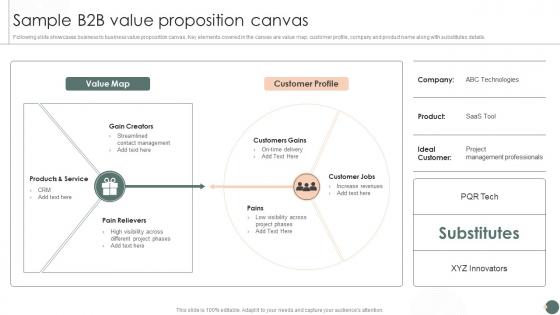
Sample B2b Value Proposition Canvas




Try Before you Buy Download Free Sample Product
 Impress Your
 Audience
 100%
100% Editable
 Save Hours
 of Time


Following slide showcases business to business value proposition canvas. Key elements covered in the canvas are value map, customer profile, company and product name along with substitutes details.
People who downloaded this PowerPoint presentation also viewed the following :
Sample B2b Value Proposition Canvas with all 6 slides:
Use our Sample B2b Value Proposition Canvas to effectively help you save your valuable time. They are readymade to fit into any presentation structure.





FAQs for Sample B2b
Your B2B value prop needs three things: specific ROI numbers, actual proof, and what makes you different. Don't just say "we save money" - buyers want exact percentages and timelines. Case studies are huge. That whole "revolutionary solution" angle? Totally played out. Show them concrete evidence of how you fix their real problems. Multiple people make these decisions now, so your messaging has to work for different stakeholders. "Reduce processing time by 40%" beats vague fluff every time. Oh, and test different versions with actual prospects - you'll be surprised what clicks.
You really need to dig into what each segment actually cares about - do proper customer interviews, look at the data. Don't just switch out some buzzwords and think you're done, that's honestly pretty transparent. Cost-focused people want to see ROI numbers. Innovation folks are all about competitive edge. Test different versions of your value prop with each group - I learned this the hard way last year. The whole point is making them feel like you get their specific problems. When you nail it, they'll think you built everything just for them. Takes more work but it's worth it.
Dude, customer feedback is everything for your value prop. You think you know what matters to them, but honestly? You're probably wrong about half of it. Talk to your best customers - ask why they picked you and what's actually changed for them since. Their words will show you which benefits to focus on and what pain points you're totally missing. Oh, and here's the thing - when prospects see real customer language in your messaging instead of marketing fluff, it just lands better. Way better than whatever your team cooked up in a conference room.
Yeah so basically you're mapping out what all your competitors are saying - their prices, messaging, the whole deal. Then you hunt for gaps they're missing. It's kinda like getting a bird's eye view before you make your move, if that makes sense? I always start with listing the top 5 competitors and their main selling points. The cool part is spotting patterns in what they suck at or totally ignore. Like, what are customers still bitching about that nobody's fixing? That's where your opportunity lives. Once you see those blind spots, you can position yourself right in them.
Honestly, conversion rates at each stage tell you everything you need to know about whether people actually get what you're selling. Sales cycle length matters too - when your messaging clicks, decisions happen way faster. I'd also look at demo-to-close rates and pay attention to whether prospects repeat your key points back to you (that's always my favorite sign). Lead quality scores are huge since clearer messaging pulls in better prospects. Win/loss interviews are gold - just ask them straight up what worked or didn't. Pick maybe 2-3 of these and stick with them for a full quarter at least.
Honestly, skip the feature lists and tell a story instead. Paint the picture: where was your client before you swooped in? What sucked for them? Then walk through how you fixed it and boom - show the results. Way more interesting than bullet points, plus people actually remember stories. Get specific with numbers too - "we cut their costs 30% in six months" hits different than some vague promise. Makes complicated B2B stuff way easier to understand. I'd create like 2-3 different customer scenarios that really show off what you do best.
Dude, the worst thing you can do is just dump all your product features on them. Like nobody cares that you have 47 integrations - they want to know if it'll save them time or help hit their numbers. Also stop using those cringe phrases like "industry-leading solutions" because literally everyone says that. Don't assume they get your technical jargon either. Here's what actually works: write down exactly what's different in their day-to-day after using your thing. Focus on outcomes, not specs. Makes such a huge difference.
Look, people's brains just work better with visuals than giant text blocks. When you say "30% cost reduction," show them a chart that makes those savings feel real - way more powerful than just the words. Executives are swamped and honestly pretty impatient, so diagrams and infographics help them get your point fast. Match your visual to what you're claiming though. Process flows work great for efficiency stuff, graphs for hard numbers, mockups for new products. Oh and always put the visual first, then explain it after. Trust me, it makes a huge difference in how sticky your message becomes.
Look, market research is basically your cheat sheet for figuring out what actually bugs your potential customers. Skip it and you're just throwing darts blindfolded. The research shows you their real problems, how they talk about stuff, what their budgets look like. Honestly, half the time what we think is amazing about our product isn't even on their radar. You'll discover which benefits they actually care about versus the features you're obsessing over. Do the homework first - otherwise you'll spend months crafting messages that completely miss the mark. Trust me on this one.
Honestly, if you don't have a solid value prop, you're just another vendor they'll dump when someone cheaper comes along. Your value proposition has to grow with them too - what worked two years ago probably doesn't cut it anymore. I've watched so many partnerships crash because companies got lazy about proving their worth. Regular check-ins are huge here. You need to show exactly how you're helping their business succeed, not just rattle off features they're paying for. Without that foundation, you're basically competing on price alone, and that's a losing game for everyone.
Honestly, you can't just blast the same message everywhere and expect it to work. LinkedIn folks want hard numbers and business results upfront. Email should hit specific problems they're dealing with. Your website? That's where you can really dive into case studies and detailed stuff. Sales calls are totally different though - make it feel like a conversation, ask questions first instead of jumping into your pitch. The key is keeping your main message the same but changing how you say it for each place. Map out who's actually using each channel, then write versions that sound natural for those people. It takes more work but it's so much better than copy-pasting everywhere.
Don't just tell people what you deliver - show them why you do it that way. Like instead of "we boost efficiency 30%," try "small businesses deserve the same tools as big companies, so we built something that boosts your efficiency 30% without all the headache." Your values are what make clients go "oh, these people actually get it." Honestly? That's what separates you from everyone else offering similar results. List out your core values first, then figure out how each one actually changes the way you work. The emotional connection matters way more than people think.
Look at Salesforce with their "No Software" thing - pure genius for IT folks sick of dealing with installations. Slack nailed it too because honestly, who wasn't drowning in email back then? "Where work happens" just clicked. Caterpillar's smart about this - they sell uptime promises instead of boring equipment specs. FedEx became legendary with that overnight guarantee because B2B customers literally couldn't afford delays. The trick? They all figured out what kept their buyers up at night. Your value prop should make procurement think "thank god, someone actually understands what we're dealing with here."
Talk to your customers first - their priorities have probably flipped completely. Maybe they don't care about cost anymore and just want flexibility. Or they need remote everything instead of face-to-face stuff. Honestly? Most companies drag their feet on this and it kills them. Check out what the disruptors are actually doing differently - not just their marketing BS, but the real changes. Then steal those ideas (legally, obviously) and test new messaging fast. The whole "let's think about this for six months" approach doesn't work when everything's changing. You've gotta move before your competition figures it out.
Honestly, B2B buyers are obsessed with sustainability right now - they want to see how you'll help their ESG numbers. AI stuff is basically expected at this point, so if you're not talking about automation or smart insights, you're missing the boat. But here's the thing - ditch all that feature-heavy messaging. People want to know what actual outcomes they'll get, not a laundry list of capabilities. Oh, and remote collaboration tools are still doing well. Data security too, obviously. I'd start by looking at your current value prop and see where you can work these angles in. Outcome-based pricing is getting traction too if that fits your model.
-
Amazing variety of PowerPoint slides. Really helpful in designing professional presentations.
-
Every time I ask for something out-of-the-box from them and they never fail in delivering that. No words for their excellence!