

Semantic Web IT Powerpoint Presentation Slides




Try Before you Buy Download Free Sample Product
 Impress Your
 Audience
 100%
100% Editable
 Save Hours
 of Time


This PowerPoint presentation briefly overviews the semantic web by covering its introduction, foundation, entities and ontologies, impact, and benefits. In this Semantic Web PowerPoint Presentation, we have covered the semantic web architecture, its working, standards of the semantic web, knowledge graph, and semantic metadata. In addition, this Semantic Web Ontology PPT contains the Markups and standards that help create semantic meta-statements, standards, and rules. Also, the Semantic Web Principles PPT presentation includes the principles and layers, everything that can be identified by URIs, resources, related links and their types, partial information, and so on. Moreover, the Semantic Web Standards deck comprises business benefits of the semantic web, the relationship of the semantic web with Machine Learning, Artificial Intelligence, and other technologies. Furthermore, this Semantic Search template caters to an overview of the semantic search mechanism and importance, the growth of semantic search, steps to obtain semantic searchs benefits, and its advantages to digital marketers. It also includes a timeline and a roadmap for semantic web development. Download our 100 percent editable and customizable template, which is also compatible with Google Slides.
People who downloaded this PowerPoint presentation also viewed the following :
Content of this Powerpoint Presentation
Slide 1: This slide displays the title Semantic web (IT).
Slide 2: This slide displays the title Agenda for semantic web.
Slide 3: This slide exhibit table of content.
Slide 4: This slide exhibit table of content- Overview of semantic web.
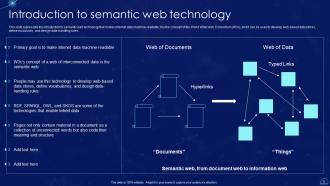
Slide 5: This slide represents the introduction to semantic web technology that makes internet data machine-readable.
Slide 6: This slide talks about the basis of semantic web technology, and it includes Web 1.0 and Web 2.0.
Slide 7: This slide talks about the motivation behind the semantic web to enable machines to understand data.
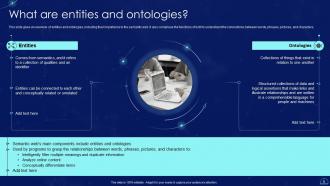
Slide 8: This slide gives an overview of entities and ontologies, including their importance to the semantic web.
Slide 9: This slide represents how the semantic web adds meaning to information on the web so that it can only provide accurate results to user queries.
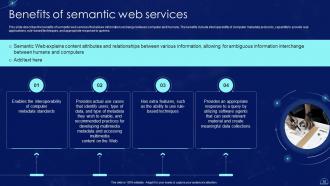
Slide 10: This slide describes the benefits of semantic web services that allows information exchange between computer and humans.
Slide 11: This slide exhibit table of content- Semantic web architecture and working.
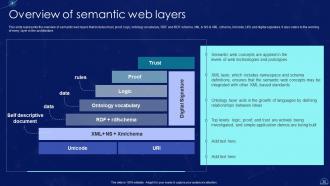
Slide 12: This slide represents the semantic web technology architecture overview by showcasing various layers of it.
Slide 13: This slide represents the working of semantic web technology on the internet, and it also includes how it is a supplement to the web and not a replacement for it.
Slide 14: This slide exhibit table of content- Standards apply to the semantic web.
Slide 15: This slide represents the resource description framework overview that helps define the data about the information.
Slide 16: This slide outlines the overview of SPARQL, which is a graph database analytics protocol and declarative programming language.
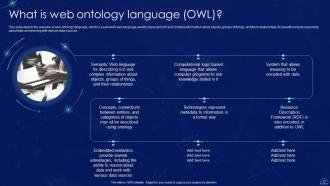
Slide 17: This slide depicts the overview of web ontology language.
Slide 18: This slide exhibit table of content- Semantic metadata and knowledge graphs.
Slide 19: This slide describes how semantic metadata caters to semantic tags on the existing web pages for better understanding.
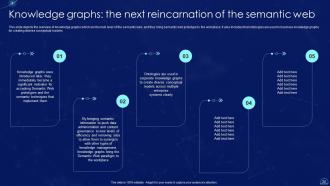
Slide 20: This slide depicts the overview of knowledge graphs which are the next level of the semantic web, and they bring semantic web prototype to the workplace.
Slide 21: This slide exhibit table of content- Markups and standards that help create semantic meta-statements, standards, and rules.
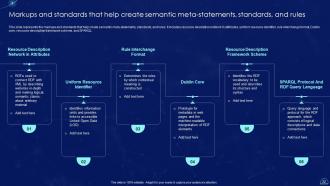
Slide 22: This slide represents the markups and standards that help create semantic meta-statements, standards, and rules.
Slide 23: This slide exhibit table of content- Semantic web main principles and layers.
Slide 24: This slide represents the first principle of the semantic web, that is, everything can be identified by Universal Resource Identifier (URI).
Slide 25: This slide depicts the second principle of the semantic web, which is resources and links can have types that are not available on the existing internet.
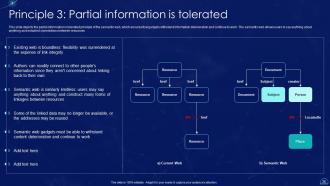
Slide 26: This slide depicts the partial information is tolerated principle of the semantic web.
Slide 27: This slide explains there is no need for the absolute truth principle of the semantic web.
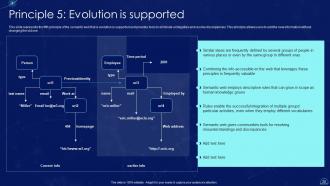
Slide 28: This slide represents the fifth principle of the semantic web that is evolution is supported and provides tools to eliminate ambiguities and resolve discrepancies.
Slide 29: This slide talks about the sixth principle of the semantic web, which is a minimalist design that makes complex tasks easy.
Slide 30: This slide represents the overview of semantic web layers.
Slide 31: This slide exhibit table of content- Semantic web business benefits.
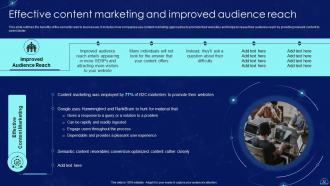
Slide 32: This slide outlines the benefits of the semantic web to businesses.
Slide 33: This slide represents the business benefits of semantic web to enhance their revenue by providing more user-friendly internal navigation to the users.
Slide 34: This slide talks about the better conversion rates through semantic site search.
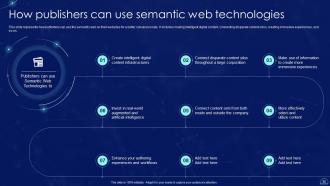
Slide 35: This slide represents how publishers can use the semantic web on their websites for a better conversion rate.
Slide 36: This slide exhibit table of content- Semantic web with ML, AI and other technologies.
Slide 37: This slide talks about the relationship between machine learning and artificial intelligence, which are components of data science.
Slide 38: This slide talks about the distinction between the semantic web with other technologies.
Slide 39: This slide exhibit table of content- Overview of semantic search.
Slide 40: This slide represents the overview and importance of semantic search mechanisms that understand the intent of the user’s query.
Slide 41: This slide talks about the growing applications of semantic search in recent years.
Slide 42: This slide describes the six steps to obtain the semantic search’s benefits.
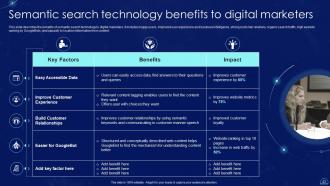
Slide 43: This slide describes the benefits of semantic search technology to digital marketers.
Slide 44: This slide exhibit table of content- Timeline for semantic web deployment.
Slide 45: This slide represents the timeline for semantic web deployment and development, including the steps to be performed at each month’s interval.
Slide 46: This slide exhibit table of content- Roadmap for semantic web deployment.
Slide 47: This slide represents the roadmap for semantic web deployment and development, including the steps to be performed at each month’s interval.
Slide 48: This is the icons slide.
Slide 49: This slide presents title for additional slides.
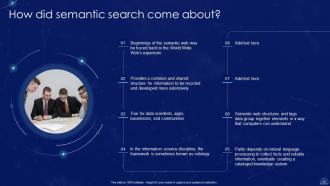
Slide 50: This slide display How did semantic search come about?
Slide 51: This slide represents the implementation challenges of semantic web technology.
Slide 52: This slide exhibits yearly timeline of company.
Slide 53: This Column chart display for two different products.
Slide 54: This Line chart display for two different products.
Slide 55: This slide display Circular process.
Slide 56: This slide depicts posts for past experiences of clients.
Slide 57: This slide display 30 60 90 days plan.
Slide 58: This slide display Mind map.
Slide 59: This slide shows puzzle for displaying elements of company.
Slide 60: This slide display Venn.
Slide 61: This is thank you slide & contains contact details of company like office address, phone no., etc.
Semantic Web IT Powerpoint Presentation Slides with all 66 slides:
Use our Semantic Web IT Powerpoint Presentation Slides to effectively help you save your valuable time. They are readymade to fit into any presentation structure.































FAQs for Semantic Web IT
Think of the web as one massive database that computers can actually understand - not just random documents everywhere. There are four main things: use URIs for everything, make data machine-readable with RDF, build shared vocabularies, and let computers reason automatically. It's pretty cool how Google answers "Who is Obama's wife?" without that exact text existing anywhere, right? That's this stuff working. Your content needs to work for both humans AND machines using standard formats. Just start with schema markup on whatever you've already got. Way easier than it sounds.
So basically, the Semantic Web fixes that annoying data compatibility problem using standards like RDF and shared vocabularies. Your data isn't stuck in weird proprietary formats anymore. Instead, everything uses common ontologies that work like translators between different platforms. URIs keep everything consistent - so when one system calls them "customers" and another says "clients," they still map to the same thing. Pretty neat actually. Oh, and definitely check out schema.org vocabularies first - they've probably already figured out the standards for whatever you're working on. Saves you tons of time.
So ontologies are like smart vocabularies that actually get what you're searching for instead of just matching words. When you type "car," the system knows you probably want "automobile" or "vehicle" results too. The cool part is semantic reasoning - it connects dots that aren't obvious in your data. You'll get way better results and won't miss stuff. Honestly, if you're building search features, grab some ontologies for your specific area. Makes such a difference compared to basic keyword matching.
So RDF is what makes the Semantic Web tick - it's basically a way to structure data so computers can actually understand how things relate to each other. You know those "Subject-Predicate-Object" statements? Like "John works for Microsoft" or "Sarah created this document." That's RDF triples in action. Once you get it, it's pretty cool how elegant the whole system is. Different platforms can share and process this structured data automatically. Honestly took me forever to wrap my head around it at first, but now I use it all the time. If you're building anything that needs to work across different systems, definitely start with learning RDF triples - they're your foundation.
So basically, you can use Semantic Web stuff to connect your data better. RDF and ontologies are the main tools - they create relationships between datasets that computers can actually read. Pretty neat concept, honestly. Instead of having everything stuck in separate systems, you're giving all your data a shared language. Short-term, try adding schema markup to your site. Knowledge graphs work great for customer data too, though that's a bit more involved. The payoff is solid - automated integration, way better search, and analytics that actually make sense across your whole setup.
Ugh, data quality is gonna be your worst nightmare - you'll be cleaning and standardizing stuff from different sources forever. Building good ontologies is surprisingly tricky too. Getting teams to agree on knowledge structure? Good luck with that lol. Performance tanks once you're reasoning over big datasets, which is annoying. Most existing systems need major refactoring for integration. Oh, and don't try to semantify everything right away - that's a recipe for disaster. Pick one specific use case for a pilot project first. Trust me on this one.
So linked data is basically about making web info machine-readable using URIs as identifiers. When you hit those URIs, you get useful data back instead of just random stuff. The cool part? Everything links to related external sources, so instead of isolated data chunks, you get this massive connected web that apps can actually crawl through. It's like transforming the web from scattered documents into one huge database you can query - honestly pretty neat when you think about it. RDF and other standard formats let different systems talk to each other. Just start by adding structured data to your own stuff and link to established datasets like DBpedia.
So basically, Semantic Web stuff makes search engines way better at understanding your content. You add structured data markup to your pages - think of it like giving Google a cheat sheet about whether you're posting a recipe, product review, whatever. Yeah, it's kinda technical at first but honestly? The payoff is huge. Rich snippets, better search rankings, all that good stuff. I'd start simple - just throw some basic schema markup on your main pages. Even basic organization and webpage schemas help tons. My cousin's bakery saw way more traffic after adding recipe markup. Worth the learning curve for sure.
So the Semantic Web makes your apps way better at figuring out what you're actually looking for. Your search results get more relevant because the system understands context, not just keywords. Voice assistants give you smarter answers, and you'll get recommendations that actually make sense. Apps can connect info across different platforms without being weird about it. It's kinda like having a friend who gets what you mean instead of just hearing your exact words - which honestly is pretty huge when you think about it. Way less frustrating than current search sometimes.
Oh it's everywhere already! Healthcare uses it for connecting patient records and drug research. Amazon's creepy-good product suggestions? That's semantic web stuff. Banks use it to catch fraud by understanding how transactions relate to each other. Honestly, government agencies probably have the messiest implementation since they're trying to connect ancient systems across departments. Media companies do content personalization with it too. If you're thinking about using it, just look for places where your data doesn't talk to each other - that's usually where it helps most.
So AI and ML make the Semantic Web way less painful by doing the boring work for you. They can pull entities and relationships straight from text using NLP - no more manual RDF tagging hell. Machine learning handles ontology matching too, which honestly saves so much time when you're trying to connect different data sources. The whole manual approach just falls apart at scale anyway. With AI doing the semantic annotation automatically, you get way richer connected data without wanting to tear your hair out. Oh, and definitely check out spaCy or OpenIE if you want to mess around with entity extraction.
So for Semantic Web stuff, I'd go with Apache Jena if you're doing Java - it's solid for RDF and SPARQL. Python folks usually love rdflib, super easy to pick up. Virtuoso's great for big triple stores but honestly the setup is kinda annoying. GraphDB and Stardog are worth checking out if you need enterprise features. Oh, and JSON-LD processors are clutch for web APIs since they integrate really smoothly. Start with either Jena or rdflib depending on what language you prefer. Both have decent docs too.
So basically, Semantic Web stuff can fix how government agencies share data. Right now it's a mess - like the DMV literally can't talk to tax offices because everything's in silos. With this tech, citizens get one portal instead of bouncing around 20 different sites. You can automate compliance checking too, which is huge. Machine-readable data makes budget transparency actually work for once. Search gets way smarter across all their databases. Honestly, the efficiency gains for regulatory reporting alone would pay for itself. I'd say start with just one department first though.
So the Semantic Web makes open data way more useful - think of it as giving your datasets a common language. When you add semantic markup, other systems can actually understand what your data means and how it connects to other sources. Pretty cool, right? Researchers and developers can find your stuff more easily and mash it up with other datasets in ways that actually make sense. RDF or schema.org markup is where you'd want to start - honestly, it's not as scary as it sounds. Your data becomes machine-readable instead of just sitting there looking pretty. The whole linked data thing really does work.
Yeah, so linked data basically turns into digital breadcrumbs that can trace back to you - it's wild how easily info gets connected across different sources. There are workarounds though. Differential privacy adds random "noise" to datasets, which sounds counterintuitive but works. You can also build access controls right into your semantic annotations. Honestly, the crypto crowd has some solid methods for secure data sharing too. W3C's working on privacy standards specifically for this stuff. Just don't make the classic mistake of trying to add privacy protections after you've already built everything - design it in from day one.
-
Great product, helpful indeed!
-
A perfect platform for all your presentation needs. Unlimited products at an affordable price.