


Service blueprint template creating a service blueprint for your organization




Try Before you Buy Download Free Sample Product
 Impress Your
 Audience
 100%
100% Editable
 Save Hours
 of Time


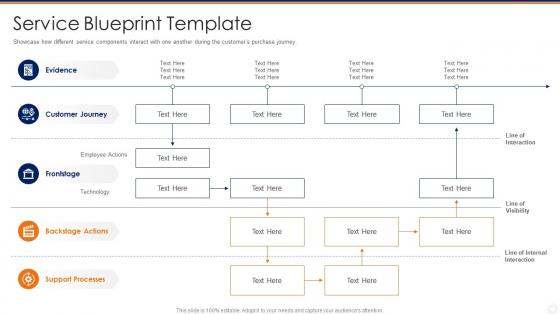
Showcase how different service components interact with one another during the customers purchase journey.
People who downloaded this PowerPoint presentation also viewed the following :
Service blueprint template creating a service blueprint for your organization with all 6 slides:
Use our Service Blueprint Template Creating A Service Blueprint For Your Organization to effectively help you save your valuable time. They are readymade to fit into any presentation structure.





FAQs for Service blueprint template creating a service blueprint
A service blueprint is a comprehensive visualization tool that maps customer journeys alongside employee actions, backend processes, and supporting systems, showing both visible and invisible service interactions. Unlike traditional process maps that focus solely on workflows, service blueprints uniquely separate frontstage customer touchpoints from backstage operations, enabling organizations to identify service gaps, streamline customer experiences, and optimize resource allocation across multiple service layers simultaneously.
A comprehensive service blueprint template should include customer actions, frontstage employee actions, backstage employee actions, support processes, and physical evidence across all touchpoints. These elements work together by mapping the complete service journey, identifying pain points and improvement opportunities, and ensuring seamless coordination between customer-facing and behind-the-scenes operations, ultimately delivering enhanced customer experiences and operational efficiency.
Businesses can customize service blueprint templates by adapting customer journey stages, modifying touchpoints and channels, adjusting employee roles and responsibilities, and incorporating industry-specific processes and compliance requirements. Through strategic customization, organizations in healthcare, retail, and financial services streamline operations, enhance customer experiences, and optimize resource allocation, ultimately delivering more targeted solutions that align with their unique operational goals and customer expectations.
Service blueprints are particularly beneficial when organizations face complex customer interactions, multiple touchpoints, or cross-departmental service delivery challenges. They prove especially valuable for banks streamlining loan processes, hospitals coordinating patient care, and retail companies integrating online-offline experiences, ultimately delivering operational clarity, reduced service gaps, and enhanced customer satisfaction while enabling teams to identify improvement opportunities.
A service blueprint facilitates better communication by creating a shared visual language that maps customer touchpoints, employee actions, and backend processes in one comprehensive view. This unified framework enables marketing, operations, IT, and customer service teams to understand interdependencies, identify collaboration points, and align efforts seamlessly, ultimately delivering more cohesive customer experiences and streamlined organizational efficiency.
Common challenges when creating service blueprints include defining clear customer touchpoints, mapping complex backstage processes, ensuring cross-departmental collaboration, maintaining accurate process documentation, and balancing detail with usability. These obstacles often stem from organizational silos, incomplete data visibility, and varying stakeholder perspectives, with many companies finding that structured templates and iterative workshops streamline blueprint development while enhancing operational transparency.
Organizations use service blueprints to enhance customer experience by mapping customer touchpoints, identifying pain points, and streamlining service delivery processes across all interaction channels. Through detailed visualization of front-stage and backstage activities, companies in retail, banking, and healthcare can eliminate friction points, reduce wait times, and create more seamless customer journeys, ultimately delivering improved satisfaction and competitive advantage.
Technology streamlines service blueprint creation through digital mapping tools, automation platforms, data analytics systems, and collaborative software that enable real-time visualization and continuous optimization. These solutions enhance cross-departmental coordination, identify process bottlenecks, and facilitate seamless updates, with many organizations finding that integrated technology platforms ultimately deliver faster service improvements and measurable operational efficiency gains.
Service blueprints enhance customer journey mapping by adding behind-the-scenes operational processes, employee actions, and support systems that enable each customer touchpoint. While customer journey maps focus on the front-stage experience, service blueprints reveal backstage activities, with organizations in retail, healthcare, and financial services finding that this strategic combination delivers comprehensive process optimization and improved service delivery.
**INPUT**: What are some best practices for designing an effective service blueprint? **OUTPUT**: Effective service blueprint design includes mapping all customer touchpoints, defining clear frontstage and backstage activities, identifying pain points, documenting supporting processes, and establishing measurable metrics. These practices streamline operations by enhancing visibility across departments, reducing service gaps, and improving customer experiences, with many organizations finding that comprehensive blueprints ultimately deliver faster problem resolution and increased operational efficiency. [Word count: 58 words]
Yes, service blueprints excel at revealing service delivery gaps by mapping customer touchpoints, employee actions, and support systems across the entire journey, highlighting disconnects between planned and actual experiences. Through visual process mapping, organizations can identify bottlenecks, redundancies, and missing interactions that impact customer satisfaction, while streamlining operations and ultimately delivering more cohesive, efficient service experiences.
Service blueprints should be updated quarterly or whenever significant changes occur in service processes, customer touchpoints, or organizational structure. Regular reviews ensure the blueprint accurately reflects current operations, with many service organizations finding that scheduled updates alongside new product launches, technology implementations, or customer feedback integration maintain operational alignment and enhance service delivery effectiveness.
Service blueprint templates can be adapted for healthcare through patient journey mapping, retail via customer touchpoint optimization, financial services with compliance checkpoints, hospitality through guest experience workflows, and manufacturing via quality control processes. These industry-specific modifications enable organizations to address sector regulations, operational requirements, and customer expectations more effectively, ultimately delivering streamlined services and enhanced competitive advantage.
Ensuring stakeholder contribution to service blueprints involves conducting structured workshops with representatives from each touchpoint, implementing collaborative mapping sessions where departments identify their specific interactions, and establishing clear feedback loops throughout the process. Through cross-functional teams and iterative review cycles, organizations streamline communication between front-office, back-office, and support functions, ultimately delivering comprehensive blueprints that reflect real operational workflows and enhance service delivery across all customer journey stages.
Key metrics include customer satisfaction scores, service delivery time, error rates, employee efficiency measures, and cost per service interaction. These metrics enable organizations to identify bottlenecks, streamline touchpoints, and enhance overall service quality, with many businesses finding that systematic measurement ultimately delivers improved customer experiences and operational efficiency.
-
Informative presentations that are easily editable.
-
Nice and innovative design.