

Service level agreement ppt slides




Try Before you Buy Download Free Sample Product
 Impress Your
 Audience
 100%
100% Editable
 Save Hours
 of Time


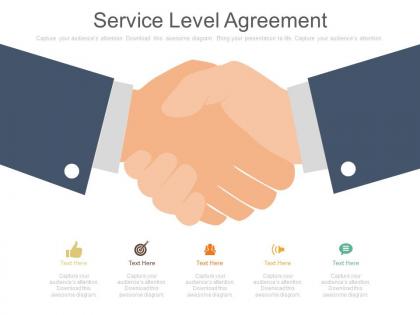
The business environment is full of agreements between businesses and individuals. Our service level agreement PowerPoint slideshow has been designed for you to make your audience understand the significance of developing business contracts. The service level agreement Presentation template design comes with professionally designed handshake graphic along with text boxes where you can add your company information. You can easily communicate your key strategies and terms with our service level agreement PPT visual. Written contracts provide individuals and businesses with a legal document stating the expectations of both parties and how negative situations will be resolved. Contracts often represent a tool that companies use to safeguard their resources. Let our creative PowerPoint slide be a part of your presentation and attract your audience. Also walk through our other PPT designs which can be downloaded and use as per the requirement. All our designs are completely editable and you can easily modify them as per your choice. Handle dissent with our Service Level Agreement Ppt Slides. Disseminate your thoughts in a convincing fashion.
People who downloaded this PowerPoint presentation also viewed the following :
Service level agreement ppt slides with all 5 slides:
Our Service Level Agreement Ppt Slides assure you excellent alternatives. You can create a customized display.

FAQs for Service level
You'll need service descriptions, performance metrics, and availability targets as your foundation. Response times and escalation procedures are crucial too. Define exactly what counts as downtime - trust me, this prevents so many headaches later. Include responsibilities for both sides, plus penalties for missed targets. Reporting requirements matter because nobody wants nasty surprises. Don't forget maintenance exclusions either. Legal should definitely review the penalty stuff before you sign anything. Being super specific upfront saves you from people trying to wiggle out of things down the road.
So basically an SLA is like having a written agreement that spells out what you'll actually deliver - response times, uptime guarantees, all that stuff. No more "but I thought you meant..." drama later. It protects you too when clients get unrealistic expectations (trust me, they will). Plus when things inevitably break, you've already outlined what happens next and how you'll fix it. Honestly, the more specific you get with yours, the better. Vague wording always screws you over down the road. Makes everything way cleaner for both sides.
So most companies track uptime first - like 99.9% availability, that's pretty standard. Response times for support tickets matter too, plus how fast you actually fix problems. Page load speeds, transaction times, error rates - all that performance stuff. Security response time is huge now (everyone's freaking out about getting hacked). MTTR and customer satisfaction scores come up a lot too. Honestly though, pick metrics your users actually care about, not just what sounds fancy. Oh and make sure you can actually measure whatever you choose consistently - I've seen teams pick impossible-to-track stuff before.
Look, you can't just copy-paste generic SLAs everywhere. Healthcare absolutely needs rock-solid uptime and security - people's lives are literally on the line. Retail? They're sweating about Black Friday crashes and checkout speeds. Financial services are nuts about response times because every minute of downtime costs them insane money. Manufacturing companies honestly care way more about scheduled maintenance windows than perfect 24/7 availability. Figure out what actually breaks your industry's back - regulations, business cycles, whatever keeps your CEO up at night. Then build your metrics around that stuff instead of some cookie-cutter template.
Think of penalties as what actually gives your SLA some bite - otherwise it's basically worthless paper. When service drops below what you agreed on, you get compensated through credits or money back. Some SLAs have bonuses for overperforming, but honestly those are unicorns. The real deal is making sure your contract spells out exactly how they calculate penalties. You don't want fuzzy math when you're trying to get paid back for downtime. It's what stops providers from just shrugging when things break.
Honestly, just start small and don't overcomplicate it. Figure out your main services first, then pick metrics you can actually hit - I've watched so many teams promise crazy uptime numbers they obviously can't deliver. Be real about what you can do right now and give yourself breathing room. Define stuff like "downtime" super clearly so nobody argues about it later. Oh and definitely run it by your ops people AND the business folks before you commit to anything. Short sentences work. They'll spot problems you totally missed, plus you need buy-in from everyone anyway.
Oh totally! SLAs are definitely negotiable - most companies just throw their standard template at you hoping you won't question it. You'll want to hammer out uptime guarantees, response times, and penalty clauses that actually make sense for your situation. Also dig into their escalation procedures and how they handle maintenance windows. The resolution timeframes are huge too. Don't forget about service credits and what qualifies for them (this part gets tricky). Honestly, I've seen people save themselves major headaches by negotiating based on their real budget and needs upfront. Just document everything so there's no "wait, that's not what we agreed on" drama later.
Honestly, the hardest part is proving what actually went wrong and whose fault it was. Getting clean data both sides accept is a nightmare - like was that outage really their servers or your connection acting up? Vendors love to argue about what counts as "critical" too. Then comes the fun part of actually getting paid when they screw up. Most will fight you or try pushing store credit instead of real money. Oh, and document absolutely everything beforehand. Set up proper monitoring first because without rock-solid proof, your SLA is basically worthless paper.
Dude, manual tracking is such a pain - you'll definitely miss things. Get some automated monitoring set up instead. APM tools like New Relic or Datadog work great for this stuff. Response time trackers, uptime monitors, all that. Your ticketing system should flag you *before* you breach an SLA, not after (learned that one the hard way). I'd start with your most critical SLAs first and automate those. Oh, and make sure everything feeds into one dashboard so your stakeholders aren't bugging you constantly asking for updates. Trust me on this one.
Breaking your SLA can really mess things up for you. Financial penalties are the most common consequence - think service credits or straight-up refunds to your client. Worst case scenario? They could terminate the whole contract or come after you for business damages. Some penalty structures are absolutely ruthless, I've seen companies get hit hard. Your reputation takes a beating too, which makes future negotiations way trickier. Oh, and definitely read through those penalty clauses carefully so you know what you're walking into if stuff goes wrong.
SLAs are honestly huge for customer satisfaction because people just want to know what to expect, you know? Like if you tell someone you'll respond in 2 hours and actually do it, they're happy. Miss that deadline constantly and they'll bounce - I've seen it happen so many times. Trust builds when you hit those commitments consistently. The trick is being realistic about what you promise though. Way better to say 4 hours and deliver in 2 than promise 1 hour and always be late. Customers hate uncertainty more than slightly longer wait times, at least in my experience.
Oh man, SLA breaches are the worst. Document everything immediately - what broke, when it happened, impact on users. You'll need to loop in stakeholders and clients right away (yeah, it's awkward but you gotta be transparent). Fire up your incident response plan to stop the bleeding. Once things are stable, dig into the root cause analysis. Create a timeline for fixes. Also check your SLA penalties because those can get expensive fast. The whole thing is basically about shifting from "oh crap everything's on fire" mode to actually preventing it next time.
Look, annual reviews are the absolute minimum – but honestly, that's kinda lazy. Whenever you roll out new tech or have a major service meltdown, review them immediately. I've watched companies ignore their SLAs for years then act shocked when nothing makes sense anymore. Quarterly check-ins work way better for catching trends early. Your customers and team will give you real feedback if you actually ask. Oh, and set that calendar reminder right now or you'll forget like everyone else does. Stay ahead of problems instead of chasing them.
Okay so SLAs are what you promise customers - like "we'll respond in 2 hours." Then OLAs are the internal stuff between your teams to actually make that happen. So IT might promise to fix servers in 30 minutes so you can hit that customer promise. ULAs are with outside vendors - your cloud provider saying they'll give you 99.9% uptime or whatever. It's basically a chain working backwards from what you told customers. I always found it easier to start with the customer promise first, then figure out what everyone else needs to commit to internally. The acronyms are pretty much unavoidable in this space unfortunately.
Dude, don't just stick your SLAs in some random shared folder - nobody ever looks there. Email them out, throw them in Slack channels, put the key numbers right in your dashboards. I swear half the arguments I've seen about response times happen because the SLA was just sitting there unread. Keep bringing them up in meetings and incidents. Your support tools should display the targets so people actually see them every day. Oh and make simple one-pagers for new people - saves you from explaining the same stuff over and over.
-
Informative design.
-
Very well designed and informative templates.