

Slides de apresentação de gerenciamento de nível de serviço





Try Before you Buy Download Free Sample Product
 Impress Your
Audience
 100%
Editable
 Save Hours
of Time


Elucidar os métodos para melhorar suas ofertas usando estas Slides de Apresentação de Gerenciamento de Nível de Serviço. Este slideshow de desempenho de produto PPT retrata os desafios do SLM, a implementação do SLM, os elementos de serviço, etc. Aproveite este modelo de PPT de taxa de serviço para demonstrar a necessidade de processos de SLM, como a melhoria da prestação de serviços, etc. Utilize estas slides de PPT de qualidade de serviço para retratar os desafios que impedem a implementação do processo, como o representante do cliente, etc. Utilize este visual de PPT de acordo de nível de serviço para demonstrar as etapas do processo de SLM, como atualizar a estrutura de serviço, identificar os requisitos de serviço, ativar o serviço, etc. Além disso, você pode revelar os indicadores de desempenho do SLM, como os SLAs em revisão, o cumprimento dos níveis de serviço, os SLAs monitorados, etc. Defina o nível de serviço necessário para várias unidades de negócios, como fabricação e suporte ao cliente, usando esses visuais de gerenciamento de serviços. Baixe este infográfico de PPT de qualidade de serviço e forneça uma experiência perfeita para seus clientes atuais e potenciais.
People who downloaded this PowerPoint presentation also viewed the following :
Conteúdo desta apresentação em PowerPoint
Slide 1: Este slide apresenta a Gestão de Níveis de Serviço. Declare o nome da sua empresa e comece.
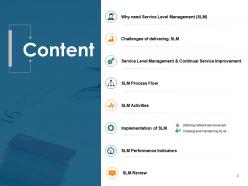
Slide 2: Este slide mostra o conteúdo da apresentação.
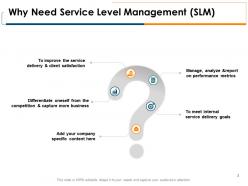
Slide 3: Este slide explica Por que precisamos da Gestão de Níveis de Serviço (SLM).
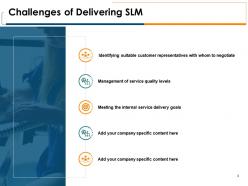
Slide 4: Este slide apresenta os Desafios da Entrega de SLM como - Identificar representantes adequados dos clientes com quem negociar, Gerenciamento dos níveis de qualidade do serviço, Atender às metas internas de entrega de serviços, etc.
Slide 5: Este é um slide opcional mostrando os Desafios da Entrega de SLM.
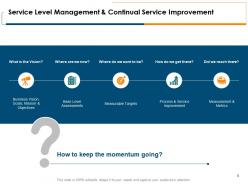
Slide 6: Este slide exibe Gestão de Níveis de Serviço e Melhoria Contínua do Serviço.
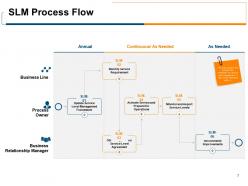
Slide 7: Este slide representa o Fluxo de Processos de SLM realizado para a gestão de níveis de serviço.
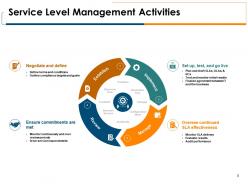
Slide 8: Este slide mostra as Atividades de Gestão de Níveis de Serviço como - Supervisionar a eficácia contínua do SLA, Garantir que os compromissos sejam cumpridos, Configurar, testar e entrar em operação, Negociar e definir.
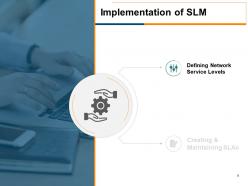
Slide 9: Este slide mostra a Implementação de SLM com imagens relacionadas.
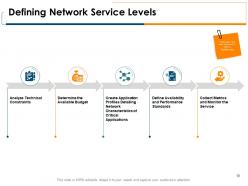
Slide 10: Este slide apresenta a Definição de Níveis de Serviço de Rede com ícones e texto relacionados.
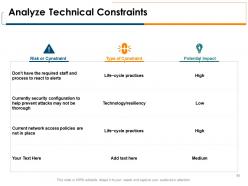
Slide 11: Este slide exibe Analisar Restrições Técnicas.
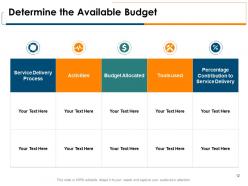
Slide 12: Este slide representa Determinar o Orçamento Disponível em forma tabular.
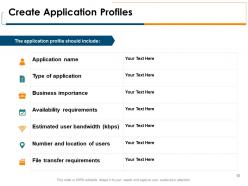
Slide 13: Este slide mostra Criar Perfis de Aplicativos.
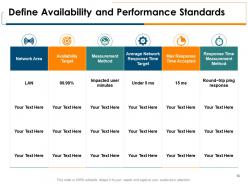
Slide 14: Este slide mostra Definir Padrões de Disponibilidade e Desempenho.
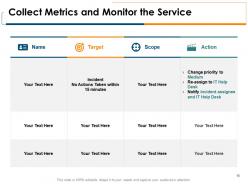
Slide 15: Este slide apresenta Coletar Métricas e Monitorar o Serviço.
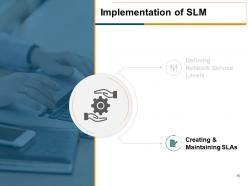
Slide 16: Este slide exibe a Implementação de SLM destacando a Criação e Manutenção de SLAs.
Slide 17: Este slide representa os Benefícios dos SLAs com imagens relacionadas.
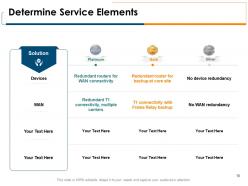
Slide 18: Este slide mostra Determinar Elementos de Serviço.
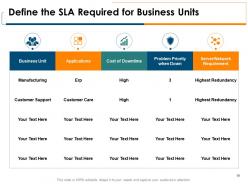
Slide 19: Este slide mostra Definir o SLA Necessário para as Unidades de Negócios.
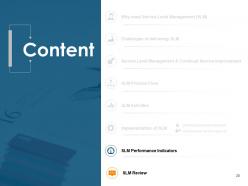
Slide 20: Este slide destaca os Indicadores de Desempenho de SLM e a Revisão de SLM.
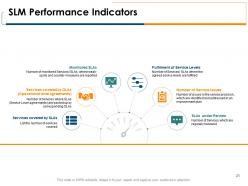
Slide 21: Este slide apresenta os Indicadores de Desempenho de SLM descrevendo - Cumprimento dos Níveis de Serviço, Número de Problemas de Serviço, SLAs em Revisão, Serviços cobertos por SLAs, SLAs Monitorados, Serviços cobertos por OLAs.
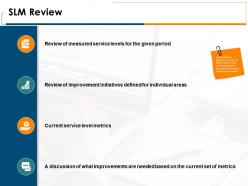
Slide 22: Este slide representa a Revisão de SLM para medir as definições de nível de serviço e fazer melhorias.
Slide 23: Este slide exibe Ícones de Gestão de Níveis de Serviço.
Slide 24: Este slide é intitulado como Slides Adicionais para avançar.
Slide 25: Este slide mostra um gráfico de colunas agrupadas com comparação de três produtos.
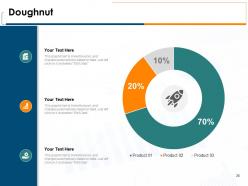
Slide 26: Este slide exibe um gráfico de rosca com dados em percentagem.
Slide 27: Este é o slide Nossa Missão com imagens e texto relacionados.
Slide 28: Este é o slide Conheça Nossa Equipe com nomes e cargos.
Slide 29: Este é o slide Sobre Nós para mostrar especificações da empresa, etc.
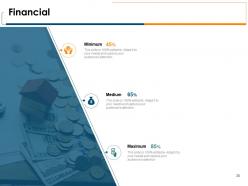
Slide 30: Este é um slide Financeiro. Mostre suas informações financeiras aqui.
Slide 31: Este é um slide de Citações para transmitir mensagens, crenças, etc.
Slide 32: Este slide é intitulado como Notas Adesivas. Poste suas notas importantes aqui.
Slide 33: Este é um slide de Obrigado com endereço, números de contato e endereço de e-mail.
Gerenciamento de nível de serviço apresentação de slides em PowerPoint com todas as 33 slides: 1. Introdução ao gerenciamento de nível de serviço 2. Objetivos do gerenciamento de nível de serviço 3. Definição de nível de serviço 4. Componentes do gerenciamento de nível de serviço 5. Processo de gerenciamento de nível de serviço 6. Identificação de requisitos de nível de serviço 7. Definição de métricas de nível de serviço 8. Estabelecimento de acordos de nível de serviço 9. Monitoramento e relatórios de nível de serviço 10. Revisão e melhoria contínua do nível de serviço 11. Papéis e responsabilidades no gerenciamento de nível de serviço 12. Desafios e benefícios do gerenciamento de nível de serviço 13. Alinhamento com a estratégia de negócios 14. Integração com outros processos de gerenciamento de serviços 15. Gerenciamento de expectativas do cliente 16. Comunicação efetiva com os clientes 17. Gerenciamento de incidentes e problemas de nível de serviço 18. Gerenciamento de mudanças de nível de serviço 19. Gerenciamento de capacidade e disponibilidade 20. Gerenciamento de continuidade de serviço 21. Gerenciamento de fornecedores e terceiros 22. Gerenciamento de riscos de nível de serviço 23. Métricas-chave de desempenho (KPIs) de nível de serviço 24. Relatórios e painéis de controle de nível de serviço 25. Análise de tendências e previsões de nível de serviço 26. Melhoria contínua do nível de serviço 27. Governança e estrutura organizacional 28. Treinamento e desenvolvimento de competências 29. Ferramentas e tecnologias de suporte 30. Casos de sucesso e melhores práticas 31. Desafios emergentes e tendências futuras 32. Conclusão e próximos passos 33. Perguntas e respostas
Utilize nossos slides de apresentação de gerenciamento de nível de serviço para economizar seu tempo valioso de forma eficaz. Eles estão prontos para se encaixar em qualquer estrutura de apresentação.







FAQs for Service level management
So you've got three main pieces: SLAs, SLOs, and SLIs - basically your agreements, targets, and how you measure stuff. Focus on metrics users actually care about, not just whatever's easiest to track. You'll need solid monitoring and a game plan for when things break (spoiler: they will). Regular check-ins with stakeholders help keep everyone aligned. Honestly, the biggest mistake is overcomplicating it. Keep things simple so everyone gets what you're measuring and why it matters. Oh, and start with your most critical services first - don't try to boil the ocean.
Honestly, you've gotta flip your whole approach here. Start with what actually makes your company money - sales, happy customers, whatever keeps the lights on. Then work backwards to set your SLAs. Like if your checkout page crashing costs $10K an hour, that number should totally drive your uptime goals. Don't just pick random percentages because they sound good. The trick is translating all that technical stuff into language your boss actually cares about. I learned this the hard way - nobody gives a damn about server metrics if you can't connect them to real business impact.
KPIs are your early warning system - they catch problems before they blow up. I'd start with 3-5 metrics that actually tie to your SLAs, not just whatever's easiest to track. Response times creeping up? You'll spot it week over week instead of getting blindsided. Plus they're perfect for those awkward stakeholder meetings where you need hard data to back up resource requests. The trick is focusing on stuff your users actually care about. Honestly, most teams track way too much noise. Review weekly and you'll catch issues while they're still fixable.
Honestly, automation is a game-changer for SLM stuff. Set up monitoring tools that track your metrics automatically and send alerts when things go sideways - saves you from constantly checking dashboards. Most platforms can handle the reporting too, which is nice since manual reports are such a pain. The escalation workflows are pretty sweet - incidents get routed to the right people without you playing phone tag. AI analytics can even predict problems before they hit, though I'm still figuring out how reliable that is. Start with whatever's eating up most of your time first.
Honestly, the hardest part is figuring out SLAs that actually make sense for your business - not just numbers that look impressive. Getting everyone on the same page is a nightmare because each team wants totally different metrics. Plus measuring stuff consistently? Way trickier than you'd think, especially when your systems barely talk to each other. And then there's the fun part of managing what customers expect vs what you can realistically pull off. My advice? Start with just a few critical services. Get those dialed in first, then slowly add more. Trust me on this one.
So basically, SLM works because you're telling customers exactly what to expect - like "we'll respond in 2 hours" or whatever. Then you actually do it. Sounds simple but most companies mess this up somehow. The cool part is tracking everything and showing off when you beat your own promises. Customers love seeing those reports where you hit 99% uptime when you only promised 95%. When stuff goes wrong (and it will), having those agreements already in place makes the conversation way less awkward. You can be like "hey, we're behind on our 24-hour target but here's our plan." Just pick your biggest customer complaints first and build metrics around those.
First thing - research what's standard in your industry so you're not going in blind. Don't take their initial offer, they totally expect pushback anyway. Know what you absolutely need vs what would just be nice. Here's the thing though - focus on metrics that actually matter to your business, not just impressive-sounding numbers. Set up both penalties for when they screw up AND bonuses when they nail it. Oh, and make sure you can actually track whatever you agree to measure. Otherwise you're just signing fancy paperwork that means nothing.
Track your SLA compliance first - that's the main thing. Customer satisfaction scores matter too, plus how fast you're resolving stuff vs your targets. Honestly, the dashboards can be addictive when they're all green! Business impact is huge though. Are people complaining less? Critical services staying up? I'd watch your resolution times and availability percentages each month. You know you've won when stakeholders aren't constantly asking "when's this getting fixed?" - they actually trust you'll deliver. Start with maybe 3-4 metrics your users actually care about.
Send those monthly dashboards before anyone asks - trust me on this one. Context matters way more than just throwing numbers at people, so explain what the metrics actually mean for their day-to-day stuff. Got an outage brewing? Jump on it immediately with updates and your fix plan. I learned this the hard way, but honestly it's better to over-communicate than leave people wondering what's happening. Oh, and set up quarterly check-ins to see if your SLAs still make sense or if they need tweaking. Start building these habits now before you're stuck putting out fires.
Honestly, you've gotta get your SLAs super specific first - like actual numbers each team can hit, not just vague goals. Marketing can't promise 24-hour fixes if support is already buried (learned this the hard way lol). Pick maybe 2-3 key metrics per department instead of tracking every little thing. Set up a shared dashboard so everyone sees their numbers in real time. Regular cross-team meetings help too, but actually review the data together instead of just emailing reports around. Most important thing? Make sure everyone agrees on what "good service" actually means before you start measuring anything.
So SLAs are what you promise your actual customers - like "we'll fix your issue in 4 hours." OLAs are totally different. They're internal deals between your own teams about how they'll support each other. Your support team might have an OLA with IT saying they'll respond to escalations in 30 minutes. Honestly, most people mix these up all the time. The key thing is making sure your internal OLA timelines actually work with what you're telling customers in the SLA. Otherwise you're just setting everyone up to fail, which sucks for morale.
Oh man, that sucks but happens to everyone eventually. First thing - call your customer ASAP and own it. Don't wait around hoping they won't notice. Start documenting everything now because you'll need it for the post-mortem (trust me on this one). Check your SLA for penalty clauses - yeah, those fun little things nobody likes talking about. Process any credits or compensation fast. Honestly? How you handle this matters way more than the actual breach. Be super transparent about what went wrong and your prevention plan. Keep them updated throughout - radio silence kills relationships faster than downtime does.
Honestly, continuous improvement is like giving your SLM superpowers. You're building this feedback loop that spots problems way before they blow up in your face. Every month, dig into your performance data and hunt for patterns - that's where you'll find the real insights. Instead of guessing what should work, you're making decisions based on actual results. Think of it as a 24/7 health check for your services (minus the annoying doctor visits). This lets you tweak targets proactively, crush those annoying recurring issues, and your customers will actually trust your commitments. Start with monthly SLA reviews - seriously game-changing stuff.
Oh man, SLAs get weird when you're dealing with different cultures. "Urgent" in NYC hits way different than in Tokyo - like, completely different timelines. Some teams are super blunt about outages while others dance around it politely. Time zones suck but honestly the communication styles will trip you up more. Different regions have totally different ideas about what's acceptable downtime too. My advice? Write your SLAs with cultural context baked in from day one. Don't just assume everyone's on the same page about response times and escalations.
AI monitoring tools are getting crazy good at predicting problems before they actually break anything. You'll want to start playing around with some now because everyone's moving toward automated SLA management - way less manual work. Edge computing's also shaking things up since services are spread everywhere now, which makes measuring performance way trickier. Cloud-native stuff and containers are making everything more scalable too (though honestly the learning curve can be steep). Point is, these changes are happening whether we're ready or not, so might as well get ahead of it.
-
Visually stunning presentation, love the content.
-
Great designs, Easily Editable.