


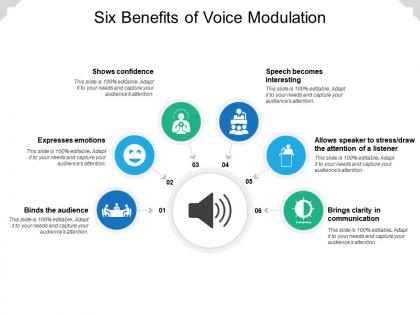
Six benefits of voice modulation




Try Before you Buy Download Free Sample Product
 Impress Your
 Audience
 100%
100% Editable
 Save Hours
 of Time


Folks are grateful for your helpful hints due to our Six Benefits Of Voice Modulation. Be able to give them a good hunch.
People who downloaded this PowerPoint presentation also viewed the following :
Six benefits of voice modulation with all 5 slides:
Our Six Benefits Of Voice Modulation are an instant inspiration. Folks feel activated at the first glance.

FAQs for Six benefits
So there's four main things: pace, pitch, volume, and pauses. Speed up or slow down depending on what you're saying. Change your tone to show emotion - like going higher when you're excited. Volume's obvious but people forget to use it for drama. Pauses though? Game changer. Seriously, they make people actually listen to your important stuff. I used to just talk at the same speed and tone the whole time - terrible mistake. Your audience will zone out immediately. Try reading something out loud and mess around with all these elements. You'll be shocked how much better it sounds.
Dude, voice modulation is a game changer for keeping people awake during your talk. Mix up your pitch and pace - think of it like being a tour guide but for ears. Monotone = instant snooze fest, trust me. I learned this the hard way at my last presentation. Pause for drama, get louder on important stuff, raise your voice when asking questions. Your brain naturally follows these vocal cues, so use that. Oh and definitely record yourself practicing. You'll cringe at first but you'll catch where you sound robotic.
So I actually do this thing where I record myself reading random stuff - news, stories, whatever - and then listen back. Warning: you'll probably hate how you sound at first lol. But you can spot where you go monotone. Try humming scales daily, it's weirdly helpful for pitch control. The "rainbow technique" is cool too - say the same sentence with different emotions to build that muscle memory. Oh and breathing exercises! Your breath totally controls your vocal range. Instead of just getting louder, change your pace or pitch to emphasize words. Makes a huge difference.
Your pitch is like emotional punctuation - it tells people how to feel about what you're saying. Go higher and you'll create excitement or urgency. Drop it low? That's how you sound serious and authoritative. Remember those monotone teachers who put everyone to sleep? Yeah, don't be that person. You can build suspense, hit key points harder, or create those intimate moments where everyone's really listening. Here's the thing though - you gotta be intentional about it. Mark up your presentation beforehand. Decide where you want to go high or low for maximum impact.
Dude, pacing is everything when you're speaking! Slow way down for your big points - gives people time to actually get it. Then speed up through the lighter stuff so you don't lose their attention. I used to talk crazy fast through presentations until someone told me they couldn't follow anything I said, which was... embarrassing. Mix it up though - if you stay the same speed the whole time, people zone out just like with monotone voices. Oh, and practice reading stuff out loud where you deliberately change your tempo every few sentences. Trust me, it feels weird at first but makes such a difference.
Honestly, it's all about reading the room and matching their vibe. With younger crowds, you can talk faster and be more conversational - they're used to that energy. But in professional settings? Slow it down, articulate clearly, give them that polished boardroom feel. Older audiences usually prefer a slightly lower pitch and more deliberate pacing. Oh, and cultural background plays a huge role too - some cultures expect high energy while others find it off-putting. I always watch how people naturally speak first, then mirror their energy level. Works way better than just winging it.
Honestly, most people either go way overboard or stay completely flat. Like, you don't need to channel your inner theater kid for a work presentation - that's just weird. But monotone is equally bad. I've noticed people tend to speed up when they're nervous, which kills any natural rhythm. Try recording yourself first (trust me on this one). Mix up your pace, throw in some pauses. Oh, and match how you sound to what you're actually talking about. Nothing worse than delivering bad news in a cheerful voice!
Dude, pauses are seriously underrated! Most people freak out about silence, but honestly it's like magic for your delivery. Drop a 2-3 second pause right after something important - people will actually lean forward. I learned this the hard way in presentations lol. You can use them instead of saying "um" constantly, plus it gives your audience time to actually process what you said. They're perfect for separating big ideas too. The rhythm thing is huge - it keeps people engaged instead of zoning out. Trust me, try it once and you'll see the difference immediately.
Volume changes everything about how people see you as a speaker. Like, seriously - when you stay monotone the whole time, everyone just checks out mentally. Your brain treats constant volume as background noise. But mix it up? Drop your voice low for the really important stuff, then speak up for your main points. That contrast thing actually boosts memory retention by around 40%, which is pretty wild. I always tell people to record themselves practicing because you don't realize how flat you sound until you hear it back. Trust me on this one.
Oh man, voice modulation is a game changer! You basically become this whole one-person show. Switch up your pitch and pace for different characters - like go higher for kids, deeper for villains, whatever feels right. Speed things up during action scenes, then slow way down for the dramatic parts. I always whisper during scary or intimate moments because it pulls people in. Even tiny changes in tone make such a difference. Practice giving each character their own voice first. Trust me, your audience will be way more hooked when you're not just reading in monotone the whole time.
Honestly, scales and lip trills are game-changers - do them daily and your range will expand without killing your voice. Tongue twisters help too! I've been doing "red leather, yellow leather" nonstop lately (kinda obsessed lol). Oh, and try reading the same paragraph as different characters - news anchor voice, then storyteller, then super excited person. Your voice is basically a muscle that needs working out. Even 10 minutes daily makes a huge difference. You'll notice way more flexibility in like two weeks, I swear.
Your voice hits so differently depending on who's listening. Americans love when you're animated and loud - shows you care. But try that in Japan or Korea? You'll seem rude or out of control. Pitch matters too. That friendly upward thing at the end of sentences? Some cultures think it makes you sound unsure. I learned this the hard way during a work call once. The same confident tone that works in New York can totally backfire in other places. If you're presenting to different cultures, definitely look up their vocal expectations first. It's wild how much context changes everything.
Dude, there's actually some solid options for this! Apps like Orai or Speeko are pretty decent for tracking your pitch and pace while you practice. If you're presenting virtually, Zoom's got those little audio bars that'll show if you're too loud or quiet. Wireless mics sometimes have monitoring built in too, which is clutch. Honestly though? Don't sleep on just using your phone's voice memo app - I was surprised how much I picked up on when I listened back to myself later. Oh, and if you use teleprompter apps, a bunch of those have voice feedback features now. Start simple with recording yourself first.
Okay so here's what I've noticed - when you slow down just a little and drop your pitch slightly, people actually listen more. Volume matters too, but consistency is the real game changer. You know how news anchors have that measured way of talking? That's what you're going for, minus the robot voice obviously. Record yourself speaking normally first, then try it with these tweaks. The difference is pretty wild. Don't overthink it though. Just be more intentional about how you're delivering what you say and you'll sound way more credible.
Virtual presentations are brutal because everything gets flattened through the tech. Your voice loses so much nuance - what feels like big emphasis to you sounds totally flat to them. And let's be real, half your audience is multitasking anyway. You've gotta overdo the pitch changes and slow way down, even if it feels weird. Longer pauses too since video calls mess with timing. Oh, and definitely test your actual mic setup first - I learned this the hard way when I sounded like I was talking through a tin can.
No Reviews