

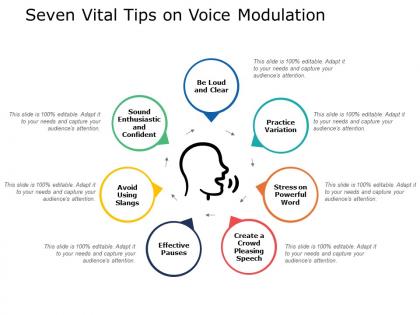
Seven vital tips on voice modulation




Try Before you Buy Download Free Sample Product
 Impress Your
 Audience
 100%
100% Editable
 Save Hours
 of Time


Counsel the demoralized with our Seven Vital Tips On Voice Modulation. Convince them that better days are around the corner.
People who downloaded this PowerPoint presentation also viewed the following :
Seven vital tips on voice modulation with all 5 slides:
Convince folks that better days are around the corner with our Seven Vital Tips On Voice Modulation. Be able to counsel the demoralized.


FAQs for Seven vital tips
So there's four main things: pitch, pace, volume, and pauses. Don't be that person who talks in monotone - we've all sat through those painful presentations! Your voice should go up and down naturally to hit your key points. Slow down when something's really important, then pick up speed for the easier stuff. Throw in some volume changes to wake people up. And honestly? The pauses are underrated - they give people a second to actually process what you said. Just don't make it feel like you're performing Shakespeare or whatever. Record yourself practicing first though - you'll probably sound way flatter than you think.
Honestly, voice modulation saved my last presentation from being a total snoozefest. People zone out SO fast when you talk in monotone - I used to be terrible at this. Now I slow way down for the big points, get louder when I'm excited about something, sometimes even whisper for drama (sounds cheesy but it works). Your brain basically gives the audience little nudges to pay attention. Record yourself practicing and you'll hear exactly where you sound flat. Those dead spots? That's where you add the vocal variety. Makes such a difference.
Your pitch is honestly what makes or breaks how people listen to you. Practice humming scales or just read stuff out loud while messing with your tone on purpose. Higher pitch shows excitement, lower sounds more authoritative - but don't go full Batman voice lol. I used to be super monotone until I started recording myself reading random articles. You'll notice where your voice naturally goes up and down. Then just exaggerate those spots way more than feels normal. It'll sound weird at first but becomes second nature pretty quick.
Dude, your voice is literally everything when you're presenting. Like, nobody wants to listen to someone who sounds like they're reading a grocery list, you know? Mix up your pitch and speed - whisper something important, get excited about the cool stuff. I swear people zone out the second you go monotone. Actually, try recording yourself talking about something you genuinely care about. You'll notice your voice gets way more animated naturally. Use those same vocal patterns when you present. The emotions in your voice hit harder than your actual words most of the time.
Oh this is such a game changer! Drop your voice super low for serious parts - people literally lean in to hear you better. Then get louder for your big points. My favorite trick? Pause dramatically, then go quiet. Gets them every time lol. You can also slowly build volume to create excitement (works great for stories). Just don't do what I used to do and get loud when nervous - be purposeful about it. Mark up your notes ahead of time with little volume reminders so you don't forget!
Honestly, pace can make or break your whole presentation. Talk too fast and people just can't keep up - their brains literally shut off. But go too slow? Everyone's checking their phones. I learned this the hard way lol. What works is mixing it up: drag out the important stuff so it really lands, then speed through the boring transitions. Oh, and definitely record yourself practicing because we're all terrible at noticing when we sound like robots. You'll probably cringe, but those awkward spots are exactly what need fixing.
Honestly, voice modulation is a game changer for making people actually remember what you said. Slow down and drop your pitch when you hit the important stuff - it makes people lean in. Volume changes work too (just don't yell lol). I used to race through presentations until someone told me about pausing. Game changer. Like, pause right before your big point and suddenly everyone's paying attention. You can also switch up your rhythm - if you've been steady the whole time, then BAM, change it up and people know something important's coming. Practice marking up a speech first.
Oh man, the worst thing you can do is talk in the same boring tone the whole time - instant snooze fest. I've seen people rush through their words when they're nervous too, which just makes everything harder to follow. What really gets me is when someone's talking about something exciting but sounds completely dead inside. Like, match your energy to what you're saying! Record yourself practicing - you'll catch the weird stuff you don't realize you're doing. Mix up your pitch, throw in some pauses. Your voice should actually help sell whatever you're talking about, not sabotage it.
Honestly, just start recording yourself reading stuff out loud - news articles are perfect because they've got different moods. Do some basic breathing exercises and vocal warm-ups too. I'm weird about this, but humming scales actually helps your range more than you'd think. Don't try to fix everything at once though. Pick one thing and stick with it for a while. Your voice is basically a muscle, so you need that daily consistency. Even 10-15 minutes helps. You'll hear the difference in a few weeks if you don't skip days.
Oh nice question! So there's a bunch of ways to tackle this. Audacity's probably your best starting point - it's free and you can actually see your pitch patterns which is kinda cool. Adobe Audition works too but costs money. For real-time stuff, try Orai or VoiceAnalyzer - they'll give you feedback while you're practicing. Honestly though? Your phone's voice memo thing works fine if you're just getting started. There's also Speeko which has AI analysis of how you sound. I'd mess around with recording yourself in Audacity first - you'll be surprised what patterns you notice once you can actually see them visually.
Dude, voice stuff varies SO much by culture. Western audiences love when you get animated - change your pitch, get louder for emphasis. But try that in Japan or Korea? You'll sound aggressive as hell. I bombed a presentation once doing exactly that. Latin American crowds are usually cool with passionate delivery, whereas Scandinavians prefer you keep it chill. Honestly, your best move is asking someone local beforehand. They'll tell you if steady and measured works better than dramatic and punchy for your specific audience.
Okay so vocal scales are honestly your best friend - just do the whole "do re mi" thing daily, even though it feels dorky at first. I'd also try reading stuff out loud with crazy exaggerated emotions. There's this "siren" exercise where you glide from low to high pitch smoothly - super helpful. Don't skip breathing work either, diaphragmatic breathing makes a huge difference. Oh, and record yourself saying the same paragraph with different emotions so you can actually hear what changes. Start with 10 minutes a day. You'll be surprised how fast you improve!
When speakers want to sound authoritative, they drop their voice lower and slow way down on the important stuff. Creates this whole gravitas thing. Don't just get louder though - that comes off pretty desperate honestly. Mix up your volume instead. Oh and monotone = instant credibility killer. The really good speakers will pause right before they say something big, builds up the tension. Match your energy to what you're actually talking about too. Record yourself sometime - you'll probably notice your voice gets all high and rushed when you're nervous. Dead giveaway.
You know how lawyers always sound so serious in court? There's actually a reason for that. When you're delivering really heavy stuff - bad news, medical results, legal testimony - you want to dial back the vocal variety. Too much up-and-down in your voice makes people think you're less credible. Crisis situations too. I learned this the hard way during a work presentation once. The monotone thing feels super unnatural at first, but it genuinely makes you sound more authoritative. Save the dramatic vocal range for when you're telling stories, not when someone's job is on the line.
Honestly, just match your vibe to whoever you're talking to. Kids need that animated, slower delivery - they eat that stuff up. Executives? Keep it steady and authoritative. I used to overthink this so much lol. Room size matters too - speak louder in big halls, softer in small meetings. Corporate presentations need measured pacing, but team meetings can be way more conversational and fast. The trick is reading the room's energy. Don't try changing everything at once though. Pick one thing - like pace or volume - and practice that until it feels natural.
No Reviews