


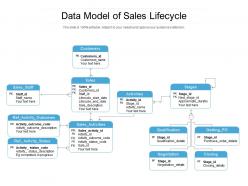
Data model of sales lifecycle





Try Before you Buy Download Free Sample Product
 Impress Your
 Audience
 100%
100% Editable
 Save Hours
 of Time


Time to bring your presentations to the next level. Data Model Of Sales Lifecycle are on hand to upgrade your presentations.
People who downloaded this PowerPoint presentation also viewed the following :
Data model of sales lifecycle with all 2 slides:
Time to get into the boardroom. Data Model Of Sales Lifecycle offer a last moment way to make your presentation look like you've been up all night.
FAQs for Data model
The key sales lifecycle stages include lead generation, qualification, needs assessment, proposal development, negotiation, closing, and post-sale relationship management. These stages interconnect through continuous data flow and feedback loops, with insights from closing and customer success informing lead qualification criteria, while needs assessment directly shapes proposal development, ultimately creating a seamless pipeline that enhances conversion rates and customer retention.
A sales lifecycle data model enhances forecasting accuracy by tracking customer progression through defined stages, analyzing historical conversion patterns, and identifying bottlenecks that impact deal velocity. Through predictive analytics and stage-specific metrics, sales teams can better predict pipeline outcomes, optimize resource allocation, and adjust strategies proactively, ultimately delivering more reliable revenue forecasts and improved quota attainment.
CRM software centralizes sales lifecycle tracking by capturing lead generation, opportunity progression, conversion rates, sales velocity, and customer retention metrics across all pipeline stages. Through automated data collection and real-time analytics, sales teams can identify bottlenecks, optimize deal flow, and accelerate closing times, with many organizations finding that integrated CRM systems ultimately deliver improved forecasting accuracy and enhanced sales performance.
Businesses identify sales lifecycle bottlenecks through conversion rate analysis, pipeline velocity tracking, stage duration monitoring, and predictive analytics that reveal where prospects stall or drop off. Through CRM data analysis and automated reporting, organizations can pinpoint inefficiencies like lengthy approval processes or inadequate lead qualification, ultimately streamlining operations and accelerating revenue generation.
Essential metrics include lead conversion rates, pipeline velocity, win rates, average deal size, customer acquisition cost, and sales cycle length. These metrics enable organizations to identify bottlenecks, optimize resource allocation, and enhance forecasting accuracy, with many sales teams finding that tracking stage-specific performance ultimately delivers improved revenue predictability and competitive advantage.
Data visualization improves sales lifecycle understanding by transforming complex pipeline data into clear dashboards, charts, and interactive reports that reveal bottlenecks, conversion patterns, and performance trends. Through visual analytics, sales teams can quickly identify where prospects stagnate, optimize resource allocation, and accelerate deal progression, ultimately enhancing forecasting accuracy and strategic decision-making across the entire sales process.
Key factors include data integration capabilities, scalability requirements, real-time processing needs, customer touchpoint mapping, and compliance frameworks. These considerations enable organizations to streamline lead management, enhance forecasting accuracy, and optimize conversion rates, with many sales teams finding that strategic data modeling ultimately delivers improved pipeline visibility and accelerated deal closure across complex sales cycles.
A/B testing integrates into the sales lifecycle through email campaign variations, proposal format testing, pricing strategy experiments, follow-up timing optimization, and sales script comparisons across different customer segments. Through systematic testing at each lifecycle stage, sales teams can identify higher-converting approaches, optimize resource allocation, and enhance customer engagement rates, ultimately delivering improved conversion rates and shorter sales cycles.
Organizations should avoid data silos, inconsistent data definitions across departments, inadequate data governance, poor integration between CRM and analytics platforms, and neglecting user training. These pitfalls can lead to fragmented insights, inaccurate forecasting, and reduced adoption rates, with many companies finding that comprehensive change management and cross-functional collaboration are essential for successful implementation.
Buyer behavior significantly influences sales lifecycle progression by determining stage duration, conversion rates, and decision-making patterns, with behaviors like information-seeking extending awareness phases while price sensitivity accelerates negotiation stages. This can be modeled through behavioral analytics platforms that track engagement metrics, decision triggers, and purchasing patterns, enabling sales teams to customize approaches, predict stage transitions, and ultimately optimize conversion rates across different buyer personas and market segments.
Historical sales data patterns reveal customer behavior trends, seasonal fluctuations, conversion bottlenecks, optimal touchpoint timing, and revenue cycle predictability across different segments. These insights enable organizations to forecast more accurately, optimize resource allocation, and identify high-value prospects earlier, with many companies finding that predictive analytics ultimately streamline sales processes and enhance competitive positioning.
A sales lifecycle data model adapts across industries by modifying stage definitions, metrics, and touchpoint requirements to reflect sector-specific buyer behaviors, regulatory compliance needs, and decision-making processes. For instance, B2B manufacturing emphasizes lengthy evaluation phases with technical specifications, while retail focuses on rapid conversion metrics, ultimately enabling organizations to optimize pipeline management and forecast accuracy within their unique market dynamics.
Lead scoring prioritizes prospects by assigning numerical values based on demographics, behavior, and engagement levels, enabling sales teams to focus efforts on high-conversion opportunities. Through predictive modeling and automated scoring algorithms, organizations streamline resource allocation, accelerate qualification processes, and improve conversion rates, with many finding that systematic lead scoring delivers significantly higher ROI and shorter sales cycles.
Machine learning algorithms enhance sales lifecycle data models by analyzing historical patterns, identifying customer behavior trends, and predicting conversion probabilities at each stage. These algorithms streamline forecasting accuracy, automate lead scoring processes, and optimize resource allocation strategies, with many organizations finding that predictive insights ultimately deliver faster sales cycles and improved revenue outcomes.
Cross-department collaboration enhances the sales lifecycle data model by integrating diverse perspectives from marketing, customer service, finance, and operations teams, ensuring comprehensive data capture and accurate customer journey mapping. This strategic combination enables organizations to identify bottlenecks, streamline handoffs, and optimize conversion rates, with many companies finding that collaborative refinement ultimately delivers improved forecasting accuracy and enhanced customer experiences.
No Reviews