


Six months key stages and milestones agile transformation timeline




Try Before you Buy Download Free Sample Product
 Impress Your
 Audience
 100%
100% Editable
 Save Hours
 of Time


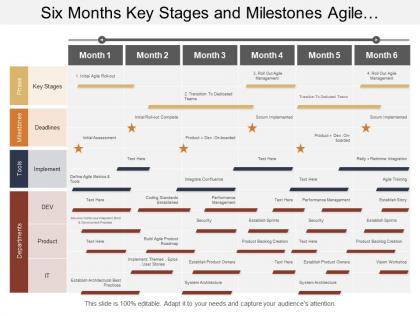
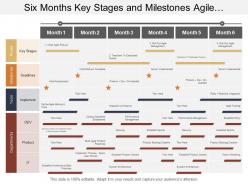
Speak to your business culture and nature change process with our predesigned six months key stages and milestones agile transformation timeline PowerPoint slide layout. Utilizing this editable agile organization change timeline PPT template design, you can undoubtedly exhibit the way your business reacts to changing necessities and solicitations of clients, changes to advancements, risks, and business improvement. This business agile transformation timeline presentation template represents three months change process. Our designs specialists have utilized the illustrations of the timeline that will assist you to explain the idea in an ideal way to the customers and the executives. Utilize this six-months achievement timeline PPT template to showcase different aspects of agile transformation which are departments, instruments, achievements, phases, key stages, deadlines, implement, dev, product, and IT. Alter the look and feel of the slide to delineate the concept of different vital subjects, for example, change management, business development, agile scrum development, business transformation, CM, agile service, agile organization model, agile transformation phases, and more. Impact your colleague and the executives with our ready to utilize six months key stages and milestones agile transformation timeline presentation slide layout. Our Six Months Key Stages And Milestones Agile Transformation Timeline allow for impressive inputs. It helps deliver a huge amount of information.
People who downloaded this PowerPoint presentation also viewed the following :
Six months key stages and milestones agile transformation timeline with all 5 slides:
Use our Six Months Key Stages And Milestones Agile Transformation Timeline to effectively help you save your valuable time. They are readymade to fit into any presentation structure.


FAQs for Six months key stages and milestones
Figure out which specific teams you're actually going to transform first - seriously, don't try to change everything at once. Pick your pilot groups and nail down the exact processes you want to fix. What does "winning" look like for you guys? Faster shipping? Better code quality? Happier devs? This whole scoping thing is honestly make-or-break time. I've seen so many companies skip this step and then wonder why everything's a disaster six months later. Get super clear on your boundaries and goals before you start shuffling people around or messing with workflows.
Don't bore them with methodology talks - they'll zone out immediately. Connect agile to problems they're already losing sleep over: missed deadlines, angry customers, burnt-out teams. Show them data that actually matters to their world: revenue numbers, customer satisfaction, how engaged their people are. I've found that real examples work way better than theory - find companies like theirs that saw actual results. Make it about fixing their headaches, not following some trendy playbook. Oh, and start small with pilot projects. Quick wins will sell the whole thing better than any PowerPoint deck ever could.
Track your team velocity, lead time, and cycle time first - those show if you're actually delivering faster. Quality stuff matters too like defect rates and customer happiness scores. The culture piece is honestly the hardest part to measure. Look at engagement surveys, how much teams collaborate across departments, whether they're making decisions without managers breathing down their necks. Retrospective action items are weirdly telling - if teams complete what they commit to, they're probably buying into the whole continuous improvement thing. Get your baselines early, check monthly, but don't freak out over temporary drops.
Start with surveys and interviews to see how people actually feel about change and working together. Focus groups are gold - different teams, different levels. Trust me, you'll hear stuff that'll blow your mind about what's really going down. Check out how teams talk to each other now, deal with problems, share info. Do people feel safe enough to speak up or try new things? That's huge. Find what's already working well (build on those wins) plus spot the roadblocks that'll fight against agile. Oh, and document it all so you can see if you're making progress later.
Yeah, so basically your project managers usually turn into Scrum Masters or Product Owners. Team leads? They stop being the ones who just assign tasks and become more like servant leaders - removing roadblocks and stuff. Middle management gets totally screwed over though, since that whole command-and-control thing just doesn't fly anymore. Developers need to think cross-functionally instead of staying in their little silos. QA becomes everyone's problem, not just one person's headache. I'd start by comparing your current org chart to agile roles - wherever you see the biggest gaps, that's where people will struggle most during the switch.
Honestly, most companies rush it and expect magic to happen in like 6 months - but you're looking at 18-24 months minimum. Leadership has to actually be on board, not just say they are. I've seen so many teams do this "agile theater" thing where they go through the motions without getting the real principles. Middle managers will push back hard because they think you're threatening their jobs. Don't try transforming your whole company at once either. Pick one team, nail it, then expand from there. Oh and budget for serious coaching - you can't just wing this stuff.
Honestly, you need to bake feedback into every step, not just wait till the end. Monthly team check-ins are clutch - plus anonymous surveys since people won't always speak up in meetings. Sprint retros work well too. Here's the thing though: actually USE what you hear to tweak your timeline. I've watched so many transformations crash because leadership completely ignored what was happening on the floor. Make it routine, not some one-off thing. Oh, and start collecting input before your next big milestone hits - you'll thank me later.
Start with SAFe or Scrum@Scale for the framework side. Then grab Jira, Azure DevOps, or Linear for tracking stuff. But honestly? I've watched teams crush it with just sticky notes on a wall. The tools aren't everything people make them out to be. What really matters is getting solid coaching - either internal people who get it or bringing in outside consultants. Training helps too - Scrum Alliance and Mountain Goat Software have decent cert programs. Oh, and don't fall into the trap of switching tools every few months. Pick like 2-3 max and actually learn them properly.
Honestly? You're looking at 18-24 months for it to really take hold. I know some companies think they can knock it out in 6 months - total wishful thinking. The first few months you'll see some changes, sure, but getting everyone actually comfortable with the whole agile mindset? That's the hard part. Really depends on how big your company is and whether leadership is genuinely on board or just going through the motions. Oh, and how much people hate change in general lol. I'd budget at least 18 months and try to celebrate the small stuff so people don't get discouraged.
Honestly, you're gonna need a combo approach here. Get everyone trained on basic agile principles first - that's your foundation. Then do the role-specific stuff: Scrum Master certs, Product Owner workshops, TDD training for your devs. The collaboration and facilitation training is actually super critical (way more than people think). Pluralsight or Coursera are solid for self-paced learning, but definitely bring in external coaches for those first workshops. Oh, and create spaces where people can mess up safely - experimentation is key. Start with one pilot team, learn from their mistakes, then roll it out to others.
Honestly, start with small cross-functional pilot projects right away - that's where the magic happens. Get people from different departments actually working together instead of just talking about it. Regular "show and tell" sessions help too, where teams can demo what they're building to each other. Oh, and you absolutely need executives from each area backing this thing, otherwise people just slip back into their old habits (which, let's be real, is way easier). The trick is setting up shared metrics that actually force collaboration - like customer satisfaction scores where multiple teams have to work together to win. Skip the endless meetings though. Nobody needs more of those.
Honestly, you've gotta celebrate the small wins or people will check out. Break everything down into 3-6 month chunks so teams actually see progress happening. I can't tell you how many times I've watched transformations completely crash because leadership forgot to acknowledge victories along the way - it's brutal to watch. Keep sharing those success stories and maybe rotate people between your best teams and the ones struggling. Oh, and don't get stubborn if something's not working. Pause, pivot, whatever. Most crucial thing though? Keep reminding everyone why you're doing this in the first place.
Dude, leadership style will totally make or break your agile transformation. Executives who keep micromanaging while preaching agile? That's a disaster waiting to happen - I've watched it crash and burn so many times. Your teams can't self-organize if you're breathing down their necks constantly. Coach instead of commanding. Remove roadblocks rather than creating new ones. Trust people to actually solve problems without you hovering over every decision. Servant leadership works best here - basically flipping your role from "tell everyone what to do" to "help everyone succeed." Honestly though, start by looking at your own habits first because that's the hardest part.
Yeah, ING Bank is probably the best example - they ditched traditional departments for small cross-functional squads and their time-to-market got way better. Everyone talks about Spotify's model too, though they've actually changed a lot from their original setup. Microsoft really turned things around under Satya Nadella. Their whole engineering culture shifted and you can see how it helped with their cloud success. Amazon's basically been doing this forever with their two-pizza teams (which honestly makes sense for them). But here's the thing - don't just copy the processes. The culture change is what actually matters for these transformations to work.
Honestly, start with whatever's driving you crazy right now. If communication sucks, grab Slack or Teams. Sprint tracking a mess? Jira or Azure DevOps will save your sanity. CI/CD pipelines are where the magic happens though - automate testing and deployments, and suddenly you're shipping way faster. Miro's clutch for remote retros (way better than trying to use sticky notes on camera, ugh). Real-time dashboards give you actual visibility into what's happening. Oh, and automate the boring stuff wherever you can. Just pick one thing first - don't try to overhaul everything at once or you'll hate yourself.
-
Content of slide is easy to understand and edit.
-
Great product with effective design. Helped a lot in our corporate presentations. Easy to edit and stunning visuals.
-
Informative presentations that are easily editable.
-
Excellent products for quick understanding.
-
Very unique, user-friendly presentation interface.
-
Commendable slides with attractive designs. Extremely pleased with the fact that they are easy to modify. Great work!