


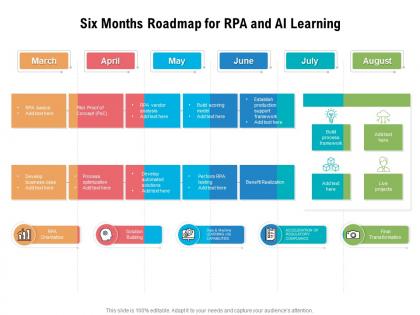
Six months roadmap for rpa and ai learning




Try Before you Buy Download Free Sample Product
 Impress Your
 Audience
 100%
100% Editable
 Save Hours
 of Time


A well thought out action plan makes execution easier and increases the possibility of success significantly. Ensure hitting all the milestones within the deadlines by introducing our fully customizable Six Months Roadmap For RPA And AI Learning. Streamline the work related information, budget, timeframe, key deliverable, landmarks, and major steps involved, all in one place to give an organized overview of the project by utilizing our PowerPoint theme. Minimize time lag and increase work efficiency by providing insight into the process with our comprehensively researched roadmap PowerPoint layout. Color coding helps in highlighting the process and grabs the attention of the audience. Download our handy Six Months Roadmap For RPA And AI Learning to identify the possible problem areas in a much shorter time and propose solutions. Have a productive brainstorming session with your workforce by utilizing our action plan visualization tool.
People who downloaded this PowerPoint presentation also viewed the following :
Six months roadmap for rpa and ai learning with all 2 slides:
Use our Six Months Roadmap For RPA And AI Learning to effectively help you save your valuable time. They are readymade to fit into any presentation structure.
FAQs for Six months roadmap for rpa
RPA automates rule-based, repetitive tasks through software robots, while AI mimics human intelligence for decision-making, pattern recognition, and learning from data. These technologies complement each other strategically, with RPA handling structured processes like data entry and invoice processing, while AI enhances these automations through intelligent decision-making, ultimately delivering faster operations and improved accuracy.
Essential skills include programming languages like Python and R, data analysis and visualization, machine learning fundamentals, process mapping, and business analysis capabilities. These competencies enable professionals to design intelligent automation solutions, interpret complex datasets, and bridge technical implementation with business requirements, with many organizations finding that professionals combining technical expertise with domain knowledge deliver the most impactful results.
Organizations can identify automation-ready processes by evaluating rule-based, repetitive tasks with high transaction volumes, clear decision criteria, and standardized inputs across departments like finance, HR, and customer service. These processes should present minimal exceptions, involve structured data, and consume significant manual effort, with many companies finding that automating invoice processing, data entry, and report generation delivers immediate efficiency gains while freeing employees for strategic work.
Machine learning enhances RPA processes by enabling intelligent decision-making, predictive analytics, pattern recognition, and adaptive automation capabilities. Through ML algorithms, organizations can automate complex workflows involving unstructured data processing, exception handling, and continuous process optimization, while banks and healthcare institutions find that cognitive automation delivers faster processing times and improved accuracy.
RPA and AI integration improves operational efficiency by automating complex decision-making processes, reducing manual errors, and accelerating task completion across multiple business functions. Through intelligent automation, organizations streamline workflows, enhance data processing accuracy, and minimize resource allocation costs, with many financial services and healthcare institutions finding that this strategic combination ultimately delivers faster customer service and significant competitive advantage.
RPA implementation best practices include starting with rule-based, high-volume processes, conducting thorough process mapping, ensuring stakeholder buy-in, and establishing proper governance frameworks. Organizations should begin with pilot projects in departments like finance or HR, scale gradually while maintaining robust security protocols, and continuously monitor bot performance, with many companies finding that proper change management and employee training ultimately deliver sustainable automation benefits and organizational efficiency.
Common RPA adoption challenges include process complexity, employee resistance, inadequate infrastructure, skills gaps, and change management difficulties. These obstacles can be mitigated through comprehensive training programs, stakeholder engagement initiatives, phased implementation approaches, and strategic partnerships with technology vendors, with many organizations finding that proactive planning and cross-functional collaboration ultimately deliver smoother transitions and sustainable automation success.
Businesses can measure RPA ROI through cost savings from reduced manual labor, decreased processing times, improved accuracy rates, and enhanced compliance metrics. Financial institutions and healthcare organizations typically track metrics like transaction processing costs, error reduction percentages, and employee productivity gains, with many finding that comprehensive measurement frameworks deliver clearer strategic insights and justify further automation investments.
Future trends in RPA and AI include hyperautomation, intelligent document processing, conversational AI, process mining, and low-code automation platforms. These technologies revolutionize business operations by enabling end-to-end process automation, reducing manual intervention, and delivering predictive insights, with many organizations finding that strategic combination of RPA and AI ultimately creates competitive advantage through faster decision-making and enhanced operational efficiency.
Individuals can stay updated with RPA and AI advancements through continuous learning platforms, industry certifications, professional communities, vendor documentation, and specialized publications. These resources enable professionals to track emerging technologies, best practices, and implementation strategies, with many organizations finding that employees who actively engage with multiple learning channels deliver more innovative automation solutions and maintain competitive advantage in an increasingly digital workplace.
Leading RPA and AI learning platforms include Coursera, edX, Udacity, UiPath Academy, Automation Anywhere University, and specialized providers like Pluralsight and LinkedIn Learning. These platforms deliver comprehensive curricula through hands-on projects, industry certifications, and expert-led instruction, with many professionals finding that combining vendor-specific training with broad AI fundamentals creates the most strategic foundation for career advancement.
Healthcare, financial services, manufacturing, retail, and telecommunications are expected to see the highest RPA and AI adoption growth in coming years. These industries leverage automation to streamline patient care workflows, accelerate loan processing, optimize supply chains, enhance customer experiences, and improve network management, with many organizations finding that strategic implementation delivers significant cost reduction and competitive advantage.
Ethical considerations significantly influence AI-RPA development through responsible data governance, algorithmic transparency, bias mitigation protocols, and compliance frameworks that ensure fair decision-making processes. These principles guide organizations in creating accountable automation systems, with many financial services and healthcare institutions finding that ethical AI frameworks ultimately enhance customer trust, regulatory compliance, and sustainable competitive advantage.
Successful RPA and AI integrations include JPMorgan's COIN for contract analysis, Bank of America's Erica chatbot for customer service, UPS's ORION for route optimization, and Walmart's inventory management automation. These strategic combinations streamline operations by reducing processing time, enhancing customer experiences, and minimizing operational costs, with many organizations finding that integrated approaches deliver significantly faster services and competitive advantages.
Cross-functional collaboration enhances RPA and AI learning initiatives by combining diverse expertise, accelerating knowledge transfer, and identifying practical automation opportunities across departments. Teams from IT, operations, finance, and HR can share real-world use cases, troubleshoot implementation challenges together, and develop comprehensive solutions that address multiple business processes simultaneously, ultimately delivering faster adoption and broader organizational transformation.
No Reviews