


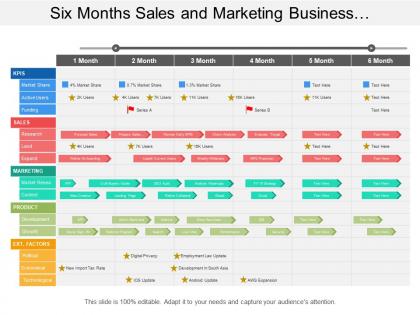
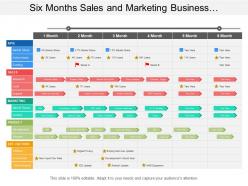
Six months sales and marketing business development timeline





Try Before you Buy Download Free Sample Product
 Impress Your
 Audience
 100%
100% Editable
 Save Hours
 of Time


We are proud to represent our business oriented six months sales and marketing business development timeline PPT template. This professionally designed business development roadmap PPT template has been crafted by experts to fulfill your business needs. The design template is highly useful as it provides a clear overview of business development strategies for the six months that will be helpful in achieving your business goals. The PPT template can be used by business managers, sales and marketing professionals, top management in sales and marketing presentations. This sales plan template can be used to display strategies and tactics for sales, key metrics such as revenue, budget in most comprehensive way. This powerful business proposal PowerPoint template has been designed specifically for six months sales, marketing, and business development, still you can customize the design according to your business needs, resources and goals. So, just download this wonderful business development roadmap PPT template and show your business plan for product in front of team members, seniors in most effective manner. Address irate feelings with our Six Months Sales And Marketing Business Development Timeline. Decrease the degree of anger around.
People who downloaded this PowerPoint presentation also viewed the following :
Six months sales and marketing business development timeline with all 5 slides:
Be complimented for your choice with our Six Months Sales And Marketing Business Development Timeline. You will believe in your gut feelings.
FAQs for Six months sales and marketing
So here's the deal - start with research and planning to figure out your target market. Takes way longer than you'd think but whatever, it's necessary. Next comes lead generation through content and campaigns. Then nurture those prospects with targeted messaging. After that, close the deals through your sales process. Don't forget retention and upselling afterward - that's where the real money is honestly. B2B cycles usually run 3-18 months while B2C moves much faster. Track your metrics at each stage so you can tweak things. The whole buyer's journey mapping thing sounds boring but it actually helps a ton.
Get everyone in a room with a whiteboard and map out the whole customer journey together. Define exactly when marketing hands off leads to sales - no more guessing games. Both teams need to track the same metrics so you're not working toward different goals. Yeah, you'll need weekly meetings (ugh, I know), but they actually help. Your content calendar has to match what sales needs - no point pushing intro content when they're trying to close deals with case studies. Honestly, shared accountability is what makes it work. When both teams sink or swim together, the politics disappear pretty fast.
Honestly, customer feedback is like a mirror for your sales timing - it shows you what's actually happening vs what you think is happening. When people keep saying they need more evaluation time, stretch out your nurturing phase instead of pushing those sales deadlines. We totally bombed a campaign last year by rushing it! Monthly feedback reviews are clutch. Map them against your current timeline and you'll see exactly where things are falling apart. Some touchpoints actually matter, others are just... there. The feedback tells you which is which pretty quickly.
Honestly, tech is a total game-changer for speeding up sales stuff. I'd start with a CRM to track leads automatically - saves me tons of time. Email automation handles nurturing prospects while you sleep, which is pretty sweet. Social media schedulers alone save me like 5 hours weekly (I was manually posting like an idiot before). Analytics tools show you what's actually moving the needle vs. what's just busy work. AI can personalize content without you writing everything from scratch, plus it'll flag your hottest leads. Don't go crazy though - pick one tool that fixes your biggest headache first.
Okay so honestly, start with basic awareness stuff - website traffic, social media reach, you know the drill. Then move into engagement metrics like email opens and download rates. I always think lead scoring gets way more complicated than it needs to be, but conversion rates are solid gold. Sales velocity and close rates matter most at the end obviously. Pipeline value too if you're tracking bigger deals. Here's the thing though - don't go crazy with data. Pick maybe 3-4 metrics per stage that actually move the needle for your specific business. Otherwise you'll just drown in spreadsheets.
Honestly, most people mess up by being way too optimistic about timing. Like, they'll plan a campaign launch in two weeks when it really needs a month. Always add 20% buffer time - trust me on this one. Don't cram everything together either, marketing needs room to actually build momentum. Also check that you're not launching right when your sales team is drowning in quarter-end chaos. That's happened to us before and it was brutal. Track what's actually working vs what you thought would work. Regular check-ins save you from going completely off the rails.
Quarterly reviews are the bare minimum, but honestly? Monthly check-ins work way better when you're running big campaigns. Markets shift crazy fast - your January timeline can look totally ridiculous by March. Your team's bandwidth changes too, which nobody really accounts for upfront. I'd set up recurring calendar blocks and actually treat them seriously, not like those meetings everyone skips. Use that time to move deadlines around, shift resources, or completely change direction based on what's really happening vs what you thought would happen.
Honestly, make them super specific - like "500 qualified leads" not some vague "brand awareness" thing. Every 2-4 weeks works best for check-ins. We once waited 3 months and it was a disaster, had to fix everything last minute! Track both the quick stuff (email opens) and what actually matters (revenue). Each milestone should connect to your bigger quarterly picture. Oh, and assign someone to own each one - nobody wants that awkward "wait, who was supposed to handle this?" moment during reviews. Short bursts keep you nimble.
You gotta completely flip your strategy depending on when people actually want to buy your stuff. Before peak seasons hit, pump up your marketing spend and messaging. Then pull back hard during dead periods - no point burning cash when nobody's shopping. Winter coats in July? Yeah, that's not happening. The trick is planning these cycles months ahead. Your holiday campaign? Map that out by summer, trust me. Oh, and use those slow months for testing weird new ideas and stockpiling content for when chaos hits again.
HubSpot's probably your best bet if you want the full CRM package - that's what most sales teams I know swear by. Salesforce works too but it's kinda overkill unless you're huge. For simpler stuff, Asana and Monday.com handle project timelines really well. Honestly though? I've seen teams crush it with just Trello or Google Sheets when they're starting out. CoSchedule is solid specifically for marketing campaigns. The main thing is getting everyone to actually use whatever you pick - doesn't matter how fancy it is if half your team ignores it. Just make sure it plays nice with your current tools.
Okay so basically you want to match your content to where people are in your buying journey. Blog posts and social stuff work great for getting attention early on. Then hit them with case studies and demos when they're actually considering you. Product comparisons and testimonials close the deal at the end. The tricky part? Your sales team needs to be looped in on timing - I've seen so many companies just throw content out there randomly. Map it to how long your sales cycle actually takes. Track what's working too, because honestly half the content most companies make doesn't move anyone closer to buying. It's all about connecting the dots between what you're creating and how people actually behave when they're shopping around.
Honestly, it depends on your industry's sales cycle more than anything else. B2B software? You're looking at 6-12 months easy. E-commerce is totally different - maybe just weeks. Think about who you're selling to too. Individual buyers move fast, but corporate committees? Good luck getting past their first coffee meeting. Your budget matters obviously - more money means you can move faster. Oh, and don't forget seasonal stuff if that applies to your business. I'd start by googling what's normal for your industry, then adjust based on your team size and how complex your product actually is.
Honestly, you can test pretty much anywhere in your funnel. Ad copy and targeting are obvious starting points. Landing pages too - headlines, CTAs, all that stuff. Email subject lines though? That's where I've seen some crazy differences, like 40%+ improvement sometimes. Test your nurture sequences once people convert. Sales templates work well for this too. Oh and pricing pages if you have them. Just don't go nuts testing everything at once - stick to one thing per test or you'll never know what actually moved the needle. Run tests long enough to get real data, not just a few days. I'd start with whatever's your biggest bottleneck right now.
Lead scoring is a total lifesaver for figuring out who to call first. You give points for stuff like email clicks, demo requests, job titles, company size - whatever matters to your sales process. The cool part? Hot leads get fast-tracked while others stay in nurture mode longer. I'd set up different point thresholds that trigger specific workflows automatically. No more guessing if someone's ready or just browsing around your site for fun. It literally shows you who's most likely to buy so you're not wasting calls on tire-kickers.
Dude, you really can't skip the customer journey map - I learned this the hard way. Without it, you're just throwing sales pitches at random times and hoping something sticks. The map shows you exactly when people are actually ready to talk versus when they're still just browsing around. I used to think I could wing the timing, but honestly? You'll either bug people too early or miss your window completely. Map out how your customers currently move through your process first. Then you can actually build a timeline that makes sense instead of guessing.
-
Very unique and reliable designs.
-
Informative presentations that are easily editable.