


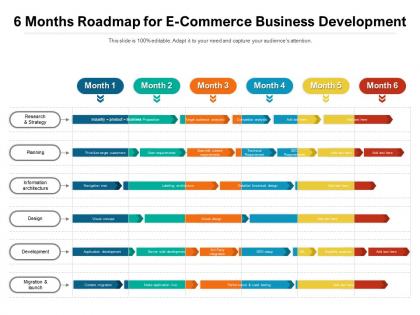
6 months roadmap for e commerce business development




Try Before you Buy Download Free Sample Product
 Impress Your
 Audience
 100%
100% Editable
 Save Hours
 of Time


The success rate of business plans is hugely dependent on the plan of action, and this editable 6 Months Roadmap For E Commerce Business Development rightly serves the purpose. Encapsulate all the information related to the project in a well structured manner to obtain maximum efficiency by incorporating our stunning PowerPoint theme. State the critical deliverable, steps involved, time frame, workforce allocation, and lots more in an easy to understand manner by utilizing this pre designed roadmap powerpoint templates. You can also prioritize your tasks and discuss the problem areas with your colleagues by incorporating this tailor made PPT layout. Empower your work plan by employing this professionally designed PPT theme. Entrepreneurs can download 6 Months Roadmap For E Commerce Business Development as a beneficial communication tool that facilitates in collaborating with different tasks and achieve targets.
People who downloaded this PowerPoint presentation also viewed the following :
6 months roadmap for e commerce business development with all 2 slides:
Use our 6 Months Roadmap For E Commerce Business Development to effectively help you save your valuable time. They are readymade to fit into any presentation structure.
FAQs for 6 months roadmap for e
Honestly, you need four main things for a decent e-commerce roadmap. First - map out how customers actually move through your site (trust me, it's never what you expect). Tech infrastructure comes next, then figure out which features to prioritize based on real pain points, not just what sounds cool. Set some solid KPIs too. I'd start by auditing your current setup and finding the biggest things blocking conversions. That's basically your roadmap right there. Focus on stuff that'll actually move the revenue needle - you can worry about the fancy features later.
Start with whatever customer data you already have - demographics, buying patterns, feedback stuff. Check out your competitors too and see who they're going after. Honestly, surveys and interviews are way underrated but they're pure gold for this. Social media insights help a lot, plus Google Analytics if you're already running something. The main thing is building actual buyer personas, not just saying "everyone" is your target (we've all been there lol). Get specific with it so you can build everything around what real customers actually want and need.
Your tech stack is literally what decides if your e-commerce plans can actually happen or not. Look at what you've got now - can it handle integrations? Will it scale when you blow up? Don't ignore stuff like AI and mobile either, that's where everything's heading. I've seen too many people get excited about roadmaps then realize their platform can't do half of it. Super frustrating. Match your timeline to what your dev team can realistically pull off, not just the business side wishlist. Trust me, rebuilding from scratch in a couple years because you chose wrong? Not fun.
Honestly, quarterly reviews are way better than those yearly plans that everyone ignores. I'd check in with customer data and surveys constantly - people's shopping habits change so fast now. Save like 20-30% of your roadmap for random stuff that pops up. My old team made this mistake where we stuck to some ancient plan while customers were already doing completely different things. Set up regular meetings where you can actually change direction based on real user behavior. Oh, and don't predict what'll happen six months out - you'll probably be wrong anyway.
Honestly, I'd focus on conversion rate and average order value first - those two will tell you if things are actually working. Customer acquisition cost is crucial too, otherwise you're just burning money. Cart abandonment drives me nuts but you gotta track it to fix checkout problems. Customer lifetime value shows whether people actually stick around or just buy once and ghost you. Also watch your traffic sources and returning customer percentage. I made the mistake of tracking like 15 metrics when I started - total chaos. Stick to maybe 5 or 6 max and check weekly. Those first two I mentioned though? If they're going up, you're golden.
Dude, you absolutely need to prioritize mobile optimization - like, it's not even a choice anymore. More than 60% of people shop on their phones now. Google ranks mobile-friendly sites higher too, so there's that. If your site sucks on mobile, you're literally pushing away most of your customers. The ones who stay? They'll probably be annoyed the whole time. Make sure it loads fast and the checkout doesn't make people want to throw their phone. Honestly, just try using your own site on mobile first - if it pisses you off, fix it.
Security first - get PCI compliance sorted and use tokenization for customer data. Don't even think about building payment processing yourself, it's honestly a mess. Stripe or PayPal APIs are your friends here. Your customers want options too - cards, Apple Pay, buy-now-pay-later stuff. Keep your checkout simple with good error messages. Test failed payments religiously because that's where things break. Oh, and set up a backup processor - I learned this the hard way when our main one crashed during a sale. You'll thank me later.
Honestly, start with Google Analytics or Mixpanel to track how people move through your site. You'll see exactly where they're bouncing and what's actually converting. A/B test literally everything - I know it sounds tedious, but even button colors make a difference. Cart abandonment rates are huge to watch, plus customer lifetime value and those seasonal patterns. Oh, and don't go crazy buying every analytics tool at once. Pick one, get good at reading the data, then add more. The conversion optimization stuff comes easier once you know what you're looking at.
Dude, the hardest part is picking what to build first when you've got no money but like a thousand ideas bouncing around. Do you focus on basic stuff that actually functions, or the cool features that'll set you apart? Can't do it all at once obviously. Making those MVP calls can literally make or break you. And here's the kicker - you're basically guessing what people want since you don't have real user data yet. Oh, and don't over-engineer v1 like I did lol. Keep it dead simple, get feedback from actual humans early, then iterate from there.
First thing - audit what you've actually got right now. Check your fulfillment speeds, inventory tracking, return handling, all that stuff. Most companies think their supply chain is way more connected than it really is (learned this the hard way at my last job). Match everything to what you're promising customers. If you're advertising 2-day shipping, your warehouses better deliver on that. Connect your inventory systems to your e-commerce platform so stock levels update in real time. Make sure suppliers can handle those crazy Black Friday spikes too. Oh, and get your supply chain people talking to your digital team regularly - they need to be on the same page.
Honestly, just nail three things: make it personal, stupid fast, and remove all the annoying bits. Pull their browsing data to suggest stuff they'd actually want. Your site needs to load instantly - I'm talking under 3 seconds or people bounce. Checkout should be like two clicks max. Most folks are on mobile now so that better work perfectly. Good chat support helps too, but really it's about cutting out everything between wanting something and buying it. Oh, and look at where people bail during checkout - that'll tell you exactly what's broken.
Honestly, don't treat social media like some add-on you'll figure out later. Build it right into your whole e-commerce plan from day one. Start with brand awareness, then get into user-generated content and influencer stuff to pull people to your site. Quick warning though - tracking conversions gets messy, so set up proper attribution early or you'll hate yourself later. Pick platforms where your people actually are instead of spreading yourself thin everywhere. Oh, and definitely plan for Instagram Shopping and TikTok's shopping features in your tech build. Map out your content calendar now and sync it with when you're launching products.
Honestly, you gotta think about SEO from the very beginning when building your e-commerce site. Don't just slap it on later - I've seen that go sideways so many times. Plan your whole site structure and URLs with search in mind first. Do your keyword research early so it shapes everything - product descriptions, categories, the works. Also factor in technical stuff like page speed when picking your platform (mobile optimization too, obviously). Oh and definitely audit where you stand now with search rankings. That'll show you the biggest keyword gaps in your space. Way easier to build it right than fix it later, trust me.
Start with an audit of your current environmental impact - like, actually map out the whole customer journey from browsing to delivery. Then grab some quick wins: eco-friendly packaging, carbon offset options at checkout, digital receipts instead of printed ones. Shipping routes are huge too - optimize those or find greener logistics partners. Your search functionality should highlight sustainable products (people are way more into this now, it's honestly surprising how much they care). Pick 2-3 things for next quarter and build momentum from there. Don't try to do everything at once or you'll burn out your team.
Honestly, the worst mistake is trying to build everything at once instead of focusing on one problem that actually matters. I learned this the hard way - burned through so much cash on features literally nobody used. Test your ideas with real customers first, even if it feels awkward asking. Customer service and logistics sound boring but they'll absolutely destroy you if you ignore them. Better to start tiny and nail the basics. Short sentences work. Build your next steps around what's actually making you money, not what sounds cool in meetings. Way too many people skip the validation part and wonder why they're hemorrhaging cash.
No Reviews