

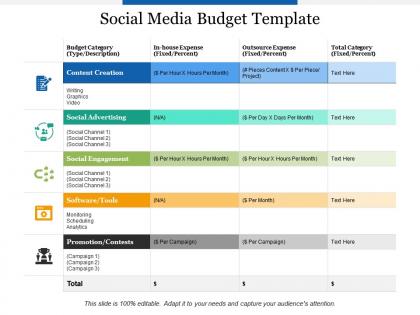
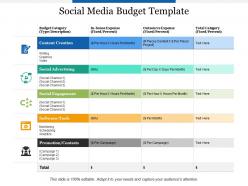
Social media budget template social advertising powerpoint presentation outline professional




Try Before you Buy Download Free Sample Product
 Impress Your
 Audience
 100%
100% Editable
 Save Hours
 of Time


Our Social Media Budget Template Social Advertising Powerpoint Presentation Outline Professional enhance your charisma. They add to your ability to attract.
People who downloaded this PowerPoint presentation also viewed the following :
Social media budget template social advertising powerpoint presentation outline professional with all 5 slides:
Make an articulate analysis with our Social Media Budget Template Social Advertising Powerpoint Presentation Outline Professional. The audience will accept your conclusions.
FAQs for Social media budget template social advertising powerpoint
Key factors include target audience size, platform costs, campaign objectives, industry competition, and seasonal trends. These elements work together to determine optimal resource allocation, with many businesses finding that balancing reach goals with cost-per-acquisition targets across platforms like Facebook, Instagram, and LinkedIn ultimately delivers better ROI and sustainable growth.
Businesses determine social media advertising ROI by tracking conversion rates, customer acquisition costs, lifetime value metrics, and revenue attribution through platform analytics and UTM parameters. Through comprehensive measurement dashboards, companies calculate cost-per-lead, engagement-to-sale ratios, and brand awareness lift, with many organizations finding that multi-touch attribution models deliver the most accurate ROI assessments.
Companies typically allocate 15-25% of their marketing budget to social media advertising, though this varies by industry, target demographics, and business maturity. While B2C companies in retail, hospitality, and consumer goods often invest 20-30% due to visual engagement opportunities, B2B organizations may allocate 10-15%, with many finding that strategic social media investment delivers measurable ROI through enhanced brand awareness and lead generation.
Social media advertising formats include video ads, carousel ads, story ads, sponsored posts, and display banners across platforms like Facebook, Instagram, LinkedIn, and Twitter. These formats enable businesses to showcase products through visual storytelling, target specific demographics with precision, and drive engagement through interactive elements, with many organizations finding that diversified format strategies deliver higher conversion rates and broader audience reach.
Seasonal trends significantly impact social media advertising budgets through fluctuating demand patterns, increased competition during peak periods, and varying consumer behavior across different months. Retailers often allocate 40-60% of annual budgets to holiday seasons, while travel companies boost spending for summer campaigns, ultimately requiring flexible budget structures that accommodate these predictable revenue cycles and maximize competitive advantage.
Budgeting tools for social media ads include Facebook Ads Manager, Google Ads Editor, HubSpot Marketing Hub, Hootsuite Insights, and specialized platforms like AdEspresso or Qwaya. These technologies streamline budget allocation by automating bid management, providing real-time spend tracking, and delivering cross-platform analytics, with many marketing teams finding that integrated dashboards ultimately enhance campaign efficiency and ROI optimization.
Audience targeting options significantly influence budget allocation by determining cost-per-click rates, competition levels, and potential reach across different demographics and interests. Highly competitive audiences like affluent professionals or tech enthusiasts typically require larger budget portions, while niche targeting often delivers better ROI with smaller allocations, ultimately enabling marketers to balance broad awareness campaigns with precision targeting for maximum efficiency.
Key metrics include click-through rates, conversion rates, cost per acquisition, return on ad spend, and engagement rates across platforms. These indicators streamline campaign optimization by measuring audience response, purchase behavior, and revenue generation, with many marketing teams finding that tracking multiple metrics simultaneously delivers comprehensive performance insights and competitive advantage in increasingly data-driven advertising landscapes.
Businesses should adjust their budget by analyzing conversion rates, cost-per-acquisition metrics, and ROI across different platforms and campaigns, reallocating funds toward high-performing channels while reducing spend on underperforming areas. Through performance data analysis, companies can optimize budget distribution by increasing investment in successful demographics, peak engagement times, and effective ad formats, ultimately delivering improved campaign efficiency and stronger returns on advertising investment.
Hidden costs in social media advertising include platform fees, creative production expenses, audience research tools, A/B testing resources, and campaign management software subscriptions. These often-overlooked expenses can significantly impact budgets, with many businesses finding that additional costs for graphic design, video production, and analytics tools can increase total campaign expenditure by 30-40%, ultimately requiring more comprehensive budget planning.
Small businesses can maximize limited social media budgets by focusing on targeted audience segmentation, leveraging organic content creation, utilizing cost-effective platforms like Facebook and Instagram ads, and implementing strategic timing for posts. These approaches enable efficient resource allocation, enhanced engagement rates, and measurable ROI tracking, with many small retailers and service providers finding that strategic combinations of organic and paid content ultimately deliver competitive advantages while minimizing advertising costs.
A/B testing optimizes social media advertising spend by comparing different ad variations, targeting parameters, creative elements, and budget allocations to identify the highest-performing combinations. Through systematic testing of headlines, visuals, audiences, and bid strategies, marketers can reduce cost-per-acquisition, increase conversion rates, and maximize ROI, with many brands finding that continuous optimization delivers significantly better results than static campaigns.
Businesses can account for creative development costs by allocating 15-20% of their total advertising budget to design, video production, copywriting, and photography expenses. This strategic allocation enables companies to maintain consistent content creation, support A/B testing initiatives, and refresh campaigns regularly, while many organizations find that quality creative assets ultimately deliver higher engagement rates and improved return on advertising spend.
Overspending management strategies include setting daily spending limits, implementing automated bid caps, monitoring cost-per-acquisition metrics, using audience targeting refinements, and establishing campaign pause triggers. These controls streamline budget allocation by preventing runaway costs, optimizing audience reach, and maintaining ROI thresholds, with many advertisers finding that proactive monitoring ultimately delivers more efficient campaigns and better resource allocation.
Businesses should review their social media advertising budget monthly for tactical adjustments and quarterly for strategic realignments, considering campaign performance, seasonal trends, and competitive landscape changes. Many retail, e-commerce, and service companies find that this dual approach enables rapid optimization of underperforming campaigns while maintaining strategic allocation flexibility, ultimately delivering better ROI and sustained competitive advantage.
No Reviews