


Solid waste monitoring system municipal solid waste management ppt diagrams




Try Before you Buy Download Free Sample Product
 Impress Your
 Audience
 100%
100% Editable
 Save Hours
 of Time


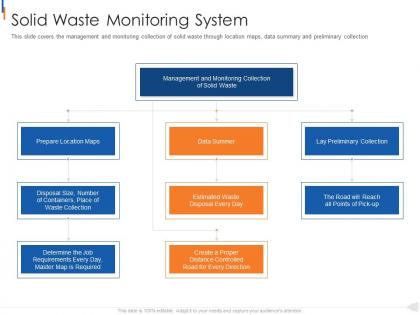
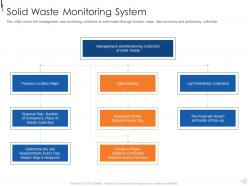
This slide covers the management and monitoring collection of solid waste through location maps, data summary and preliminary collection.
People who downloaded this PowerPoint presentation also viewed the following :
Solid waste monitoring system municipal solid waste management ppt diagrams with all 2 slides:
Use our Solid Waste Monitoring System Municipal Solid Waste Management Ppt Diagrams to effectively help you save your valuable time. They are readymade to fit into any presentation structure.
FAQs for Solid waste monitoring system municipal solid waste
Key components include IoT sensors for fill-level detection, GPS tracking for vehicle optimization, data analytics platforms, automated scheduling systems, and real-time reporting dashboards. These technologies streamline waste collection by reducing unnecessary pickups, optimizing route efficiency, and enabling predictive maintenance, with many municipalities finding that integrated monitoring delivers cost reductions and improved service reliability.
Real-time data collection revolutionizes solid waste management by enabling predictive scheduling, optimizing collection routes, and monitoring bin capacity levels continuously. Through IoT sensors and smart analytics, municipalities and waste management companies streamline operations, reduce fuel costs by up to 30%, and enhance service reliability, while ultimately delivering improved urban cleanliness and operational efficiency.
Solid waste monitoring systems commonly utilize IoT sensors, RFID tracking, GPS fleet management, smart bin sensors, and data analytics platforms. These technologies streamline operations by enabling real-time fill-level monitoring, optimizing collection routes, and reducing operational costs, with many municipalities finding that integrated systems ultimately deliver enhanced service efficiency and significant resource savings.
Solid waste monitoring contributes to sustainable urban development by optimizing collection routes, reducing operational costs, and minimizing environmental impact through data-driven resource allocation. Through IoT sensors and smart analytics, cities streamline waste management operations, enhance recycling rates, and improve air quality, with many municipalities finding that efficient monitoring systems ultimately deliver cleaner environments and enhanced quality of life for residents.
Mobile applications enhance solid waste monitoring by enabling real-time data collection, route optimization, citizen reporting, and automated scheduling through GPS tracking and digital workflows. These apps streamline operations for waste management companies and municipalities by facilitating instant reporting of missed collections, bin status updates, and service requests, ultimately delivering improved operational efficiency and enhanced citizen engagement in waste management programs.
Local governments can utilize solid waste monitoring data by identifying waste generation patterns, optimizing collection routes, predicting future capacity needs, and developing targeted reduction strategies. This data-driven approach enables municipalities to create evidence-based policies for recycling programs, landfill management, and resource allocation, while helping city planners design more efficient waste management systems that reduce operational costs and enhance environmental sustainability.
Challenges include limited technological infrastructure, insufficient funding for sensor networks, lack of technical expertise, unreliable power supply, and inadequate data management systems. These obstacles present both implementation difficulties and strategic opportunities, with many developing nations finding that phased deployment approaches, local partnerships, and mobile-based solutions can overcome resource constraints while delivering improved waste collection efficiency and environmental outcomes.
Public participation enhances solid waste monitoring effectiveness by providing real-time reporting, increasing data collection coverage, and fostering community ownership of waste management practices. Through mobile apps and citizen feedback platforms, municipalities can identify illegal dumping, monitor collection schedules, and track recycling compliance, while communities become active stakeholders in maintaining cleaner environments and more efficient waste systems.
Key metrics include waste generation rates, collection efficiency percentages, route optimization performance, contamination levels, and cost per ton processed. These indicators enable municipalities and waste management companies to streamline operations, reduce collection costs, and improve recycling rates, with many organizations finding that comprehensive monitoring delivers measurable environmental benefits and operational savings.
Data visualization transforms complex waste management data into clear, actionable insights by converting metrics like collection volumes, disposal patterns, recycling rates, and cost analyses into intuitive charts, graphs, and dashboards. Through interactive visualizations, municipalities and waste management companies can identify seasonal trends, optimize collection routes, and track sustainability goals, while stakeholders easily interpret performance data, ultimately enabling data-driven decisions that enhance operational efficiency and environmental outcomes.
Artificial intelligence improves solid waste sorting through computer vision for material identification, machine learning algorithms for contamination detection, predictive analytics for collection optimization, and automated robotic sorting systems. These technologies streamline operations by reducing manual labor, increasing recycling accuracy, and minimizing landfill waste, with many municipalities finding that AI-powered systems deliver faster processing and significantly lower operational costs.
A solid waste monitoring system addresses illegal dumping through smart sensors, GPS tracking, surveillance cameras, automated alerts, and real-time data analytics that detect unauthorized waste disposal activities. These technologies enable municipalities to respond rapidly to violations, optimize enforcement patrol routes, and implement predictive monitoring strategies, with many cities finding that proactive surveillance significantly reduces cleanup costs while enhancing community environmental standards.
**INPUT**: What best practices can be adopted for training personnel involved in solid waste monitoring? **OUTPUT**: Training best practices include comprehensive system operation protocols, real-time data analysis techniques, equipment maintenance procedures, safety compliance standards, and environmental regulation updates. These programs enhance operational efficiency by reducing monitoring errors, improving response times, and ensuring regulatory compliance, with many waste management organizations finding that well-trained personnel deliver significantly better environmental outcomes and cost savings. [Word count: 58 words]
Collaboration between stakeholders significantly enhances solid waste monitoring by integrating diverse expertise, resources, and data sources from municipalities, waste management companies, environmental agencies, and communities. Through shared monitoring platforms and coordinated collection efforts, cities achieve more comprehensive tracking, faster response times, and improved recycling rates, ultimately delivering cost-effective waste management and better environmental outcomes.
Long-term benefits include reduced operational costs, enhanced regulatory compliance, improved resource recovery rates, predictive maintenance capabilities, and data-driven decision making. These systems enable municipalities and waste management companies to optimize collection routes, minimize environmental impact, and increase recycling efficiency, ultimately delivering significant cost savings and competitive advantage in an increasingly sustainability-focused market.
-
Best way of representation of the topic.