


Sustainability waste management key performance indicators industrial waste management




Try Before you Buy Download Free Sample Product
 Impress Your
 Audience
 100%
100% Editable
 Save Hours
 of Time


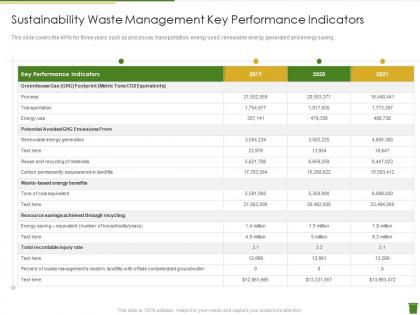
This slide covers the KPIs for three years such as processes, transportation, energy used, renewable energy generated and energy saving
People who downloaded this PowerPoint presentation also viewed the following :
Sustainability waste management key performance indicators industrial waste management with all 2 slides:
Use our Sustainability Waste Management Key Performance Indicators Industrial Waste Management to effectively help you save your valuable time. They are readymade to fit into any presentation structure.

FAQs for Sustainability waste management key performance indicators
Effective sustainability KPIs for industrial waste management include waste diversion rates, landfill reduction percentages, recycling efficiency metrics, energy recovery measurements, and cost-per-ton reduction tracking. These indicators enable organizations to streamline operations, minimize environmental impact, and enhance resource allocation, with many manufacturing and chemical processing facilities finding that comprehensive KPI frameworks ultimately deliver operational savings and competitive advantage in increasingly regulated markets.
Organizations align waste management KPIs with sustainability goals by integrating metrics like waste diversion rates, circular economy indicators, carbon footprint reduction, resource recovery percentages, and compliance benchmarks into comprehensive sustainability frameworks. Through strategic alignment, manufacturing companies, healthcare facilities, and retail operations streamline environmental reporting, enhance operational efficiency, and demonstrate measurable progress toward net-zero commitments, ultimately delivering competitive advantage in increasingly sustainability-focused markets.
Regulatory requirements serve as foundational frameworks that establish minimum compliance standards, emission thresholds, waste reduction targets, and reporting mandates that directly inform sustainability KPI development. These regulations drive organizations across manufacturing, chemical, and energy sectors to track metrics like hazardous waste reduction and recycling rates, ultimately enabling enhanced environmental performance while ensuring competitive advantage through proactive compliance and operational efficiency.
Companies leverage IoT sensors, automated tracking systems, data analytics platforms, cloud-based monitoring tools, and AI-powered waste classification technologies to enhance data collection accuracy and real-time visibility. These technologies streamline waste measurement by automating data capture, reducing manual errors, and providing comprehensive dashboards, with many manufacturing and industrial organizations finding that improved data quality enables better resource allocation and significantly enhances their sustainability reporting capabilities.
Best practices for setting realistic industrial waste reduction KPI targets include conducting comprehensive baseline assessments, benchmarking against industry standards, implementing phased reduction goals, and aligning targets with operational capacity and regulatory requirements. Manufacturing facilities and chemical plants increasingly find that starting with 5-10% annual reduction targets, while incorporating employee training and process optimization measures, delivers sustainable progress and measurable cost savings.
Waste diversion rates serve as a comprehensive KPI by measuring the percentage of waste redirected from landfills through recycling, composting, reuse, and energy recovery programs. This metric enables organizations to track circular economy progress, reduce disposal costs, demonstrate regulatory compliance, and showcase environmental stewardship to stakeholders, with many manufacturing and retail companies finding that higher diversion rates ultimately deliver both cost savings and enhanced sustainability credentials.
Lifecycle assessments contribute to effective waste management KPIs by quantifying environmental impacts across production, usage, and disposal phases, enabling organizations to identify critical measurement points and reduction opportunities. Through comprehensive LCA data, manufacturing facilities, chemical plants, and food processors establish targeted KPIs for waste diversion rates, resource efficiency, and carbon footprint reduction, ultimately delivering measurable sustainability outcomes and competitive advantage.
Common challenges include inconsistent data collection systems, lack of standardized measurement protocols, resistance to operational changes, integration difficulties with existing workflows, and insufficient staff training on sustainability metrics. Many manufacturing and chemical processing facilities find that overcoming these hurdles requires strategic investment in monitoring technologies, comprehensive employee education programs, and phased implementation approaches, ultimately delivering enhanced environmental compliance and operational efficiency.
Organizations can benchmark their waste management KPIs against industry standards by accessing databases like EPA's Waste Reduction Model, joining industry associations for peer data sharing, and utilizing third-party sustainability reporting platforms. Through these resources, companies in manufacturing, food processing, and pharmaceuticals compare metrics like waste diversion rates and recycling percentages, ultimately identifying improvement opportunities and achieving competitive advantage.
Tools for tracking industrial waste management KPIs include waste management software platforms, IoT sensors and monitoring systems, environmental management information systems (EMIS), data analytics dashboards, and automated reporting solutions. These technologies streamline data collection, enhance real-time monitoring, and deliver comprehensive reporting capabilities, with many manufacturing facilities and industrial operations finding that integrated platforms significantly improve compliance tracking and sustainability performance measurement.
Organizations should review sustainability KPIs for waste management quarterly for operational metrics and annually for strategic goals, while conducting comprehensive assessments during regulatory changes or facility expansions. This approach enables manufacturers, chemical plants, and food processing companies to adapt to evolving waste streams, regulatory requirements, and technology improvements, ultimately maintaining competitive advantage through optimized resource efficiency and environmental compliance.
Employee engagement significantly impacts waste management sustainability KPIs by driving behavioral changes, improving compliance rates, fostering innovation in waste reduction practices, and enhancing accountability across operations. Through training programs and incentive structures, manufacturing plants, chemical facilities, and food processing companies achieve 20-40% better KPI performance, with engaged teams identifying cost-saving opportunities and ultimately delivering stronger environmental outcomes.
Companies can integrate waste-to-resource strategies into sustainability KPIs by tracking circular economy metrics like material recovery rates, waste diversion percentages, and resource conversion efficiency alongside traditional waste reduction targets. These frameworks enable organizations to measure transformation outcomes such as energy generation from organic waste, recycled material integration, and revenue from byproduct sales, ultimately delivering competitive advantage while advancing environmental goals.
Waste-to-energy conversion as a KPI measures how effectively organizations transform industrial waste streams into usable energy resources, tracking both environmental impact reduction and operational cost recovery. This metric enables companies across manufacturing, chemical processing, and food production sectors to demonstrate circular economy principles while generating revenue streams, ultimately delivering enhanced sustainability credentials and improved resource efficiency in an increasingly environmentally-conscious marketplace.
Collaboration with stakeholders enhances sustainability KPIs by incorporating diverse perspectives, ensuring data accuracy, and aligning measurement goals across the supply chain. Through strategic partnerships with suppliers, regulatory bodies, and waste management vendors, organizations streamline reporting processes, identify optimization opportunities, and ultimately deliver improved compliance rates and cost reductions while building stronger environmental accountability.
-
Excellent design and quick turnaround.
-
Editable templates with innovative design and color combination.
-
Professional and unique presentations.
-
Awesomely designed templates, Easy to understand.