

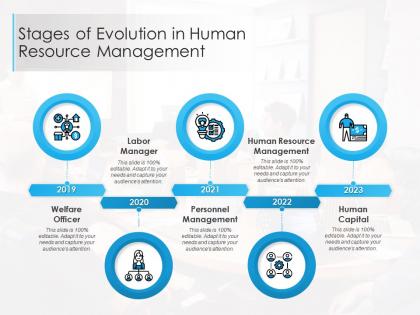
Stages of evolution in human resource management




Try Before you Buy Download Free Sample Product
 Impress Your
 Audience
 100%
100% Editable
 Save Hours
 of Time


Our Stages Of Evolution In Human Resource Management are topically designed to provide an attractive backdrop to any subject. Use them to look like a presentation pro.
People who downloaded this PowerPoint presentation also viewed the following :
Stages of evolution in human resource management with all 2 slides:
Use our Stages Of Evolution In Human Resource Management to effectively help you save your valuable time. They are readymade to fit into any presentation structure.
FAQs for Stages of evolution in
So HR basically started in the 1880s with companies trying to take better care of workers. Taylor came along in the early 1900s with his time studies - classic scientific management stuff. Then the 1930s Hawthorne studies were huge because they proved relationships at work actually boost productivity (groundbreaking, right?). After WWII, formal HR departments popped up in the 50s and 60s. The real game-changer was the 1980s when "personnel" became "human resources" and suddenly HR wasn't just filing paperwork anymore - they became strategic business partners. Now we're all about employee experience and data analytics. It's wild how much it's evolved, but that progression explains why today's HR has to balance being people-focused while still hitting business goals.
Oh man, HR tech has changed everything! We went from literal filing cabinets to cloud systems that do most of the work for you. Recruiting's totally different now - LinkedIn hunting instead of newspaper ads, plus AI does the initial screening (which honestly saves so much time). Performance reviews happen year-round through apps instead of those dreaded annual forms. Payroll runs itself, thank god, because doing that math manually was brutal. Your employees can handle their own stuff too - time off requests, updating addresses, whatever - through self-service portals. But the real game changer? Having actual data on engagement and turnover predictions instead of just winging it.
Honestly, globalization turned HR upside down. Companies went from hiring locally to managing teams across five continents overnight. Now HR folks need to understand different cultures, handle remote international workers, and somehow navigate totally different labor laws in each country. The talent competition got brutal too - you're not just competing with the company down the street anymore, but with everyone worldwide. It's actually pretty intense when you think about it. HR had to get way more strategic and worldly real quick. I'd start by looking at your current hiring process and see where you might be thinking too small about finding people.
HR used to just be payroll and policy stuff - you know, the paperwork people. But now? Companies figured out their employees are actually what makes them money, not just expenses. So HR became way more strategic. You're analyzing data to predict who's gonna quit, designing talent plans that match business goals, sitting in on big leadership meetings. Way more interesting than processing time-off requests all day! The key is learning to talk business metrics and revenue - that's honestly how you stay relevant in this field now.
So the civil rights movement totally changed how companies hire people. Before the 1960s? Pure chaos - businesses could basically discriminate however they wanted. Then the Civil Rights Act hit in '64, plus they created the EEOC to actually enforce this stuff. Suddenly HR wasn't just about filing paperwork anymore. Companies had to start taking diversity seriously because there were real legal consequences. Honestly, those old boys' clubs didn't go down without a fight though. But yeah, every diversity program you see today builds off what started back then. It's wild how much those foundational laws still matter.
HR's done a total 180 since the early 1900s. Back then? Just compliance stuff and paperwork - honestly sounds like torture. Now it's about being a real business partner. You're focused on employee experience, using data analytics, developing talent instead of just the basic hire-and-fire routine. The old "personnel departments" were basically glorified filing cabinets. Today's HR is all about culture and keeping good people around with flexible work, career growth opportunities, that kind of thing. So when you look at what you're doing - are you still just pushing paper or actually helping people grow and hitting business goals?
Honestly, it's all about mixing the old with the new these days. Companies are using AI to screen people initially, but personal connections still matter a ton - like, that "people hire people" mentality isn't going anywhere. Most decisions now get backed by data analytics, and your company's brand on social media is everything. The big change? Instead of scrambling when you need someone, smart companies build talent pipelines way ahead of time. Oh, and candidate experience is crucial because one bad review can wreck your reputation. You should probably start identifying potential hires now, even if you don't need them yet.
Honestly, the whole employee engagement thing has come a long way from those basic carrot-and-stick methods. Used to be all about rewards and punishments - pretty shallow if you ask me. These days people want work that actually means something, plus they need to feel psychologically safe and have real input on decisions. Intrinsic motivation is where it's at now. Personal growth, feeling valued as actual humans instead of just worker bees - that's what drives engagement. Oh, and here's a wild idea: actually ask your team what motivates them instead of guessing!
Dude, HR analytics is wild - you can literally predict who's gonna quit before they even know it themselves. Instead of just guessing who your best people are, the data shows you patterns you'd miss otherwise. Pay gaps, bias issues, all that stuff becomes obvious. My favorite part? No more hiring based on "gut feelings" that are usually wrong anyway. You actually have proof of what works. Though honestly, don't try to do everything at once - that's overwhelming. Just pick something simple like tracking why people leave and go from there. It's pretty addictive once you start seeing the patterns.
So basically, all these laws like the Civil Rights Act and ADA forced HR to completely transform. Before that, it was just basic hiring and payroll stuff. Now? Mountains of compliance paperwork. Every new regulation meant creating policies, training programs, documentation - you name it. Companies realized they needed formal processes to avoid getting sued left and right. OSHA made workplace safety a huge thing, FMLA added family leave requirements. Even now with GDPR and data privacy rules, it never stops. My advice? Don't wait until new laws hit to adapt. Being proactive saves you from scrambling later.
Dude, the whole field is changing so fast right now. AI is taking over recruitment and performance reviews - honestly kind of scary how quick it's happening. Remote work broke all the old rules, so HR has to figure out onboarding and company culture from scratch basically. Mental health and wellbeing became huge too. Oh, and you can't just wing decisions anymore - everything's data-driven now. I'd start learning HR software and get good with analytics if I were you. My cousin works in HR and she's constantly having to learn new platforms. That's definitely where things are going.
Honestly, culture drives everything HR does - it's like the background music nobody talks about but totally sets the mood. Your policies either match where the company's actually going or they just fall flat. I've watched places try to force old-school top-down approaches in collaborative environments and it's painful. Remote work changes everything too - suddenly all your communication strategies need an overhaul. What works in one culture bombs in another. The tricky part? You gotta read where your culture's headed, not just listen to what leadership says they want. Otherwise you're always playing catch-up.
Honestly? Don't treat your employees like replaceable cogs - that never works out. Taylorism back in the early 1900s proved this when it caused massive strikes everywhere. IBM figured this out early and invested heavily in training their people. Meanwhile other companies ignored worker feedback and tanked. Southwest Airlines basically built their entire success around this concept (which is pretty smart if you ask me). The pattern's always the same: rigid top-down management fails, but flexible approaches that actually develop employees win every time. Just ask your team what motivates them - their answers might shock you.
Oh man, it's crazy how much this has changed! HR used to just do the bare minimum - workers' comp, maybe throw an annual health fair. That was it. Now? Companies finally get that stuff like mental health support and work-life balance actually affects their profits through better retention. Smart ones are weaving wellness into flexible work policies, mental health resources, personalized benefits - the whole deal. Honestly though, here's what I'd do first: just ask your team what they actually want for support. Half the time it's totally different from what you'd guess.
Ugh, where do I even start? Tech changes faster than I can keep up with, and don't get me started on managing remote teams - it's like herding cats sometimes. Everyone wants different work-life balance stuff now, and honestly the goalposts keep moving every few months. Plus you've got boomers wanting one thing, Gen Z wanting the complete opposite. New compliance rules drop out of nowhere too. Finding people with both technical skills AND people skills? Good luck with that. Oh, and I forgot - staying flexible is huge. Keep learning constantly and build wiggle room into everything you do.
-
Informative design.
-
Unique design & color.
-
Awesome presentation, really professional and easy to edit.
-
Thanks for all your great templates they have saved me lots of time and accelerate my presentations. Great product, keep them up!
-
Graphics are very appealing to eyes.