

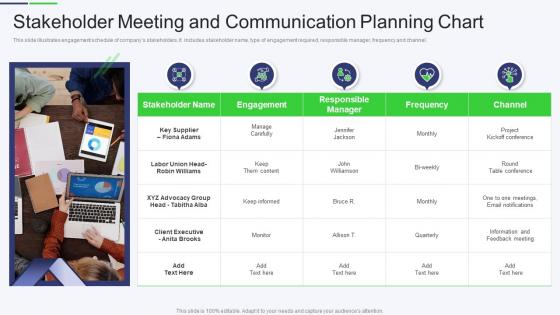
Stakeholder Meeting And Communication Planning Chart




Try Before you Buy Download Free Sample Product
 Impress Your
 Audience
 100%
100% Editable
 Save Hours
 of Time


This slide illustrates engagement schedule of companys stakeholders. It includes stakeholder name, type of engagement required, responsible manager, frequency and channel.
People who downloaded this PowerPoint presentation also viewed the following :
Stakeholder Meeting And Communication Planning Chart with all 6 slides:
Use our Stakeholder Meeting And Communication Planning Chart to effectively help you save your valuable time. They are readymade to fit into any presentation structure.





FAQs for Stakeholder Meeting And
Honestly, it's all about being upfront and actually listening to people. Map out everyone who's affected or has any pull - don't just go for the obvious choices. Tell them exactly what you need and what they'll get back. Here's the thing though - people can totally tell when you're just going through the motions, so genuinely hear them out. Timing matters too. Get their input while decisions are still flexible, not when everything's already locked down. I'd start by figuring out who needs to be involved and when, then work backwards from there.
Start by listing everyone who's actually affected by what your company does - employees, customers, suppliers, investors, local communities, regulators, the usual suspects. Get different departments involved in this brainstorming because they'll catch people you totally missed. Here's the key part: rank them by how much power they have over you AND how much you impact them. Those high-power, high-impact people? That's your A-list. Honestly, making a simple grid to map this out saves so much confusion later. Makes it super obvious who you need to focus on first.
Look, stakeholder engagement totally falls apart without good communication. You can't just guess what people want. Listen to their actual concerns first. Then keep them in the loop with regular updates - nobody wants to feel left out of decisions that affect them. Use whatever works: emails, meetings, quick surveys. The key thing? Actually show them how their feedback changed something. Close that loop or they'll think you're just going through the motions. Also set up regular check-ins so it becomes routine instead of this big formal thing every few months.
Honestly, advisory committees work pretty well if you actually let them make decisions instead of just listening to updates. Regular consultation sessions are good too. Co-design workshops where stakeholders help shape things from the start - that's where you get real buy-in. Surveys feel kinda one-way though, most people hate those. Give them actual voting rights on stuff that affects them, or put them in working groups developing proposals. Figure out who's impacted most first, then match your approach to their schedules. Some people want quick check-ins, others need deeper involvement.
Honestly, there's so many ways to do this. Surveys are probably easiest - you can reach tons of people and get actual numbers. Focus groups are amazing for deep insights but ugh, the scheduling is brutal. For sensitive stuff or your VIPs, definitely do one-on-one interviews. Oh, and don't forget the simple things like feedback forms or suggestion boxes (I know they sound old school but they work). Coffee chats can be surprisingly effective too. Really just depends on your people and how they like to communicate. Start with whatever feels least awkward for your group.
Track the obvious stuff first - meeting attendance, survey responses, how often people actually reach out to you. Numbers don't lie. But the real insights come from watching behavior changes. Are people giving you better feedback now? Collaborating more instead of just complaining? Conflicts wrapping up quicker? I'd throw in some quick pulse surveys asking if they feel heard - sounds cheesy but it works. The ultimate test though? Whether they stick around long-term and start bringing their colleagues into the mix. That's when you know you've cracked it.
Honestly, it's usually a mess of competing priorities and people who can't communicate properly. Different groups want totally different things - shocking, right? Good luck getting executives to respond when you actually need their input. Everyone thinks they're the most important, which makes managing expectations a nightmare. Oh, and if they've sat through a bunch of "stakeholder workshops" before? Forget it - they're already checked out. My advice is pretty straightforward: figure out who really matters early on. Tell each group exactly what you need from them, don't be vague about it. Follow up relentlessly because people forget everything.
Dude, tech can totally change how you handle stakeholder stuff. Digital platforms let you collect feedback in real-time and do virtual meetings that actually reach more people. Social media tools help you spot problems before they explode - which honestly saves so much headache later. Online collaboration is perfect for people with crazy schedules since they can jump in whenever. Plus analytics give you real numbers on what's working. My advice? Pick just one tool that fixes your biggest current mess. Don't go overboard trying to change everything at once or you'll burn out.
Start by figuring out who your stakeholders are and what they actually give a damn about - it's not always what you'd expect. Don't blast everyone with constant updates (trust me on this one). When problems come up, be honest about them and get stakeholders involved in solving stuff. In meetings, listen way more than you talk and actually do something about their concerns after. I keep a basic spreadsheet tracking who wants what kind of info and how often. Oh, and reach out before things go sideways, not after. Being ahead of problems beats scrambling to fix them every time.
Oh man, this is huge! Different cultures have totally opposite communication styles. Some want super direct feedback, others think that's incredibly rude. I bombed my first international project because of this exact thing. You've gotta research their backgrounds first, but honestly? Just ask them straight up how they prefer to communicate. Hierarchical cultures need you to go through the big bosses first. More collaborative ones expect input from everyone. Even your meeting format and decision timelines will need tweaking based on who you're working with.
Honestly, social media is perfect for this stuff because people are already scrolling anyway. You can actually have real conversations instead of those boring formal meetings nobody wants to attend. The trick is figuring out where your people hang out - like LinkedIn for business contacts, Facebook for community stuff, or maybe some niche forum if you're dealing with tech people. Real-time feedback is huge too. Someone has a complaint? You can respond immediately instead of waiting weeks. I'd start by just checking where your stakeholders are most active online and go from there.
Honestly? Start by figuring out who actually has power to kill your project vs who just complains loudly. Map out what each group really wants - half the time these "conflicts" are just miscommunication anyway. When there's real competing interests, just be upfront about the tradeoffs instead of trying to sugarcoat everything. Pick the easier fights first to get some wins under your belt. Then you can tackle the messier stuff later. I learned this the hard way - trying to make everyone happy usually backfires spectacularly. Oh, and always explain your criteria for decisions beforehand so people can't claim you're being unfair after the fact.
Honestly, the worst thing you can do is wait until the last minute to bring people in. I learned that one the hard way! Also don't just talk to the people who'll agree with you - those grumpy stakeholders usually see problems you're missing. Figure out who actually has decision-making power upfront, because nothing's worse than getting someone invested when they can't really influence anything. Oh, and don't treat it like checking boxes. Map everyone out early, be honest about what their role actually is, and listen for real. The "difficult" people often give you the best feedback if you're genuinely open to it.
Look, it's all about speaking their language. Healthcare people obsess over patient safety and compliance stuff - they literally can't move forward without checking those boxes first. Tech folks are the opposite - they want speed and disruption, so talk innovation and getting ahead of competitors. Manufacturing? Show me the cost savings and prove it won't break down. Finance is probably the trickiest because they're paranoid about risk (can you blame them after 2008?). Before any big meeting, I always research what's currently stressing out that industry's executives. Trust me, frame everything around their biggest headaches and you'll get their attention fast.
Honestly, surveys and pulse checks are your best bet here. I'd set up quarterly surveys or monthly check-ins - whatever feels realistic for your team. Net Promoter Score is pretty solid too since people actually fill those out (unlike those 20-question monsters nobody touches). Social media monitoring tools like Brandwatch can catch sentiment shifts you might miss otherwise. Even a basic spreadsheet works if you're tracking consistently. That's the real trick - stick to regular intervals so you're seeing actual trends, not just random noise. Oh, and don't overthink the tools part initially.
-
Incredibly beautiful designs that will help you get noticed! These eye-catching templates are perfect for corporate presentations that can be altered to fit any occasion or taste.
-
The templates you provide are great! They have saved me tons of time and made my presentations come alive. Thank you for this awesome product. Keep up the good work!