

Standard Operating Procedure Initiation Implementation Format Audience Purpose






Try Before you Buy Download Free Sample Product
 Impress Your
Audience
 100%
Editable
 Save Hours
of Time


Our Standard Operating Procedure Initiation Implementation Format Audience Purpose are topically designed to provide an attractive backdrop to any subject. Use them to look like a presentation pro.
People who downloaded this PowerPoint presentation also viewed the following :
Content of this Powerpoint Presentation
Slide 1: This slide introduces standard-operating-procedure. State Your Company Name and begin.
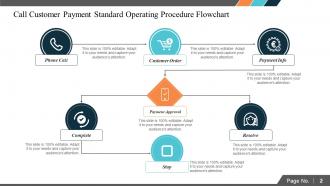
Slide 2: This slide shows Call Customer Payment Standard Operating Procedure Flowchart.
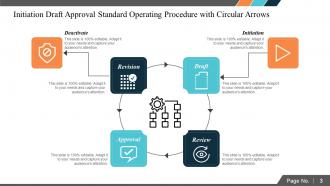
Slide 3: This slide presents Initiation Draft Approval Standard Operating Procedure with Circular Arrows.
Slide 4: This slide displays Standard Operating Procedure Icon with Gear.
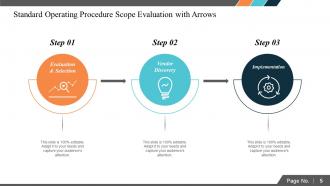
Slide 5: This slide represents Standard Operating Procedure Scope Evaluation with Arrows.
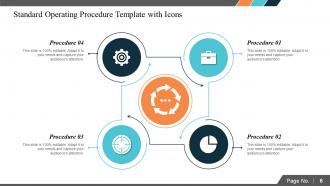
Slide 6: This slide showcases Standard Operating Procedure Template with Icons.
Slide 7: This slide shows Standard Operating Procedure with List and Downward Arrow.
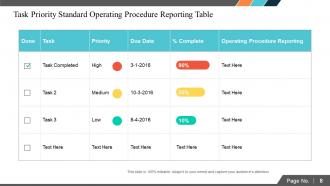
Slide 8: This slide presents Task, Priority, Standard, Operating Procedure Reporting Table.
Slide 9: This slide displays Test, Review, Standard, Operating, Procedure, Purpose.
Slide 10: This slide represents Title Update Standard Operating Procedure with Icons.
Slide 11: This slide showcases Tools, First Aid, Standard Operating Procedure at Workplace with Icons.
Slide 12: This is a Thank You slide with address, contact numbers and email address.
Standard Operating Procedure Initiation Implementation Format Audience Purpose with all 12 slides:
Use our Standard Operating Procedure Initiation Implementation Format Audience Purpose to effectively help you save your valuable time. They are readymade to fit into any presentation structure.



FAQs for Standard Operating Procedure Initiation Implementation
Start with a clear purpose statement and step-by-step procedures - that's your foundation. Define who does what, list the materials you'll need, plus safety requirements and quality standards. Trust me, I skipped the safety part once and regretted it! Version control is huge too. Include approval signatures and review dates so people aren't working from outdated versions. Make it detailed enough that someone won't bug you with constant questions. Focus on your most critical processes first. Actually test these with real users before you call it done - they'll catch stuff you missed.
You gotta tailor SOPs to whatever industry you're in, obviously. Healthcare is all about patient safety, compliance docs, sterilization stuff. Manufacturing gets crazy detailed - like, seriously the most thorough ones I've ever seen - covering equipment maintenance, quality checks, safety protocols. IT focuses more on system configs, incident response, change management. Here's what I'd do: figure out your biggest risk areas and regulatory stuff first. Then build everything around those critical points. Oh, and start with your riskiest processes - way easier than trying to tackle everything at once.
Oh man, the worst thing you can do is make them crazy detailed - like who's gonna read 20 pages just to do basic stuff? Also don't write them alone in your office without asking the actual people doing the work. I've seen so many that sound perfect but totally miss how things really happen day-to-day. Keep them updated too because old procedures are honestly worse than having nothing at all. My advice? Start simple, get your team's input right away, and set up regular check-ins so they don't become useless paperweights.
So honestly, once a year is the absolute minimum but that's kinda lazy if we're being real. For anything critical, I'd go with every 6 months - especially when your team keeps changing or you're using new tools. Also trigger a review whenever regulations shift, something goes wrong, or you improve a process. Basically anytime what you wrote doesn't match reality anymore. Oh and set those calendar reminders because I always forget otherwise. The whole point is making sure your SOPs reflect how work actually happens, not some dusty document from ages ago. Start with your most important stuff first.
Honestly, training is where most companies totally blow it with SOPs. You can have the world's best procedures written down, but if people don't actually know how to use them? Waste of time. I'd skip the whole "here's a binder, figure it out" approach - that never works. Schedule real training sessions instead. Walk through everything step by step so your team actually gets it. The why matters just as much as the what, you know? And don't forget refreshers every few months. People get rusty fast. Trust me, a little upfront training saves you tons of headaches later.
Dude, just ditch the Word docs already. Tools like Notion or Process Street let you build SOP templates that pull in your company info automatically. Real-time collab is clutch too. For creating them, Loom's great for screen recordings, and Scribe literally generates screenshots as you work through stuff. Pretty neat. Set up auto-reminders so people actually review these things instead of letting them collect digital dust. Analytics help you see which SOPs are dead weight. Start simple though—pick one tool for making them, another for storing. You can always get fancier later.
Honestly, I'd focus on compliance rates first - are people actually following the steps or just winging it? Error rates tell you the real story though. If mistakes aren't dropping, your SOP probably sucks. Track how long tasks take too, since good procedures should speed things up (unless you were trying to slow people down for safety reasons or whatever). New employee training time is clutch - they should get up to speed faster with a solid SOP. Oh, and don't forget to actually ask people what they think. Pick maybe 2-3 of these that matter most for your situation and stick with tracking those consistently.
Honestly, just bake the regulatory stuff straight into your SOPs from day one. Reference the actual reg numbers in each procedure so there's no guessing. Figure out which regulations hit your processes first, then weave those compliance steps into your normal workflows. Companies that bolt compliance on later? Total nightmare - trust me on this one. Document everything as you go and throw in some audit checkpoints. The whole point is making it feel automatic, not like you're doing double work. Oh, and set up regular reviews because regs change constantly and you don't want to get caught behind.
Get your team involved right from the start - seriously, it's a game changer. Have them map out how things currently work since they're the ones actually doing it every day. Different people should write the parts they know best. I've watched so many SOPs crash and burn because someone just wrote them alone in their office! Set up review meetings where everyone can jump in with feedback. Oh, and rotate who's leading the documentation for different stuff. You want them feeling like they built it together, not like you're just handing them another manual to follow.
Honestly, visuals are a game-changer for SOPs. Nobody wants to wade through dense paragraphs when they're trying to get work done. Screenshots and flowcharts let people actually see what button to click or which form to fill out. Way less confusing than "navigate to the third dropdown menu" or whatever. Plus your team won't mess up as much since they can just match what's on their screen to your reference image. I swear, good visuals cut down training time by like half. People follow the steps more consistently too when they don't have to guess what you meant.
Look, SOPs are basically your backup plan when things get chaotic. Instead of winging it every time, you've got a clear roadmap that anyone can follow. Honestly, I've seen too many teams crash and burn because they relied on "tribal knowledge" instead of writing stuff down. These documents catch problems early and make audits actually manageable - nobody wants to scramble explaining their processes to regulators. The best part? You can take your top performer's methods and turn them into something the whole team can replicate. Way less room for mistakes, and your operations won't fall apart when someone's out sick.
Honestly, get your team involved in writing or updating the procedures first - people actually follow rules they helped create. Keep them simple too because nobody's reading a confusing 20-page manual, let's be real. Train everyone properly, then celebrate when they do things right instead of just calling out mistakes. Your managers need to follow every step religiously though, or everyone else will start cutting corners. The biggest thing? Explain why each step matters so it doesn't feel like pointless red tape. Oh, and do random check-ins that feel supportive, not like you're trying to catch people screwing up.
So basically, SOPs are your big picture "what and why" docs that cover whole processes. Work instructions? Those are the nitty-gritty "how-to" steps for specific stuff. Think roadmap vs turn-by-turn directions - you need both but they do different things. Use SOPs for setting up procedures, compliance stuff, or getting new people up to speed. Work instructions are clutch for complex tasks where you can't mess around with exact steps or safety protocols. Honestly, most teams skimp on work instructions then act surprised when everything's all over the place. Start with your SOP framework first, then get detailed with work instructions wherever precision actually matters.
Dude, you HAVE to get your team involved when writing SOPs. They'll spot all the stuff you missed and tell you when something sounds good on paper but is totally unrealistic day-to-day. People are way more likely to actually follow procedures they helped build instead of some top-down mandate. Your employees know exactly where the current process breaks down - they live it every day. I learned this the hard way after writing SOPs in a vacuum that nobody used. Run drafts by them constantly, ask what's confusing or missing, then fix it before you finalize anything. Trust me on this one.
Oh man, version control is huge for this stuff. Use something like "SOP_ProcessName_v2.1_Date" - saves so much confusion later. Get a centralized spot where everyone can search and access docs. Seriously, I've watched teams completely lose procedures because Karen saved the "final final FINAL" version on her laptop and then went on vacation. Back up everything regularly. Keep old versions too, you never know when you'll need them. Set up review schedules so things don't get stale, and track who approved changes. SOPs are basically the backbone of your operation, so don't wing the storage system.
-
Graphics are very appealing to eyes.