

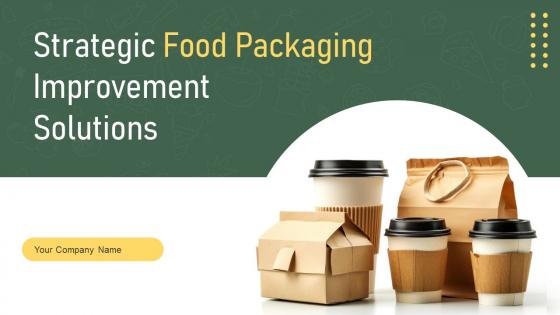
Strategic Food Packaging Improvement Solutions Powerpoint Presentation Slides




Try Before you Buy Download Free Sample Product
 Impress Your
 Audience
 100%
100% Editable
 Save Hours
 of Time


Discover the future of food packaging with our insightful PPT on Strategic Food Packaging Improvement Solutions. Uncover the transformative power of smart food packaging technology, revolutionizing supply chains and ensuring product safety. Delve into the advantages of innovative glass packaging, combining aesthetics with sustainability. The presentation guides you through the crucial steps to evaluate food packaging solutions, covering aspects like technology selection, cost-benefit analysis, and seamless integration. Elevate your understanding of the strategic enhancements that propel the food industry forward, balancing efficiency, eco-friendliness, and consumer appeal. Get access to this Presentation now.
People who downloaded this PowerPoint presentation also viewed the following :
Content of this Powerpoint Presentation
Slide 1: This slide showcase title Strategic Food Packaging Improvement Solutions. State Your Company Name
Slide 2: This slide showcase ttile Agenda strategic food packaging improvement solutions.
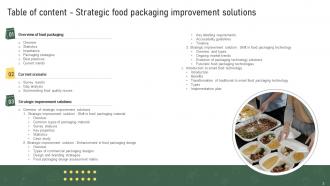
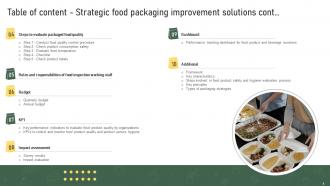
Slide 3: This slide exhibit Table of Content.
Slide 4: This slide exhibit Table of Content.
Slide 5: This slide shows Table of Content for the presentation.
Slide 6: The slide showcases overview and introduction of packaging that ensures protection of food from harmful environmental factors.
Slide 7: The slide showcases statistics that represent positive impact of food packaging initiated on purchasing decisions made by consumers in marketplace.
Slide 8: The slide showcases points highlighting importance of effective food packaging in industry that assist in creating a positive impact on consumers purchasing decisions.
Slide 9: The slide showcases strategies that assist in ensuring protection of food from outside elements present in environment and save it from contamination.
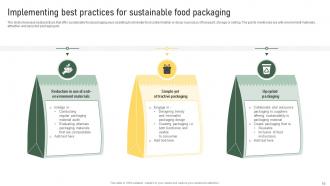
Slide 10: The slide showcase best practices that offer sustainable food packaging ways assisting to eliminate food contamination.
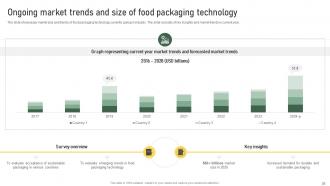
Slide 11: The slide showcases current trends prevalent in food market that mark shift towards sustainable and personalized food choices made by consumers.
Slide 12: This slide shows Table of Content for the presentation.
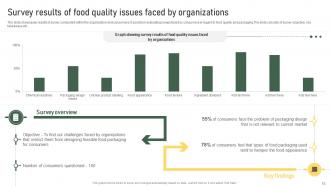
Slide 13: The slide showcases results of survey conducted within the organization and consumers.
Slide 14: The slide showcases percentage gap analysis of major challenges reported by employees in organization.
Slide 15: The slide showcases a summary of major points that came up while concluding survey results.
Slide 16: This slide shows Table of Content for the presentation.
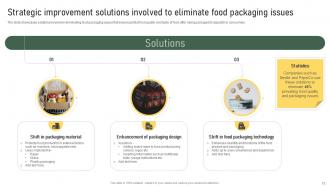
Slide 17: The slide showcases solutions involved in eliminating food packaging issues that ensure perfect food quality and taste of food after being packaged to dispatch.
Slide 18: This slide shows Table of Content for the presentation.
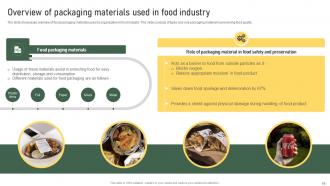
Slide 19: The slide showcases overview of food packaging materials used by organization in food industry.
Slide 20: The slide showcases packaging materials used by companies in food industry.
Slide 21: The slide showcases survey analysis of food packaging material accepted by consumers in the market.
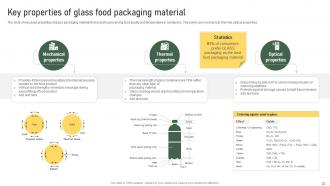
Slide 22: The slide showcases properties of glass packaging material that assist in preserving food quality and temperature in containers.
Slide 23: The slide showcases properties of glass packaging material that assist in preserving food quality and temperature in containers.
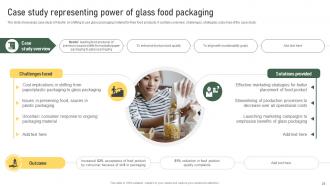
Slide 24: The slide showcases case study of Nestle’ on shifting to use glass packaging material for their food products.
Slide 25: This slide shows Table of Content for the presentation.
Slide 26: The slide showcases overview and importance of food packaging design as it assists in attracting varied customers in market.
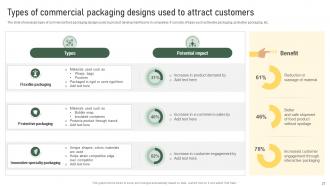
Slide 27: The slide showcases types of commercial food packaging designs used by product development teams in companies.
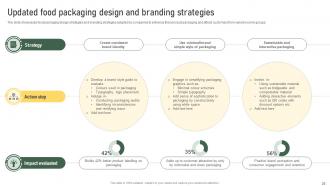
Slide 28: The slide showcases food packaging design strategies and branding strategies adopted by companies to enhance their product packaging.
Slide 29: This slide showcases design assessment matrix used by companies to evaluate customer preference regarding product design.
Slide 30: The slide displays key requirement of food product labelling on packages as it assists in knowing important information.
Slide 31: This slide showcases packaging design guidelines which should be considered while producing a product to promote consumer accessibility.
Slide 32: This slide showcases checklist representing tasks involved in effective food packaging by the product development team in a company.
Slide 33: This slide shows Table of Content for the presentation.
Slide 34: The slide showcases overview and types packaging technology used buy companies in food industry.
Slide 35: This slide is 100% editable. Adapt it to your needs and capture your audience's attention.
Slide 36: The slide showcases evolution of food packaging technology in food industry.
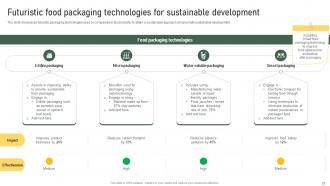
Slide 37: The slide showcases futuristic packaging technologies used by companies in food industry to attain a sustainable approach and promote sustainable development.
Slide 38: This slide shows Table of Content for the presentation.
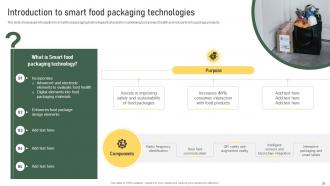
Slide 39: The slide showcases introduction to smart food packaging technologies that assist in maintaining food product health and reduce time to package products.
Slide 40: The slide exhibits importance or benefits attained by smart food technologies to both organizations and consumers.
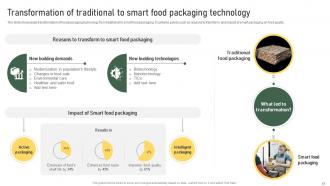
Slide 41: The slide showcases transformation of food packaging technology from traditional to smart food packaging.
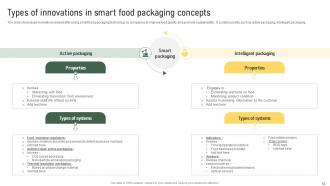
Slide 42: The slide showcases innovations viewed after using smart food packaging technology by companies to improve food quality and promote sustainability.
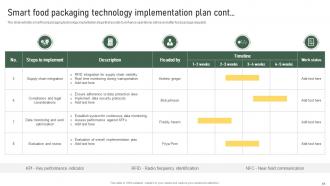
Slide 43: The slide exhibits smart food packaging technology implantation steps that assists to enhance operations before and after food package dispatch.
Slide 44: The slide exhibits smart food packaging technology implantation steps that assists to enhance operations before and after food package dispatch.
Slide 46: The slide showcases step one that involves in implementing food quality control procedure wherein manager performs this task.
Slide 47: The slide showcases step two that involves in implementing the food quality procedure that is to evaluate product consumption by checking absence of hazards.
Slide 48: The slide showcases steps three i.e. to evaluate food temperature after being packed by manually or by machines.
Slide 49: The slide showcases checklist used to evaluate and track hygiene measure of working staff during food production and packaging.
Slide 50: The slide showcases step five and the final step i.e. to check product labels indicating properties of the food product within the package.
Slide 51: This slide shows Table of Content for the presentation.
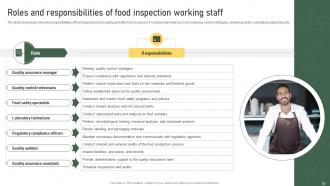
Slide 52: The slide showcases roles and responsibilities of food inspection team during and after food is packed.
Slide 53: This slide shows Table of Content for the presentation.
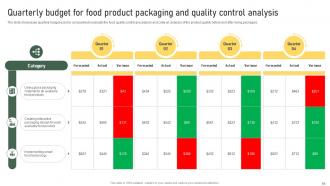
Slide 54: The slide showcases quarterly budget used by companies to evaluate the food quality control procedures and create an analysis of the product quality.
Slide 55: This slide presents an annual budget to evaluate food product quality control assurance.
Slide 56: This slide shows Table of Content for the presentation.
Slide 57: This slide exhibits KPI’s that can be followed by restaurants to ensure food quality analysis and control.
Slide 58: The slide covers KPI’s that can be used to track and evaluate the quality of food and services for continuous improvement.
Slide 59: This slide shows Table of Content for the presentation.
Slide 60: The slide showcases survey results conducted with consumers after implementing the food quality procedure and enhancing product packaging quality.
Slide 61: The slide showcases impact after implying better food technologies in packaging and quality check.
Slide 62: This slide shows Table of Content for the presentation.
Slide 63: The slide showcases dashboard representing food and beverage business performance tracking tool, which assist to evaluate monthly performance of employees.
Slide 64: This slide shows Table of Content for the presentation.
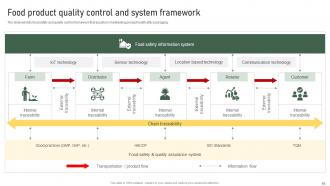
Slide 65: The slide exhibits food safety and quality control framework that assists in maintaining product health after packaging.
Slide 66: The slide provide key characteristics of food quality evaluation and monitoring system.
Slide 67: The slide exhibits steps involved in food safety and hygiene evaluation process in an organization.
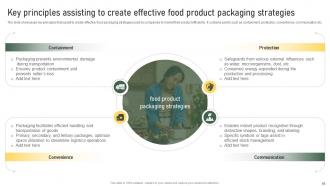
Slide 68: The slide showcases key principles that assist to create effective food packaging strategies used by companies to market their product efficiently.
Slide 69: The slide showcases types of packaging strategies that assist in optimizing food products profitability to companies.
Slide 70: The slide showcases framework of smart food packaging system adopted by companies I food industry to improve food quality.
Slide 71: This slide shows all the icons included in the presentation.
Slide 72: This slide is titled as Additional Slides for moving forward.
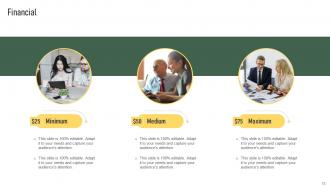
Slide 73: This is a financial slide. Show your finance related stuff here.
Slide 74: This slide provides 30 60 90 Days Plan with text boxes.
Slide 75: This is Our Team slide with names and designation.
Slide 76: This is About Us slide to show company specifications etc.
Slide 77: This is a Thank You slide with address, contact numbers and email address.
Strategic Food Packaging Improvement Solutions Powerpoint Presentation Slides with all 85 slides:
Use our Strategic Food Packaging Improvement Solutions Powerpoint Presentation Slides to effectively help you save your valuable time. They are readymade to fit into any presentation structure.










































FAQs for Strategic Food Packaging Improvement Solutions
So seaweed films and mushroom packaging are everywhere right now - honestly the performance is getting crazy good. Companies are also going hard on mono-materials since they're so much easier to recycle than those awful multi-layer things. Oh and edible coatings for produce are blowing up too. Seriously, I can't scroll LinkedIn without seeing someone's new algae wrapper lol. Just make sure your suppliers can actually handle the scale you need before diving in - learned that one the hard way with a client last year.
Look, good packaging is basically your product's first impression - it needs to work overtime. People spot a Coke bottle from across the store, right? That's what you want. Your design and messaging should tell your brand story so customers actually connect with what you're selling. Honestly, half the battle is just being memorable on the shelf. Plus if it looks cool enough for Instagram, you're getting free marketing when people post it. I'd focus on making sure everything feels consistent with your brand vibe. That's really where you'll see people coming back for more.
So packaging is pretty much your main defense against food going bad - it blocks oxygen, moisture, and light that make everything deteriorate. Barrier films keep air out, moisture absorbers stop mold, UV-blocking stuff prevents nutrients from breaking down. Modified atmosphere packaging is where things get cool though, you're actually changing the gas mix around the product. Smart packaging can boost shelf life 2-10x depending what you're working with. Fresh produce and dairy? I'd start with breathable films and temperature-stable barriers first, honestly that's where you'll see the biggest impact right away.
So basically, smart packaging uses sensors and QR codes to track your food everywhere - temperature, freshness, location, all that stuff. If something breaks in the cold chain, you'll get alerts right away instead of finding out later. The sensors actually catch spoilage before you can even see it, which is pretty genius if you ask me. Your customers can scan codes to see exactly where their food came from too. I'd probably start with just your riskiest products first and see how the numbers work out. Way better than dealing with recalls after the fact.
Honestly, packaging is all about knowing what'll kill your product first. Fresh stuff needs to breathe - think moisture control and air flow. Frozen foods? Total opposite - you're fighting freezer burn with heavy barriers. Dairy's probably the most annoying because light and temp changes wreck it fast. Snacks are more about looking good on shelves and staying crisp after opening. Ready-meals need to work in microwaves and show what's inside. Each category has different rules too, which is fun. Just figure out your main enemies - oxygen, light, moisture - then work backwards from there.
Ugh, regulations control literally everything about packaging - what materials you can use, how stuff gets labeled, all the safety requirements. FDA and USDA don't mess around with food packaging rules. You can't just choose whatever's cheapest or looks pretty, which honestly sucks sometimes. Local laws add another layer too. My advice? Factor all this compliance stuff in right from the start instead of trying to fix it later - that's always a nightmare. Oh, and definitely double-check the current rules for your specific product before you commit to anything.
Packaging is honestly a game-changer for food waste. Those barrier films and vacuum sealing can add weeks to shelf life by blocking oxygen and moisture. Modified atmosphere packaging does the same thing. Portion sizes matter too - way better than buying huge containers that go bad halfway through. I swear I've thrown out so many giant yogurt tubs over the years. The trick is figuring out what's making your specific food spoil first, then picking the right packaging tech to stop it. Could be light, air, or just time - but there's usually a solution.
Look, smart packaging is all about solving annoying problems for people. Resealable stuff, easy-open tabs, portion sizes that actually make sense - that's where you start. Tear strips are clutch, and honestly? Those clear windows so people can see the product without ripping everything open are genius. Don't forget portability either - grab-and-go sizing, things that stack nicely. Oh, and if it's microwave-safe, say so! Saves people from digging around for another container. Just figure out what frustrates your customers most when they're using the product and build the fix right into the packaging.
Yeah, upfront it's gonna hurt - like 15-40% more per unit than regular packaging. But honestly? The smart brands I know are making that money back through way less waste and better shelf life. Customers will actually pay more for it too. You'll dodge regulatory issues later, which is huge. Oh and less product spoiling means real savings over time. I'd definitely test it on whatever you sell the most of first - see if the numbers actually work before going crazy with it across everything.
Oh totally, packaging is huge for different markets. Colors mean completely different things - like white screams "pure" here but can mean death in parts of Asia, which is wild. Portion sizes are all over the place too, and some cultures want to see every single ingredient listed while others don't care as much. You've also gotta think about shopping habits - do people buy groceries daily or stock up weekly? That changes your sizing game. Religious stuff affects labels and imagery obviously. Honestly, just get local research people involved before you commit to anything. They'll save you from embarrassing mistakes.
Honestly, it's all about trade-offs. Plastic has way lower carbon emissions when they make it, but then you're stuck with waste that'll outlive us all. Paper biodegrades faster but uses crazy amounts of water to produce. Glass? Super recyclable forever, which is cool, but shipping it around creates tons of emissions because it's so heavy. Those compostable options everyone loves actually need special industrial facilities - your home compost bin won't cut it. I'd say match your packaging to how long your product needs to last, then check what recycling actually exists where you're selling. No point choosing something "eco-friendly" if it just ends up in landfills anyway.
Don't think of pretty vs. practical as opposites - they work together. Figure out your must-haves first (keeps food fresh, opens easily, etc.) then add visual stuff that actually helps people use it. Apple's packaging is overdone as an example but honestly, it works because it looks good AND makes sense. Your colors and graphics should tell people what the product does while the materials actually protect what's inside. Oh, and definitely test with real people using actual samples - not just focus groups talking about concepts. Trust me, gorgeous packaging that fails will destroy your brand way faster than boring stuff that works perfectly.
So there are basically three things to tackle: what your packaging's made of, how it's designed, and what happens after people toss it. Try switching to plant-based plastics or recycled stuff when you can. Lighter packaging = way less shipping emissions, and right-sizing cuts waste big time. Honestly those "green" labels are total BS half the time - you gotta look at the actual numbers. Oh, and make sure whatever recyclable option you pick actually works where your customers live (learned that one the hard way). Start with figuring out your current packaging's emissions first though.
So packaging really comes down to knowing how your people actually shop. What grabs them? Are they speed-shopping or do they read every label? Survey your customers about what annoys them with current packaging - that's gold. Like, families hate tiny portions but busy singles love them. If your crowd cares about the environment, skip the plastic. Honestly, I've seen brands totally miss this and wonder why sales suck. Match your packaging features to real problems they're dealing with. Convenience, sustainability, portion size - it all depends on who's buying.
Dude, temperature control is gonna be your biggest nightmare - seriously, one busted refrigerated truck and you're out thousands in spoiled inventory. Shelf-life management gets tricky too, especially when you're juggling weird package sizes that don't fit standard containers. Damage prevention is another headache since broken packaging usually means contaminated food. Oh, and everyone wants lightning-fast delivery but cheap shipping costs, which is basically impossible. My biggest tip? Find logistics companies that actually specialize in perishables. General freight companies will mess this up every time - trust me on that one.
-
Enough space for editing and adding your own content.
-
Based on my personal experience, I would recommend other people to subscribe to SlideTeam. No one can be disappointed here!