


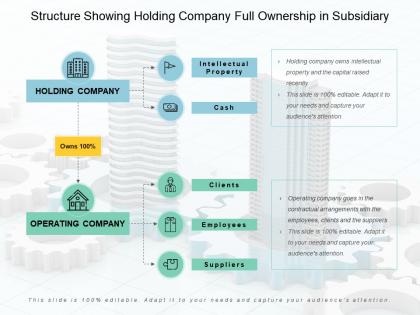
Structure showing holding company full ownership in subsidiary




Try Before you Buy Download Free Sample Product
 Impress Your
 Audience
 100%
100% Editable
 Save Hours
 of Time


Bring in the daylight with our Structure Showing Holding Company Full Ownership In Subsidiary. They will help draw away darkness.
People who downloaded this PowerPoint presentation also viewed the following :
Structure showing holding company full ownership in subsidiary with all 5 slides:
Our Structure Showing Holding Company Full Ownership In Subsidiary are empowering assets. Employ them to fashion your career.




FAQs for Structure showing holding company full
Honestly, the biggest wins are liability protection and tax benefits. Your parent company stays safe from whatever chaos happens in the individual business units. Tax-wise, you can shift income around strategically to pay less overall - though your accountant will need to handle that part obviously. Management gets way easier too since you're making decisions from the top down. Oh, and acquisitions become so much cleaner. Instead of merging everything into one giant company, you're just buying assets into separate entities. Way less messy. You'll also have more financing options and can move money around your portfolio however makes sense. Worth looking into for sure.
So basically, each subsidiary becomes its own separate legal thing. If one goes belly up or gets sued, creditors can't go after your other businesses or the main holding company. Think of it like watertight compartments - problems stay contained in just one section. You can actually take bigger swings with individual ventures without risking everything else. Just don't mix money between companies or skip the boring corporate paperwork stuff. Courts hate that and will pierce the corporate veil faster than you can say "oops." Pretty smart way to protect yourself, honestly.
So holding companies can save you serious money on taxes. Income splitting is huge - you can pay family members dividends if they're in lower brackets. Also lets you keep profits in the company instead of taking them personally right away, which defers your tax hit. Business expenses become way more flexible too, stuff you couldn't write off before. Honestly the tax code is such a mess though, and every state has different rules. I'd chat with an accountant first - they'll know what actually works in your area and won't land you in trouble.
So basically, holding companies work like this - the parent company's board handles the big picture stuff like where to put money and overall strategy. Each subsidiary still runs its own show though, with their own boards making day-to-day calls. It's way more spread out than a regular company where everything goes through one chain of command. Picture it like managing a bunch of separate businesses under one roof - they get to make their own operational decisions but have to check in on the major stuff. Honestly, the trickiest part is figuring out who gets to decide what between the parent and subsidiary levels. Otherwise you'll have people stepping on each other's toes all the time.
First thing - figure out where you want to incorporate because that'll determine your taxes, regulations, all that fun stuff. Corporate governance gets messy with multiple subsidiaries, so you need solid decision-making structures. Securities laws are honestly such a pain but unavoidable if you're issuing shares. Transfer pricing rules between the holding company and subs? Yeah, those matter too. Industry regulations depend on what you're doing obviously. Get a corporate lawyer involved early though - I learned this the hard way with another venture. Way cheaper to set things up right than clean up disasters later.
Dude, holding companies are clutch for M&A stuff. You can buy/sell at the subsidiary level without screwing up your other businesses. Everything stays separated, which is honestly genius. The consolidated balance sheet helps you get better loan terms too. Oh, and selling later? Way easier since each subsidiary is already its own thing legally. I was just dealing with something similar last month - the structure really does make a difference. Before you set anything up though, figure out which assets you want kept separate. That'll save you headaches down the road.
So basically you've got three solid options here. Getting dividends from your subsidiaries is probably your best bet - cleanest from a tax perspective. Intercompany loans are pretty handy too since you can shuffle money around when you need it. Debt's trickier because, let's be honest, holding companies don't have much to put up as collateral. If you're doing big acquisitions though, equity financing might be worth considering. I'd start by figuring out how cash actually flows between your entities right now. Just don't get too crazy with the debt - seen too many people get burned that way.
Look, holding companies basically roll up all your subsidiaries' equity into one parent balance sheet. Makes the financials look way stronger than individual companies would. The parent shows "investment in subsidiaries" as assets, but when you consolidate everything, intercompany stuff gets eliminated so you're not double-counting. Pretty smart for moving money between businesses and raising capital at the top level. Fair warning though - the accounting gets absolutely ridiculous. You'll definitely want your CPA to walk through consolidation with you because I've seen people mess this up badly.
Honestly, I'd think about it if you're looking to buy other companies or need better liability protection between different parts of your business. Multiple revenue streams? Perfect for this - like separating your real estate from IP stuff or different product lines. The setup paperwork sucks, but the protection is solid. Plus if you want investors for just one piece instead of everything, way easier to do. Tax flexibility is another win. But seriously, talk to your lawyer and accountant first - sometimes the extra complexity isn't worth it depending on your situation.
So basically a holding company spreads your risk around instead of having everything in one place. You can own pieces of totally different stuff - maybe some tech, real estate, whatever. Each investment stays legally separate, which is nice because if one goes south it won't kill your other holdings. I actually think it's one of the smarter ways to diversify. You get to move money between investments as opportunities come up too. Honestly I'd start by picking 3 or 4 sectors you're interested in, then build from there. Makes way more sense than putting everything into one thing and hoping for the best.
Honestly, start with the obvious stuff - centralize HR, IT, finance, and procurement at the holding company level. Why have each subsidiary running their own payroll when you can do it once? Standardize processes where it makes sense, but don't go crazy with it. Each sub still needs some breathing room to operate how they work best. Create these "centers of excellence" that everyone can use - basically internal consulting teams. I'd map out which functions you're doing 3-4 times across companies first. That's your low-hanging fruit right there.
Compliance gets messy real quick with this setup. Each subsidiary has its own rules to follow, plus the holding company sits on top managing everything. Different jurisdictions, different deadlines, different regulators - it's honestly exhausting just thinking about it. The good news? If one subsidiary screws up, it won't necessarily drag down the others. But here's the thing - regulators are getting smarter about looking at the big picture now. Map out all your requirements from day one (seriously, don't wing this part) and make sure your entities actually talk to each other. Communication breakdowns are where things go sideways fast.
Honestly, holding companies are pretty solid for risk management. You're not putting everything in one bucket - different subsidiaries, different industries, different problems. One business goes south? The others keep you afloat. But here's the catch - you'll be drowning in paperwork and oversight. Tracking risks across multiple entities gets messy fast. I'd set up some kind of regular reporting system from each subsidiary so you can actually see what's happening before things blow up. Then you can decide if it's worth throwing more money at a problem or just cutting your losses and moving on.
Honestly, it's mostly about complexity and money. You'll have separate tax filings for each company - my accountant friend always complains about clients who do this without thinking it through first. More paperwork, higher fees, way more compliance stuff to track. Short version: it gets messy fast. Also if you screw up the formalities between companies (separate accounts, proper meetings), you lose the liability protection anyway. Makes the whole thing pointless. I'd definitely run it by both a CPA and lawyer before doing anything. Sometimes the headache just isn't worth it.
So basically, you set up separate subsidiaries in each country you want to expand into. Each one follows local rules without messing up your main company or other markets. Think of it like having different bank accounts for different projects - probably a bad analogy but whatever. If one market crashes, your whole business doesn't go down with it. You can even bring in local partners for specific regions while staying in control. The boring part is you'll need to dig into corporate laws for each target country first, but that's where you start.
No Reviews