

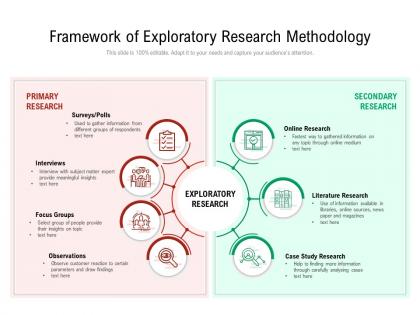
Framework of exploratory research methodology




Try Before you Buy Download Free Sample Product
 Impress Your
 Audience
 100%
100% Editable
 Save Hours
 of Time


Generate demands with our Framework Of Exploratory Research Methodology. They give birth to fresh desires.
People who downloaded this PowerPoint presentation also viewed the following :
Framework of exploratory research methodology with all 2 slides:
Be astounding with our Framework Of Exploratory Research Methodology. Generate applause from the audience.
FAQs for Framework of
Three things you gotta lock down first: who exactly you're studying (not just "customers" - be specific like "first-time buyers 25-40"), what problem you're actually investigating, and your budget/timeline. Honestly, exploratory research is a rabbit hole waiting to happen if you're not careful. Write your main research question in one sentence - if you can't, it's too broad. Oh, and don't underestimate how quickly this stuff expands. I've seen projects that started as quick user interviews turn into month-long deep dives because someone didn't set clear boundaries upfront.
So basically exploratory research is your "wtf is even happening here" phase - perfect when you're diving into something totally new. Descriptive research measures what's actually going on right now, and causal research tests if X really causes Y through experiments. I usually think of it like: exploratory = brainstorming (interviews, focus groups), descriptive = measuring stuff (surveys, data), causal = testing theories. Most projects work better if you start exploratory first, then move to the others. Honestly though, if you don't even know what questions to ask yet, definitely go exploratory.
Honestly, qualitative data is where you want to start with exploratory research. It's all about understanding the "why" behind what people do - super messy but that's where the good stuff is. Interviews, focus groups, just watching people... it gives you context that numbers can't. You're basically generating hypotheses and finding themes you wouldn't have thought to look for otherwise. Particularly helpful when you're diving into something totally new or trying to figure out weird human behavior (which, let's be real, is most human behavior). Get your qual insights first, then use those to shape whatever quantitative work comes next.
Hey! So for exploratory research, non-probability sampling is definitely the way to go. You're not trying to prove anything yet - just digging around for insights. I'd start with convenience sampling since it's super straightforward. Purposive sampling works well too if you want to be more targeted about who you're talking to. Oh, and snowball sampling is clutch when you're dealing with populations that are hard to find (which honestly can be a nightmare sometimes). These methods are flexible, so you can pivot as you figure out what you're actually looking for. Don't overthink it initially.
Triangulation is your best friend here - basically cross-checking findings with multiple data sources or methods. Document everything obsessively from the start (trust me on this one). Traditional validity measures won't work since exploratory research is supposed to be messy. Be brutally honest about your process and limitations. Member checking helps too - go back to participants and see if your interpretations actually make sense to them. Oh, and rigorous methods matter way more than statistical significance for building credibility. The transparency piece is huge.
Honestly, I'd start with interviews and focus groups first - way better for finding stuff you didn't expect. Then hit them with surveys to see if those patterns hold up with more people. There's tons of digital tools now that make remote research actually doable (thank god). But here's the thing - sometimes just watching what people do beats asking them directly. Social listening is clutch too for grabbing real opinions from Reddit and Twitter. My take? Go broad and messy first, then tighten up once you see what's actually happening.
Look, exploratory research is basically your best friend for building good hypotheses. You dig through interviews and data, then boom - patterns start jumping out that you never would've thought to test. Those "wait, that's weird" moments? Pure gold. I always tell people to write down everything, even the random outliers, because they usually point to stuff you need to account for later. My advice? Do some quick exploratory work before your main study. Use what you find to write hypotheses that actually make sense for what's really going on. Trust me, it beats guessing.
Honestly, the worst thing you can do is jump in without knowing what you're actually trying to learn - you'll drown in random data that looks cool but means nothing. Don't ask leading questions either. I've seen people basically interview themselves through their participants, which is pointless. Your sample size still matters here, even if it's just exploratory stuff. Three people won't tell you much. Stay open to being wrong about your initial ideas - that's actually where the good insights come from. Set a deadline or you'll be researching this thing until you're 90.
Set up your processes before diving in - that's honestly the biggest thing. Get multiple people checking your work and write down why you're making certain decisions. I know exploratory research feels super subjective since you're hunting for hidden patterns, but that's exactly why you need those safety nets. Keep a journal where you track your assumptions and biases as they pop up. Document everything, even the stuff that seems obvious later. Most importantly? Always ask "what else could this mean?" Don't get married to your first interpretation - challenge yourself before calling it done.
Look, I know it sounds backwards, but doing exploratory research actually makes you *faster* in the long run. You catch problems early before you've blown your budget on them. Quick user interviews or testing rough prototypes - even just a week of this stuff - can save you from building features that nobody gives a damn about. I've watched entire teams spend months on products that flopped because they skipped this step. It validates whether you actually understand your audience and competition. The trick is keeping it scrappy, not getting stuck in analysis paralysis. Think of it as insurance against wasting time later.
Informed consent is your biggest thing here - people don't always get where exploratory stuff might go. Be upfront about data use, even when your research shifts direction later (which it will). Privacy gets tricky because you're grabbing all this messy, unstructured data that might accidentally expose sensitive stuff. Document your ethical calls as you go since things move fast. Honestly, I'd make a quick ethics checklist before starting - trust me, it'll save you when everything gets chaotic. Also watch out for vulnerable populations. Discovery mode makes it way too easy to overstep without realizing it.
Honestly, most execs won't touch anything past page 2, so lead with your biggest "wow" finding right away. Skip the methodology stuff - nobody cares how you got there. Instead, tell a story that connects your research to problems they're actually losing sleep over. Dashboards and visuals beat dense reports every time. I learned this the hard way after watching too many eyes glaze over during presentations. Structure everything around themes with clear next steps. Real quotes from participants make it stick way better than just throwing numbers at people. Build your supporting evidence around that killer insight you led with.
Tech companies absolutely crush it with exploratory research because user habits change overnight. Healthcare and finance see massive wins too - they've got to dig deep into customer problems before building anything. Manufacturing's even getting into it now, which honestly surprised me at first. But it makes sense since everything's moving so fast these days. The sweet spot is when you're dealing with uncertainty or breaking into new markets. Short version: if your industry involves innovation or customer headaches, you should definitely try it. Works like magic when you don't know what you don't know.
Honestly, tech has completely changed exploratory research - you can scrape social media for trends, use AI to find patterns in huge datasets, or throw together quick online surveys. The speed is insane compared to old-school methods. But (and this might sound obvious) you still need human gut instinct to ask the right questions and figure out what all that data actually tells you. I'd probably start with what you're trying to learn first. Then work backwards to see which tools make sense. Way better than getting caught up in fancy tech just because it exists.
Oh man, Netflix is the classic example - they figured out streaming was the future while Blockbuster was still obsessing over late fees. Twitter's story is even crazier though - it literally started as a podcast platform until they realized users just wanted to post random 140-character thoughts instead. Then there's Post-it Notes, which happened because 3M scientists created this "useless" weak adhesive that couldn't stick properly. I mean, talk about happy accidents. The pattern here? Don't get tunnel vision with your research. Sometimes the best discoveries come from stuff you weren't even looking for in the first place.
No Reviews