

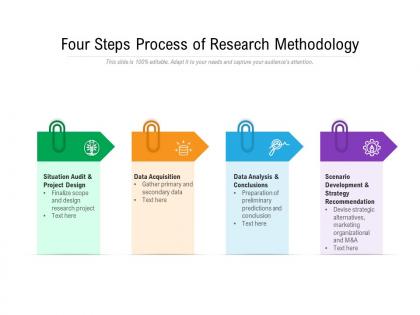
Four steps process of research methodology




Try Before you Buy Download Free Sample Product
 Impress Your
 Audience
 100%
100% Editable
 Save Hours
 of Time


Out Four Steps Process Of Research Methodology are apt for any generation. X or Y is of little concern.
People who downloaded this PowerPoint presentation also viewed the following :
Four steps process of research methodology with all 2 slides:
Generate empathy with our Four Steps Process Of Research Methodology. Develop the correct feelings in the audience.
FAQs for Four steps process
Okay so first thing - figure out if you're doing quantitative, qualitative, or mixing both. Then nail down your sampling strategy and how you'll actually collect the data. Your lit review obviously comes first to set everything up. But here's what I learned the hard way: decide your analysis plan NOW, not later when you're staring at a mountain of data going "wtf do I do with this." Also don't forget ethics approval and making sure your stuff is actually valid. So many people leave methodology till the end and then hate themselves for it.
So basically, quantitative is all about numbers and stats - surveys, experiments, that kind of thing. Perfect when you need to prove something with hard data. Qualitative is the opposite though. It's messy but way more interesting imo. You're digging into the "why" behind stuff through interviews and observations. Like, quantitative tells you what's happening, but qualitative explains why people actually do things. I'd go quantitative if you need solid proof for something. But start with qualitative if you're still figuring out what questions to even ask. Does that help?
Okay so basically you're looking at what's already been tried in your area - what worked, what bombed completely. This saves you from making the same mistakes everyone else did (trust me, there's always some obvious pitfall that seems genius until you read about it). Find 3-4 solid studies that did something similar to your plan. You can literally borrow their methods and tweak them for your questions. It also gives you backup when reviewers start questioning your choices - you've got evidence that these techniques actually produce results. The lit review shows you gaps too, which is where you can jump in with something new.
First thing - get that IRB approval sorted before you do literally anything else. I know the paperwork is a pain, but it's your safety net. Get proper consent from everyone, keep their data locked down, and be upfront about any risks or conflicts you might have. Your research design matters too - make sure you're not accidentally screwing over certain groups or introducing weird bias. Oh, and document everything because you'll need to defend your choices later. Honestly? Just dive into your school's ethics guidelines right away and bake that stuff into your plan from the start.
Honestly, mixed methods is pretty great because you get those deep qualitative insights AND solid stats to back everything up. But fair warning - it's a ton more work and takes forever compared to just picking one method. You'll need to be decent at both qual and quant analysis too, which... yeah, that's rough if you're way better at one than the other. Some professors can be weird about it and act like you're not being "pure" enough methodologically or whatever. Still, if you've got the time and your research question is complicated, it's probably your best bet for actually getting good answers.
Honestly, your sampling method makes or breaks everything. Bad sampling = your results won't mean much outside your study group. Random sampling is ideal but I get it, convenience sampling is so much easier when you're stressed about deadlines. Just know it can mess with your validity big time. Biased samples also create reliability issues since different studies end up with wildly different results. Oh and definitely call out your sampling limitations early on - like, be brutally honest about them. Reviewers actually respect that transparency way more than pretending your method was perfect.
Start with super specific research questions that connect to things you can actually measure. Don't do double-barreled questions - seriously, I've watched so many surveys crash and burn because someone tried jamming two different ideas into one question. Use validated scales if they exist, and definitely test it out first with a small group. Your answer choices need to cover everything without overlapping. Oh, and length matters way more than people think - nobody wants to spend 20 minutes on your survey. I always pilot with at least 10-15 people and time it. Trust me on this one.
Oh case studies are perfect for this kind of thing! You can really dig into the messy details that surveys totally miss. Like instead of just knowing *what* happened, you get the full story of how and why everything went down. I'm probably biased but they're my go-to for complicated research questions. The cool part is mixing different data sources - interviews, observations, documents, whatever. Just pick cases that actually connect to your research question (sounds obvious but you'd be surprised). Then stay organized with your analysis or you'll drown in data.
So it depends on a few things - what kind of study you're doing, how confident you want to be (95% is pretty standard), and how much error you can live with. Population size matters for surveys too. The math gets messy fast tbh. For basic surveys, just use an online calculator and plug in your numbers. More complex stuff like experiments? Try G*Power - it's free and actually decent. I'd figure out what precision you really need first, then work backwards. No point overthinking it if you don't need super exact results.
So if you need hard numbers and stats, stick with surveys, experiments, and structured observations - that's your quantitative stuff. Want deeper insights instead? Go for interviews, focus groups, or participant observation. Honestly, some methods work for both approaches anyway (like surveys with open-ended questions). Just match whatever method fits what you're actually trying to figure out. Numbers and patterns = quantitative. Understanding the "why" behind people's weird behaviors = qualitative. Don't just pick what seems less intimidating - base it on your research questions.
Start by coding your data - basically just labeling themes and patterns you notice. I do this in waves, broad stuff first then dive deeper. NVivo or Atlas.ti are lifesavers if you've got mountains of data (spreadsheets turn into a nightmare, trust me). Hunt for patterns that keep popping up, contradictions, weird stuff you didn't expect. Be systematic but don't force your data into boxes you've already decided on - let it tell its own story. Oh, and document everything you're thinking because you'll need to back up your conclusions later. The whole process is messier than it sounds but way more interesting.
Your research design is literally the foundation of your whole study - it decides what data you collect, how you collect it, and what methods you'll use to analyze everything. Without one, you're basically throwing darts blindfolded and hoping something sticks. A good design makes sure you're asking the right questions the right way so you can actually answer what you set out to prove. It directly impacts whether your results are valid and reliable. Honestly, I've seen too many studies fall apart because people skipped this step and ended up with data that proved absolutely nothing.
Okay so variables and controls are basically what make or break your whole experiment. You've got your independent variable - that's what you're changing on purpose. Then your dependent variable is what you're actually measuring to see what happens. But here's the thing that trips people up - you need to control all the random stuff that could screw with your results. I always tell people to literally list out every single thing that might affect your outcome, even if it seems dumb. Then figure out which ones to control, manipulate, or measure. Most failed studies happen because someone missed an obvious confounding variable.
Honestly, it's mostly about not having enough of what you need - time, money, people to study. Your amazing research plan? Yeah, reality's gonna hit hard. Data collection always drags on forever, especially with tricky populations or awkward topics. Then there's waiting around for ethics approval (ugh) or realizing halfway through that your whole approach is garbage. Oh, and technology will definitely betray you at the worst moment. Build extra time into everything. Have backup plans. Trust me on this - I learned the hard way when my survey platform crashed during finals week.
So triangulation is basically using multiple sources to back up your findings - think interviews plus surveys plus observations. Different methods pointing to the same conclusion? That's gold. You'll catch bias from single approaches and spot stuff you'd otherwise miss. Honestly, getting input from various stakeholder groups is clutch too. Even just adding one extra data collection method makes your research way more solid. It's like having several people witness the same thing instead of relying on just one person's story. Makes your whole argument much harder to poke holes in.
No Reviews