

Org chart for holding and subsidiary companies





Try Before you Buy Download Free Sample Product
 Impress Your
 Audience
 100%
100% Editable
 Save Hours
 of Time


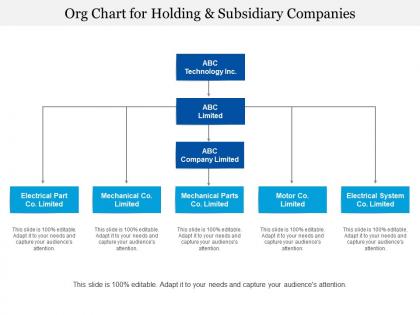
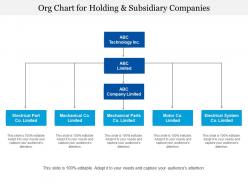
Uncover your thoroughly studied business technology concepts through, an org chart for holding and subsidiary companies PPT template. We have shown a four-stage process to include your subsidiary companies in the PPT spreadsheet. This PPT deck can also be used to explain your company's organization chart and project team structure. Edit the colors and incorporate your data and portray precise and clear information. Report the process on our org chart for holding and subsidiary companies PowerPoint design and make a record of every detail. Satisfy cravings and give them a taste of what they want and more, with our technology PowerPoint templates. Cement your bonds with our Org Chart For Holding And Subsidiary Companies. They acquire added durability.
People who downloaded this PowerPoint presentation also viewed the following :
Org chart for holding and subsidiary companies with all 5 slides:
Even disbelievers begin to come around due to our Org Chart For Holding And Subsidiary Companies. It has an impelling impact.


FAQs for Org chart for holding
Start with who reports to who - that's your foundation. Make sure everyone knows what they're actually responsible for, not just job titles. Decision-making authority is huge too. I can't tell you how many places I've worked where five people think they're the final say on something. Communication channels matter, but honestly? Don't overthink the fancy stuff. Managers need the right number of direct reports - not too many, not too few. Your structure should fit what you're trying to accomplish as a company. Skip the pretty org charts until you've nailed down the basics first.
Oh man, this stuff totally matters for team vibes. Flat structures are great - people feel empowered and decisions happen fast. But sometimes it's like herding cats, you know? Hierarchical setups can drag with all those approval chains, though at least everyone knows who's in charge. Matrix structures? Honestly, they stress people out with all the competing priorities and confusion. You really gotta match whatever structure to your company's vibe. My advice? Survey your team first about what's bugging them daily before changing anything major.
Company culture is basically your org chart's DNA. Collaborative, innovative cultures? They usually go flat with cross-functional teams. Traditional places that hate risk stick with rigid hierarchies and clear chains of command. I've watched companies try to jam square pegs into round holes - forcing structures that totally clash with their culture. Never works. People just fight the system constantly. Your structure has to match how your team actually wants to work together, not some theoretical ideal. So before any big org changes, ask yourself: does this fit who we really are? Otherwise you're setting everyone up for frustration.
Honestly, first figure out what size and complexity you're actually dealing with. Map out how decisions move through your company right now - is it total chaos or are you stuck in bureaucracy hell? Your industry matters too. A tech startup obviously can't run like some old manufacturing plant. Here's what I'd do: sketch out your current processes, then spot where things get bottlenecked or communication completely breaks down. Don't go copying structures that just look impressive on paper. Test small tweaks before you blow everything up with a major reorg. The structure should match how work actually flows, not some textbook ideal.
So flat structures cut out middle management, which is great for faster decisions and direct communication between the top and your actual workers. People feel way more empowered without all those layers watching over them. But honestly? It gets chaotic when you start growing because everyone reports to like one person, and there's nowhere to get promoted to. You lose that specialized knowledge middle managers usually have too - which actually matters more than people think. Only works if your team can handle having more responsibility dumped on them. Otherwise you're screwed.
So tech is basically flipping how companies can be structured now. Remote work tools mean you don't need everyone crammed in one office anymore - plus flatter hierarchies actually work since digital communication is so much smoother. AI and automation are cutting out middle management layers (which honestly makes sense for a lot of companies). Data analytics help teams make quick decisions without waiting for approvals up the chain. The pandemic really sped all this up too. Bottom line? Don't just slap new tech onto your old setup. Think about rebuilding how things could actually flow better with what's available now.
Dude, most restructures crash and burn because nobody tells people what's happening - then everyone freaks out. Be super upfront about why you're doing this and what things will look like after. Get your managers trained first since they'll deal with all the angry questions. Map out the role changes clearly and build transition teams mixing old and new people together. Don't rush the timeline though, that's where companies always screw up. Find your change champions early - those people who actually get excited about new stuff and can help convince the doubters. Oh, and celebrate the small wins! People need to feel like it's working or they'll give up.
Honestly, remote work totally changes how hierarchy works - not on paper, but in real life. Junior people can now message executives directly instead of going through their boss first. Middle managers hate this because they used to control who talked to who. Information spreads faster since everyone's using the same chat tools and video calls. Your company's org chart looks identical, but daily interactions feel way more equal. I've seen CEOs respond to random employees' Slack messages, which would never happen in an office hallway. You still need some structure though, just gotta be smart about it.
Yeah, your industry totally shapes how you organize. Tech goes flat because they're moving fast and need quick decisions. Manufacturing? Way more hierarchy - makes sense when safety's on the line. Healthcare gets messy with matrix structures since doctors and admins both need to be in charge of different stuff. Financial companies are super rigid too, but that's just compliance being a pain. Startups are honestly a hot mess until they figure out what they're doing. Really depends what matters most - speed, safety, following rules, or just trying not to break things while you grow.
Skip-level meetings are clutch for this. Also try cross-functional teams - gets people talking outside their normal bubbles. Town halls can work but make them interactive, not just executives droning on (we've all been there). Coffee chats with leadership are popular, though honestly they sometimes feel awkward. Anonymous surveys help too since people won't always speak up face-to-face. The biggest thing? You've got to walk the walk yourself. Be visible, approachable across all levels. Oh, and make sure feedback actually flows upward - that's where most orgs mess up.
Think of your org structure as the highway system for change - clear reporting lines mean everyone knows who's steering and what they need to do. Flat orgs move super quick but can get messy without coordination. Hierarchical ones? You'll have more control but things crawl. Honestly, there's no perfect setup. What matters is picking the right structure for whatever change you're rolling out. I'd start by figuring out who actually needs to be in the loop, then trace how decisions will bounce between teams. It's kinda like drawing a map before you start driving.
So cross-functional teams are basically when you grab people from different departments - marketing, engineering, finance, whatever - and throw them together on a project. Honestly, it's one of the best ways to actually get things done because nobody's stuck waiting for another team to make decisions. Communication gets way better too. The tricky part is making sure everyone knows what they're supposed to be doing from day one, otherwise it turns into chaos pretty quick. Also define what success looks like upfront - trust me on that one. They're great for tackling those messy problems that cross multiple departments.
Honestly, just track how fast decisions get made and whether people can actually do their jobs without bureaucratic nonsense. Check if the right folks have authority to make calls. Employee surveys are gold here - frustrated teams mean broken structure. I'd also watch project timelines and where work gets stuck. Communication clarity matters too. Like, can someone explain their role in 30 seconds without confusion? Quick gut check: survey your team about what's driving them crazy. They'll roast the structure's weak spots better than any consultant. Bottom line - does your setup help people deliver or just create more meetings?
Honestly, most startups do best when they keep things super flat - Buffer and GitLab are great examples where everyone just jumps in on whatever needs doing. But once you hit like 50-100 people? You'll need more structure or things get messy fast. Big companies have to go with divisional setups (Google's Alphabet thing) or matrix structures where you report to multiple managers - which sounds awful but somehow works at Microsoft. Speed matters more when you're small, but coordination becomes everything when you're dealing with thousands of employees. Start simple, add layers later when you absolutely have to.
Honestly, rigid hierarchies are death for agility. Your org needs to pivot fast when shit hits the fan. Cross-functional teams work way better than having everything go through five approval layers - I've seen companies die waiting for decisions from the top. Look at Netflix constantly reshuffling vs old media giants still confused about streaming. Push decision-making down to people actually doing the work. Network structures beat pyramids every time. Temporary project teams help too. Start small though - find your biggest bottlenecks first, then try flatter approaches. You don't need to blow everything up at once.
No Reviews