

Sustainable Farming Investor Presentation Ppt Template




Try Before you Buy Download Free Sample Product
 Impress Your
 Audience
 100%
100% Editable
 Save Hours
 of Time


The agriculture pitch deck caters to capital-raising initiatives for one of the pioneers in the agriculture industry with a focus on serving farming communities. Here is a competently designed Sustainable Farming Investor Presentation, effectively attracting investors by distilling the company in a condensed and marketable message for potential investors. This deck grabs investors attention through slides depicting the importance of investment in agriculture, the possible market opportunity in apple, market growth in the agriculture sector, problems existing at present, addressing reasons for soil yield loss, and the competitive advantage of agriculture firms. Grab investors attention through slides depicting salient features of agriculture products offered by the firm, essential services offered, plant health tracking, and protective initiative. It also describes investment opportunities, the global capital market platform for a firm, a profitable business model, impressive financial highlights, and a competitive assessment of major players existing. Lastly, it concentrates on key people involved, the board of directors associated, and future initiatives by agriculture firms to manage potential stakeholders. Get access to this powerful template now.
People who downloaded this PowerPoint presentation also viewed the following :
Content of this Powerpoint Presentation
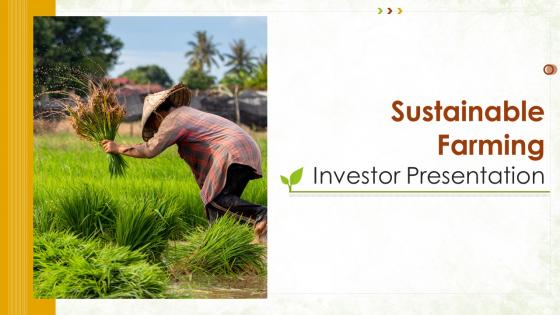
Slide 1: This slide displays the title Sustainable Farming Investor Presentation
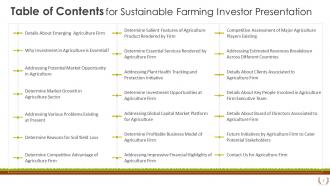
Slide 2: This slide exhibit table of content.
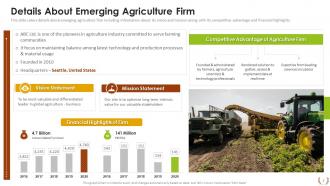
Slide 3: This slide caters details about emerging agriculture firm.
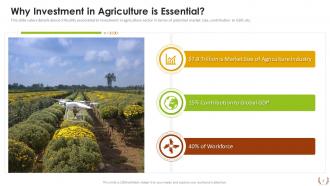
Slide 4: This slide caters details about criticality associated to investment in agriculture sector in terms of potential market size, contribution to GDP, etc.
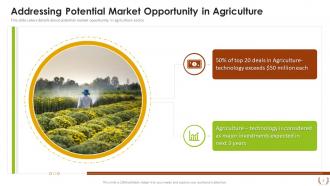
Slide 5: This slide caters details about potential market opportunity in agriculture sector.
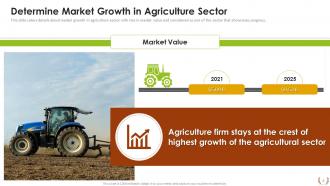
Slide 6: This slide caters details about market growth in agriculture sector with rise in market value and considered as one of the sector that showcases progress.
Slide 7: This slide caters details about various problems existing at present in terms of poor soil fertility, poor crop yields and rise in global population.
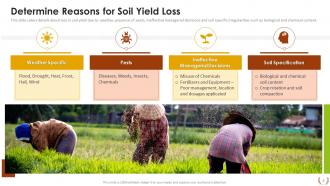
Slide 8: This slide covers Determine Reasons for Soil Yield Loss.
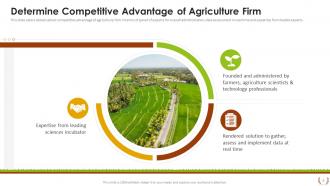
Slide 9: This slide covers Determine Competitive Advantage of Agriculture Firm.
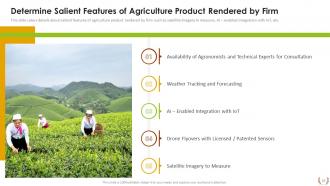
Slide 10: This slide caters details about salient features of agriculture product rendered by firm.
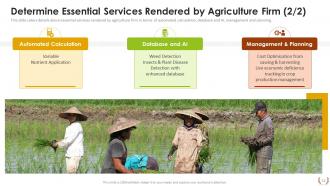
Slide 11: This slide caters details about essential services rendered by agriculture firm.
Slide 12: This slide caters details about essential services rendered by agriculture firm.
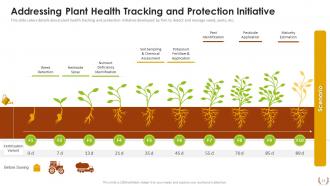
Slide 13: This slide caters details about plant health tracking and protection initiative developed by firm to detect and manage weed, pests, etc.
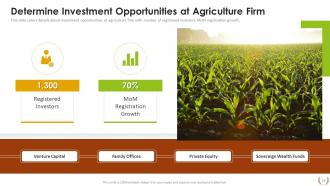
Slide 14: This slide caters details about investment opportunities at agriculture firm with number of registered investors, MoM registration growth.
Slide 15: This slide caters details about global capital market platforms for agriculture firm.
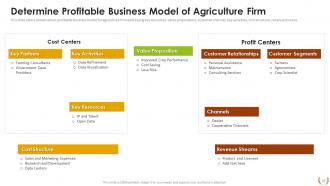
Slide 16: This slide caters details about profitable business model for agriculture firm.
Slide 17: This slide caters details about impressive financial highlights of agriculture firm in terms of consolidated turnover, equity, solvency ratio, EBITDA, etc.
Slide 18: This slide caters details about competitive landscape of various competitors existing in agriculture market by comparing them on various parameters/ features.
Slide 19: This slide caters details about estimated revenues breakdown for agriculture firm across different countries.
Slide 20: This slide caters details about clients associated to agriculture firm in terms of major clients and client testimonials.
Slide 21: Details About Key People Involved in Agriculture Firm Executive Team
Slide 22: This slide caters details about board of directors associated to agriculture firm.
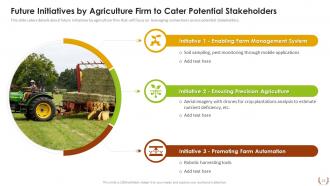
Slide 23: This slide caters details about future initiatives by agriculture firm that will focus on leveraging connections across potential stakeholders.
Slide 24: This slide display Contact Us for Agriculture Firm.
Slide 25: This slide presents title for additional slides.
Slide 26: This is the icons slide.
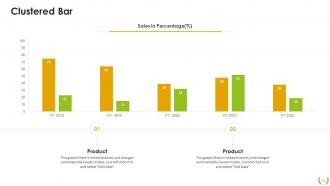
Slide 27: This slide display Clustered Bar to showcase sales of two products.
Slide 28: This slide showcase Our Target.
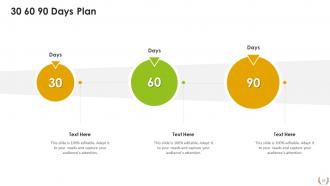
Slide 29: This slide depicts 30-60-90 days plan for projects.
Slide 30: This slide shows puzzle for displaying elements of company.
Slide 31: This slide display Important Notes.
Slide 32: This slide exhibit Timeline.
Slide 33: This slide display Venn.
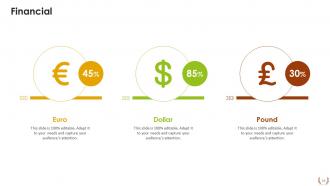
Slide 34: This slide showcase Financial.
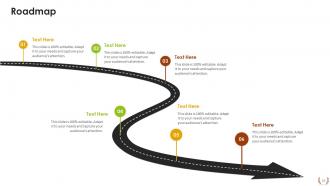
Slide 35: This slide shows roadmap of company.
Slide 36: This is thank you slide & contains contact details of company like office address, phone no., etc.
Sustainable Farming Investor Presentation Ppt Template with all 41 slides:
Use our Sustainable Farming Investor Presentation Ppt Template to effectively help you save your valuable time. They are readymade to fit into any presentation structure.















FAQs for Sustainable Farming Investor
So basically you're working *with* nature instead of fighting it. Crop rotation, composting, way less chemicals - that whole deal. Conventional farming is all about maxing out this year's harvest, but sustainable stuff thinks decades ahead. Biodiversity over those massive single-crop fields too. Oh and water conservation is massive. Honestly it's like... forcing vs flowing, you know? My cousin got into permaculture last year and won't shut up about it, but she's got some wild examples if you're interested. Check out local groups - they're usually pretty cool about sharing what actually works.
Look, if your soil sucks, you're basically screwed from the start. Good soil with lots of organic matter holds water way better and feeds itself - less money spent on fertilizers and irrigation. Plus it actually pulls carbon out of the air, which is pretty neat. Degraded soil? You'll be throwing inputs at it constantly just to keep things alive. Not fun for your wallet or the environment. Get a soil test done first though - check the organic matter and pH levels. That'll show you exactly what you're working with instead of just guessing.
Look, crop rotation is honestly game-changing for your farm. Different plant families each year breaks up pest cycles and keeps your soil from getting stripped of nutrients. Legumes are like nature's little fertilizer factories - they actually pump nitrogen back into the ground for whatever you plant next. My neighbor swears by his 4-year rotation and his yields have been consistently better than the monoculture guys. Disease patterns get totally disrupted too, so you won't need as many chemicals. Start with something simple, maybe 3-4 crops. Your bank account will definitely notice the difference.
Dude, the tech stuff for farming is honestly pretty wild these days. GPS tractors and soil sensors let you put fertilizer and water exactly where it's needed - no more guessing. Drones can catch pest problems before they get crazy, and those smart irrigation systems? They'll slash your water use by like 30-40%. The data you get is actually useful too - real-time updates on soil and crop health. Oh, and vertical farming is getting huge now. AI crop management sounds fancy but it works. I'd probably start simple though - maybe soil testing equipment or basic weather monitors. Don't go all-in right away.
Honestly, drip irrigation is a game changer - way better than those sprinklers that just waste water everywhere. Get some mulch around your plants too, keeps the soil from drying out so fast. Oh and if you're thinking about what to plant next season, drought-resistant varieties are clutch. Cover crops help a ton with soil health, which actually makes a bigger difference than you'd think for water retention. I'd start with the drip system first though - yeah it costs upfront but you'll see the savings pretty quick on your water bill.
Honestly, the trick is watching pest numbers instead of panicking over every bug you see. Set actual thresholds - like only spray when they'll actually hurt your yield. Get beneficial insects working for you, rotate crops, try companion planting. I know a guy who dropped his pesticide use 60% just doing this stuff. When you do need chemicals, be surgical about it - no carpet bombing the whole field. The goal is building an ecosystem where good bugs eat the bad ones. Oh, and definitely start with just one field so you can track what's actually working. Way less stressful than going all-in everywhere.
Yeah, monoculture farming is honestly terrible for the environment. Same crops keep sucking out identical nutrients, so your soil gets completely trashed. Plus pests and diseases can destroy everything - I remember this corn farmer who lost his whole harvest to some nasty fungus. Brutal stuff. Diverse systems are way better though. They rebuild soil naturally, need less pesticides, and wildlife actually thrives. Your farm becomes way more resilient too. If you're considering switching, maybe try companion planting first? Or cover crops - just something small to see what works for you.
Dude, sustainable farming is like building little wildlife havens instead of those boring single-crop fields. Crop rotation and cover crops give animals actual homes. You're not constantly spraying pesticides either, so bees and other helpful bugs can actually survive - which is huge for keeping pests under control naturally. Different plants create these wildlife highways that connect habitats. Animals can move around easier that way. Honestly, even just planting native flowers along your field edges makes a noticeable difference. You'd be surprised how quickly you'll see more birds and pollinators showing up.
Honestly, the money thing hits first - certification fees, different equipment, cover crops when you're not even making organic prices yet. During that 2-3 year transition you're basically spending more while still selling at regular rates, which kinda sucks. Your yields will probably drop initially too while the soil figures itself out. Learning all the new techniques is a whole different ballgame from conventional methods. Way more labor-intensive stuff. I'd definitely try it on just one field first - test things out, see what works before you commit to switching everything over. The learning curve's no joke.
Honestly, the easiest thing is just changing where you shop - hit up farmers markets or join a CSA if there's one near you. Community gardens are pretty cool too (though mine's always drama about who waters what lol). You could also bug your city council about protecting farmland from developers - that stuff actually works sometimes. Farm-to-table restaurants help farmers stay profitable, which is huge. Oh, and if you've got kids, push for garden programs at their schools. Sounds small but farmers need customers who care about how food's grown. Every purchase counts.
So basically, sustainable farming pulls CO2 straight from the air and locks it in soil. Cover crops and less tilling are huge for this. You'll also slash emissions by cutting back on synthetic fertilizers - those things take crazy amounts of energy to make. Rotational grazing builds healthier soil too while storing more carbon. The cool part? Better harvests AND you're helping the environment. My neighbor switched last year and swears by it. If you're thinking about trying this, get your soil tested first to see where your carbon levels are at, then go from there.
Hey! So sustainable farming actually saves you money in the long run. Input costs drop big time - you're buying way less fertilizer and pesticides. Soil gets healthier too, which means better yields without dumping cash into amendments. The premium pricing thing is real - people will pay more for sustainable stuff. Government incentives are pretty decent right now if you can navigate the paperwork (ugh). Cover cropping is probably your best bet to start with. Won't break the bank and you can see if the whole thing works for your operation.
Honestly, it's all about where you spend your money. Buy organic or local stuff and farmers notice - they see there's actual profit in doing things sustainably. Your grocery choices are like votes that actually count for something. More people buying these products means more farmers can afford to ditch the conventional methods (which, let's be real, are usually cheaper upfront). Supply just follows demand, so when you check labels and ask where food comes from, you're creating market pressure. Pretty simple concept, but it works.
So agroecology is basically farming that works with nature instead of against it. You design your farm like an actual ecosystem - crop rotation, beneficial bugs, healthy soil, the whole deal. Way more elegant than just spraying chemicals everywhere, honestly. Everything supports everything else, so maybe you intercrop instead of doing monocultures, or use cover crops to handle pests naturally while building soil fertility. My uncle tried this approach and swears by it now. If you're thinking about switching, don't go all-in right away. Start with one field first and see how it works on your specific land.
Honestly, it all comes down to money - farmers won't switch unless it pays better. Right now subsidies prop up industrial farming, but we need those going to regenerative stuff instead. Tax breaks for cover crops and biodiversity help too. Carbon credits are actually pretty cool - farmers get paid just for storing carbon in their soil. The organic certification process is a nightmare though, so streamlining that would be huge. Also funding more research into sustainable methods. I mean, if you can make sustainable farming more profitable than conventional, that's when you'll see real change happen.
-
Awesome use of colors and designs in product templates.
-
“You have the structure in place that are easy to explore new opportunities.I will be recommending your services to other people.”