

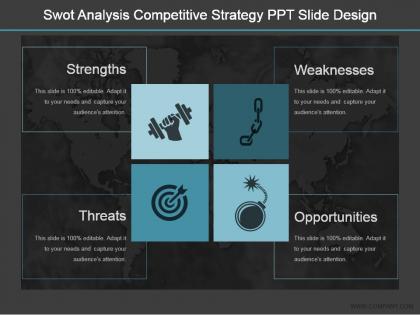
Swot analysis competitive strategy ppt slide design
You must be logged in to download this presentation.




Try Before you Buy Download Free Sample Product
 Impress Your
 Audience
 100%
100% Editable
 Save Hours
 of Time


Our Swot Analysis Competitive Strategy Ppt Slide Design are a delight to deal with. They ensure you enjoy all the effort.
People who downloaded this PowerPoint presentation also viewed the following :
Swot analysis competitive strategy ppt slide design with all 5 slides:
Coordinate your plans with our Swot Analysis Competitive Strategy Ppt Slide Design. Get all the elements on the same wavelength.

FAQs for Swot analysis competitive strategy
Honestly, most startups are drowning in weaknesses so don't stress too much about that section! Start with your team's actual skills and any real customer traction you've got - that's your strengths. Market trends and untapped customer segments are obvious opportunities. Threats? Bigger competitors and funding drying up, obviously. The tricky part is being brutally honest about your current situation instead of getting all dreamy about future plans. Oh, and don't forget stuff like missing expertise or zero brand recognition - basically the reality check nobody wants to write down.
Honestly, SWOT is pretty solid for finding opportunities you might miss otherwise. Look at what you're good at, then see where competitors are dropping the ball - that's usually where the gold is. The opportunities section is obvious, but I actually think the real value comes from mixing everything together. Maybe there's some trend happening that plays perfectly to your strengths, you know? Even threats can be sneaky opportunities sometimes. Like if new regulations hit but they actually help your business model. I'd start simple - just list your top 3 strengths and see what market gaps they could fill.
Dude, you NEED customer feedback for your SWOT or you're basically just patting yourself on the back. Get surveys, read reviews, actually talk to people - then spread those insights across all four sections. Your team might think the product rocks, but customers could be saying something totally different. That's pure gold for spotting real weaknesses. Plus they'll point out opportunities you never thought of and threats that'll blindside you otherwise. Honestly, without outside voices you're just guessing. Makes the whole analysis way more honest and actually actionable instead of wishful thinking.
Look, your strengths are basically your secret weapons for fixing weaknesses. Say you've got solid brand recognition but your digital game sucks – use that brand to score partnerships with tech companies or pull in people who actually know what they're doing online. It's like using your star players to prop up the weaker spots on your team. Map out your top 3 strengths first. Then get creative about how each one could tackle your biggest problem area. Honestly, most people overthink this part, but the connections are usually pretty obvious once you write it all out.
Honestly, the worst thing you can do is be super vague or just write down obvious crap like "need more funding." Get specific with your points and back them up with actual data - don't just wing it. Most people totally miss how strengths should connect to opportunities (and same with weaknesses/threats), which is literally the whole exercise. Also, I've seen so many SWOTs that just collect dust after one meeting. You gotta actually revisit this thing regularly and use it for real decisions. Markets shift constantly, so what was true six months ago might be irrelevant now.
SWOT analysis is basically your strategic cheat sheet - maps out strengths, weaknesses, opportunities, and threats all in one place. The cool part is connecting them together, like using what you're good at to tackle potential problems. Honestly, most people do it once and forget about it, but updating quarterly keeps it actually useful. You can spot threats early, fix weak spots before they bite you, and jump on opportunities faster. It's kind of like having GPS for business decisions - sounds obvious until you're drowning in day-to-day chaos and need that bird's eye view.
Honestly, go after the big threats first - those will straight up kill your business if you ignore them. Use your strongest assets to jump on the best opportunities you've got. Don't try fixing every weakness though (trust me, I've made that mistake). Focus on the ones blocking your opportunities or making you vulnerable to serious threats. Make a quick impact vs. effort grid - sounds nerdy but it actually helps. Quick wins give you momentum. You're not aiming for perfect here, just smart focus on what'll actually move things forward right now.
SWOT totally works for non-profits! Just think about it differently. Your strengths are things like volunteer networks, community trust, and actual impact. Funding issues and resource gaps are obvious weaknesses. Grant opportunities and partnerships are where you'll find potential - and honestly, non-profits can be way more creative here than regular businesses. Watch out for donor burnout and regulatory shifts as threats. The big difference? You're measuring mission success instead of profit. Oh, and definitely get input from your board, staff, and key volunteers first. They'll spot stuff you might miss.
Quarterly is usually a good rule of thumb, but honestly? Tech and retail move so damn fast you might need to check every 2-3 months. Stable industries can probably get away with twice yearly. The real trick is updating whenever something big happens - new competitor drops, market shifts, your company restructures. I always forget this stuff, so definitely set a calendar reminder or it'll just sit there collecting dust. Oh, and make it part of your regular planning meetings so it actually gets done.
Honestly, there's a bunch of good options depending on what you're after. Canva and Lucidchart have solid templates if you want it to look polished. Miro's awesome for team brainstorming - everyone can jump in at once. But real talk? A basic Google Doc with a simple 2x2 table does the job 99% of the time. I've seen people overthink this so much. Excel works great if you're dealing with lots of data and want to track stuff over time. Notion's pretty cool too. My take - just use whatever your team already knows, then get fancy later if you actually need it.
Oh man, culture totally flips your SWOT on its head. That direct communication style killing it in Germany? Comes off super rude in Japan - learned that one the hard way. Your strengths become weaknesses, opportunities disappear, new threats pop up. Consumer habits are wildly different everywhere, plus regulations vary like crazy. We thought our pricing was competitive globally... spoiler alert: it wasn't! Definitely get locals involved when you're analyzing international markets. They'll catch stuff you'd never think of. Trust me on this one.
Lead with your biggest wins - stuff that actually moves the needle for business goals. Yeah, use that 2x2 grid but don't just drone through each box. Tell the story behind your data instead. Max 3-4 points per section or people zone out. Here's the thing though - the magic happens when you shift from "look what we discovered" to "here's our game plan." I've seen too many presentations die at the findings stage. Wrap up with concrete next steps and make sure someone owns each action item. Otherwise it's just pretty charts that go nowhere.
Get different people in the room - not just your usual suspects. Pull someone from sales, maybe operations, whoever sees things differently. Remote sticky notes work pretty well if you can't all meet up. Have everyone brainstorm solo first, then share. Otherwise the loud people take over (you know how it is). Someone needs to facilitate and someone else should capture everything. The whole thing falls apart if people don't feel safe being honest about weaknesses. Oh, and give people a heads up beforehand so they can actually think about it.
So product SWOT is all about the nitty-gritty - market position, features, how you stack up against competitors. Organization SWOT? That's the big picture stuff like company culture, financials, where you sit in the industry. Product analysis gets super detailed (sometimes annoyingly so) about user experience and what competitors are doing. Organizational is more about leadership quality, resources, broader market trends. Honestly, I'd do organizational first. Sets the stage, you know? Then dive into specific products. The company-level insights usually end up shaping how you think about individual products anyway. Makes the whole process way more logical.
So basically you want to look at what your competitors are crushing vs what you're not so great at - that's where they could hurt you. Then flip it and see where they suck but you're solid, because that's your chance to swoop in. Like if they have incredible customer support but yours is... well, let's just say it needs work, you've got a problem to fix. But if they're super rigid with pricing and you can be flexible? Perfect opening. I'd start with maybe 2-3 main competitors and just be brutally honest about who does what better. It's uncomfortable but worth it.
-
nice
-
nice
-
Visually stunning presentation, love the content.
-
Best Representation of topics, really appreciable.