

TAM SAM SOM Market Analysis Clothing Retail Ecommerce Business Plan




Try Before you Buy Download Free Sample Product
 Impress Your
 Audience
 100%
100% Editable
 Save Hours
 of Time


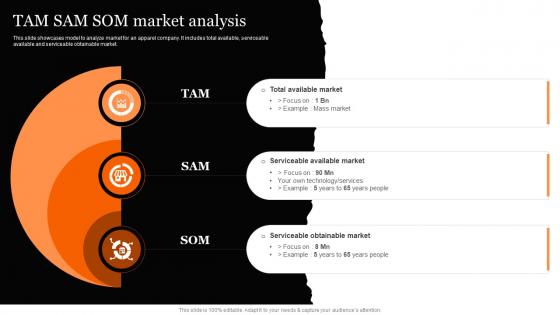
This slide showcases model to analyze market for an apparel company. It includes total available, serviceable available and serviceable obtainable market.
People who downloaded this PowerPoint presentation also viewed the following :
TAM SAM SOM Market Analysis Clothing Retail Ecommerce Business Plan with all 6 slides:
Use our TAM SAM SOM Market Analysis Clothing Retail Ecommerce Business Plan to effectively help you save your valuable time. They are readymade to fit into any presentation structure.





FAQs for TAM SAM SOM Market Analysis Clothing Retail
Key indicators to monitor include market size and growth rates, competitive landscape, customer demographics and behavior patterns, pricing trends, and regulatory changes. These metrics enable organizations to identify opportunities, assess market potential, and develop strategic positioning, with companies across retail, technology, and financial services finding that comprehensive indicator tracking delivers better investment decisions and sustainable competitive advantage.
Businesses can effectively gather data through primary research like surveys and focus groups, secondary research from industry reports and government databases, competitive intelligence tools, social media analytics, and customer feedback platforms. These methods enable companies to understand consumer behavior, identify market trends, and assess competitive landscapes, with many organizations finding that combining multiple data sources delivers more comprehensive insights and strategic advantages.
Competitor analysis reveals market positioning opportunities, pricing strategies, product gaps, customer satisfaction levels, and competitive advantages that inform strategic decisions. Through comprehensive competitor evaluation, businesses identify underserved market segments, optimize their value propositions, and develop differentiation strategies, ultimately enabling more effective market entry and sustainable competitive positioning in increasingly crowded marketplaces.
Market trends influence strategic decision-making by revealing consumer behavior shifts, competitive landscape changes, and emerging opportunities that guide resource allocation and business positioning. Companies like Netflix pivoting from DVDs to streaming, or retailers adopting omnichannel approaches based on digital shopping trends, demonstrate how trend analysis enables proactive strategy adjustments, ultimately delivering competitive advantage and sustained growth.
Primary research involves collecting original data directly from sources through surveys, interviews, focus groups, and observations, while secondary research analyzes existing data from reports, studies, and databases. Primary research delivers highly targeted insights specific to your business needs but requires more time and resources, whereas secondary research enables faster, cost-effective analysis of broader market trends, with many organizations combining both approaches for comprehensive market understanding.
Customer segmentation enables businesses to analyze market opportunities by dividing audiences based on demographics, behavior, purchasing patterns, geographic location, and psychographic traits. This strategic approach allows companies to identify high-value segments, tailor marketing strategies, optimize resource allocation, and develop targeted products, with many organizations finding that segmented analysis delivers improved customer acquisition and significantly higher conversion rates.
Effective market analysis software includes Tableau for data visualization, Google Analytics for web insights, SEMrush for competitive intelligence, SurveyMonkey for primary research, and SPSS for statistical analysis. These platforms streamline research by automating data collection, enhancing trend identification, and delivering comprehensive reporting capabilities, with many organizations finding that integrated analytics ultimately accelerate decision-making and strategic planning processes.
Identifying emerging market opportunities involves trend analysis, competitor intelligence, customer feedback evaluation, demographic studies, and technology monitoring. These strategic approaches enable organizations to spot gaps in sectors like fintech, healthcare, and sustainable energy, with many companies finding that combining data analytics with consumer insights delivers faster market entry and competitive positioning.
Macroeconomic analysis significantly impacts market evaluation by examining inflation rates, GDP growth, interest rates, employment levels, and currency fluctuations that drive overall market conditions. These indicators help investors assess sector performance, consumer spending patterns, and business cycle positioning, with financial services and manufacturing companies finding that macroeconomic insights enable strategic timing decisions and enhanced portfolio allocation strategies.
A comprehensive market analysis presentation should include market size and growth rates, competitive landscape mapping, customer segmentation data, pricing trends, and regulatory factors. These metrics enable organizations to assess market opportunities by identifying underserved segments, benchmarking against competitors, and forecasting demand patterns, ultimately delivering strategic insights that enhance decision-making and competitive positioning.
SWOT analysis enhances market insights by systematically evaluating internal strengths and weaknesses alongside external opportunities and threats, providing comprehensive competitive intelligence. This strategic framework enables organizations to identify market gaps, assess competitive positioning, and uncover growth opportunities, with many companies finding that structured SWOT evaluations deliver more targeted strategies and improved resource allocation decisions.
Common pitfalls in market analysis include relying on outdated data, overlooking competitor dynamics, ignoring customer segments, underestimating regulatory changes, and focusing too narrowly on existing markets. These oversights can lead to misguided strategic decisions, with many organizations finding that comprehensive, real-time analysis delivers more accurate forecasting and sustainable competitive advantage.
Businesses should update their market analysis quarterly for comprehensive reviews, with monthly monitoring of key metrics and immediate updates when significant market shifts occur. This strategic approach enables organizations to respond quickly to competitive changes, consumer behavior shifts, and emerging opportunities, ultimately maintaining competitive advantage in increasingly dynamic markets.
Visual aids enhance market analysis communication by transforming complex data into accessible charts, graphs, infographics, and interactive dashboards that stakeholders can quickly comprehend. These tools enable analysts to highlight key trends, comparative performance, and strategic insights more effectively, with many organizations finding that visual presentations accelerate decision-making processes and improve stakeholder buy-in across departments.
Ethical market research considerations include informed consent, data privacy protection, truthful representation of research purposes, participant anonymity, and transparent methodology disclosure. These principles build consumer trust while ensuring compliance with regulations like GDPR, with many organizations finding that ethical practices enhance brand reputation, reduce legal risks, and ultimately deliver more reliable insights for strategic decision-making.
-
Understandable and informative presentation.
-
“One of the best experiences with SlideTeam for my presentation.Everything on time, communication is efficient and price is reasonable. All good in one place.”