


Clothing Store Business Plan Powerpoint Presentation Slides




Try Before you Buy Download Free Sample Product
 Impress Your
 Audience
 100%
100% Editable
 Save Hours
 of Time


Clothing store business is a place where clothing related to men, women, and children is sold. The store follows urban casual wear, western wear clothing, and traditional wear clothing. Check out our efficiently designed Clothing store Business Plan Powerpoint Presentation. The presentation covers details regarding the company executive summary, the quick pitch providing information about the business, the clothing market, and the opportunities available with the business. It displays the key to success factors, mission, vision, and the start-up summary, including all the necessary expenses. The business plan document exhibits the growth potential analysis, including SWOT analysis and Porters five force analysis model, customer analysis, and market sizing, including TAM, SAM, and SOM. The presentation also has an offline and online marketing strategy, and sales funnel for customer retention. The financial summary includes the basic assumptions which are used for estimating the future, scenario analysis showing nominal, optimistic, and pessimistic cases, profit and loss statement, cash flow statement, balance sheet, and providing a DCF valuation model for the business after five years with a graphical representation of all the three financial statements. Get access now.
People who downloaded this PowerPoint presentation also viewed the following :
Content of this Powerpoint Presentation
Slide 1: This slide introduces Clothing Store Business Plan. State your company name and begin.
Slide 2: This slide states Agenda of the presentation.
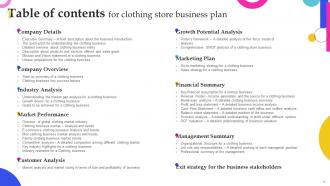
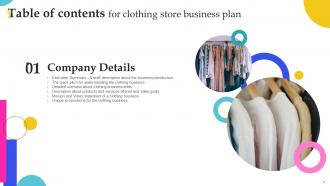
Slide 3: This slide presents Table of Content for the presentation.
Slide 4: This slide highlights title for topics that are to be covered next in the template.
Slide 5: This slide covers a brief glimpse of what the business will be offering to the customer.
Slide 6: This slide displays The Quick Pitch for understanding the clothing business.
Slide 7: This slide represents Detailed overview about the clothing business entity.
Slide 8: This slide showcases Description about the products and services offered and sales goals.
Slide 9: This slide shows Mission and Vision statement of a clothing business.
Slide 10: This slide presents Unique Proposition for the clothing business.
Slide 11: This slide highlights title for topics that are to be covered next in the template.
Slide 12: This slide displays Start-up summary of a clothing store business.
Slide 13: This slide represents Clothing business key success factors.
Slide 14: This slide highlights title for topics that are to be covered next in the template.
Slide 15: This slide showcases Understanding the market gap analysis for a clothing business.
Slide 16: This is another slide continuing Understanding the market gap analysis for a clothing business.
Slide 17: This slide shows Growth drivers for a clothing business.
Slide 18: This slide presents Goals to be achieved for a clothing business.
Slide 19: This slide highlights title for topics that are to be covered next in the template.
Slide 20: This slide displays Overview of the global clothing market industry.
Slide 21: This slide represents Clothing business market – Analysis and trends.
Slide 22: This slide showcases E-commerce clothing business analysis and trends.
Slide 23: This slide shows Men clothing business market analysis and trends.
Slide 24: This slide provides a glimpse of industry overview concerning with the women clothing market.
Slide 25: This slide presents Family clothing business market trends.
Slide 26: This slide displays Competitive analysis – A detailed comparison among different clothing brands.
Slide 27: This slide represents Key industry highlights for a clothing business.
Slide 28: This is another slide continuing Key industry highlights for a clothing business.
Slide 29: This slide showcases Industry restraints for a Clothing business.
Slide 30: This slide shows Key industry restraints of a Clothing business.
Slide 31: This slide highlights title for topics that are to be covered next in the template.
Slide 32: This slide presents Market analysis and market sizing in terms of size and profitability of business.
Slide 33: This slide highlights title for topics that are to be covered next in the template.
Slide 34: This slide provides detailed information on porter’s framework.
Slide 35: This slide displays Comprehensive SWOT analysis of a clothing store business.
Slide 36: This slide highlights title for topics that are to be covered next in the template.
Slide 37: This slide shows Go-to-marketing strategy for a clothing business.
Slide 38: This is another slide continuing Go-to-marketing strategy for a clothing business.
Slide 39: This slide presents Sales strategy for a clothing business.
Slide 40: This slide highlights title for topics that are to be covered next in the template.
Slide 41: This slide displays Key financial assumption for a startup business.
Slide 42: This slide presents revenue model of clothing retail business.
Slide 43: This slide represents breakeven graph.
Slide 44: This slide showcases Break-even analysis as a detailed clothing business summary.
Slide 45: This slide represents profit and loss statement.
Slide 46: This slide showcases graphs of gross profit of the business and earnings before interest.
Slide 47: This slide shows graphs of total revenue from operations and earnings after tax.
Slide 48: This slide represents the business’s historical and forecasted cash flow.
Slide 49: This slide showcases a graph on cash flow analysis and total assets.
Slide 50: This slide represents balance sheet statement.
Slide 51: This slide showcases a graph on cash flow analysis and total assets.
Slide 52: This slide shows the different scenarios for deriving final annual profit after tax.
Slide 53: This slide presents a scenario analysis of annual revenue break-even.
Slide 54: This slide represents the DCF valuation analysis of a business’s financials.
Slide 55: This slide highlights title for topics that are to be covered next in the template.
Slide 56: This slide showcases Organizational Structure for a clothing business.
Slide 57: This slide represents organizational structure of the business.
Slide 58: This slide shows Professional summary of the management.
Slide 59: This slide highlights title for topics that are to be covered next in the template.
Slide 60: This slide presents Exit strategy for the business stakeholders.
Slide 61: This slide contains all the icons used in this presentation.
Slide 62: This slide is titled as Additional Slides for moving forward.
Slide 63: This slide presents Roadmap with additional textboxes.
Slide 64: This slide shows SWOT describing- Strength, Weakness, Opportunity, and Threat.
Slide 65: This slide contains Puzzle with related icons and text.
Slide 66: This slide depicts Venn diagram with text boxes.
Slide 67: This is About Us slide to show company specifications etc.
Slide 68: This slide shows Post It Notes. Post your important notes here.
Slide 69: This is a Timeline slide. Show data related to time intervals here.
Slide 70: This is a Financial slide. Show your finance related stuff here.
Slide 71: This is a Thank You slide with address, contact numbers and email address.
Clothing Store Business Plan Powerpoint Presentation Slides with all 76 slides:
Use our Clothing Store Business Plan Powerpoint Presentation Slides to effectively help you save your valuable time. They are readymade to fit into any presentation structure.








































































 Click here to view PDF
FAQs for Clothing Store Business Plan
So for your clothing store business plan, start with the usual stuff - executive summary, market analysis, who you're targeting, and your financial projections. Product sourcing and pricing are huge, don't skip those. The competition research is honestly such a pain but you gotta do it right. Also cover where you want your store, staffing, and how you'll handle inventory. Oh and make your financial section show 3 years out with realistic numbers - investors can smell BS from miles away. Just grab a template and tweak it for whatever niche you're going after.
Start with online surveys - hit up social media and Google Forms to ask people about shopping habits and what they're willing to spend. But honestly, the real gold is visiting your competition in person. Make a whole day of it and take notes on everything - pricing, how they set up the store, what's selling. Census data will show you local demographics, and you'll want to check foot traffic around potential spots. Seasonal stuff matters too, plus any local events that could boost sales. Mix the hard data with actual conversations though. Nothing beats talking to real people who might actually shop there before you dump money into this thing.
You've got tons of options - brick-and-mortar, pure online, hybrid, consignment, subscription boxes, pop-ups. Hybrid's honestly where it's at these days. People want the convenience of shopping online but still need to try stuff on, especially clothes. Pure online can crush it if you're targeting a specific niche and have solid social media game. Traditional stores still do amazing in busy areas though. My cousin actually just opened one downtown and she's killing it. But really, figure out who you're selling to and what you can afford first. Then pick whatever model actually makes sense for your situation, not just what sounds trendy.
Start with your product mix and pricing - that tells you who can actually buy your stuff. Demographics matter: age, income, lifestyle, shopping habits. Fast fashion for college kids? Professional workwear? Totally different audiences. Hang out near potential locations and watch foot traffic. Check out similar stores nearby too. Social media gives you decent data if you're already posting. I'd survey friends and random people about shopping preferences - sounds weird but it works. Make 2-3 detailed customer profiles with specific ages, jobs, motivations. Then test those assumptions with actual research instead of just guessing.
Hey! So first thing - get a good POS system that shows real inventory numbers. Game changer. Then track your bestsellers vs. what's just sitting there collecting dust. Set automatic reorder points for your core stuff so you don't run out of the basics. Seasonal timing is everything (nobody wants sundresses in January, right?). The 80/20 thing is real - like 20% of your inventory probably makes most of your money. For trendy pieces, order smaller batches more often since fashion changes so fast. Oh, and definitely audit what you have now first - organize everything by how fast it sells. That'll show you where your buying budget should actually go.
Look at what your competitors charge first. Then figure out your actual costs - wholesale, rent, utilities, all that stuff. Most clothing stores do 50-100% markup on top of costs. Honestly, seasonal changes will throw you for a loop, so brace yourself for that. Try testing different prices on small batches to see what sells. Oh and do that $29.99 thing instead of $30 - people are weird about it but it works. Your prices need to match your brand though. Can't sell cheap stuff at boutique prices. Start conservative, then adjust based on what actually moves.
Okay so Instagram and TikTok are gonna be your bread and butter - fashion is super visual obviously. Post styling videos, behind-the-scenes stuff, customers wearing your clothes. Email's solid for new drops and sales too. Find some local micro-influencers who actually fit your vibe (not just anyone with followers, you know?). Google My Business is clutch since people search "clothing stores near me" all the time. Oh and honestly? Pick like two things you can crush instead of doing everything half-assed. Quality over quantity always wins.
Honestly, location can make or break your store. High foot traffic and visibility are huge - I've seen amazing boutiques fail just because they were hidden away somewhere. Sure, cheaper rent sounds tempting, but you'll probably lose more in sales than you save. Look for spots with complementary businesses nearby and decent parking (or good transit). The demographics matter too - no point selling trendy stuff where people shop purely on price, you know? Oh, and definitely check out foot traffic patterns at different times before you commit to anything.
Instagram and TikTok are your best bet - they're made for showing off clothes. Post styling videos and behind-the-scenes stuff. Stories work great for daily arrivals too. Facebook's still decent for older customers and ads, though honestly I barely use it anymore. Don't worry about perfect photos - I've seen brands blow up with just phone pics. Consistency matters way more than fancy equipment. Pick two platforms max so you don't burn out. Oh, and batch your content when you can! Like, film a bunch of videos in one day instead of scrambling daily.
Okay so for your business plan you'll need three key financial projections. Sales forecast is first - break that down by product type and seasons since fashion is crazy cyclical. Cash flow statements are honestly the most important one because buying inventory upfront can totally screw with your timing. Monthly breakdowns for year one at least. Then do P&L projections for like 3-5 years. Oh and factor in markdowns, returns, theft - that stuff kills your margins way more than you'd expect. Just make sure the numbers actually make sense to investors, you know?
Honestly, I'd start by hitting up trade shows - that's where you meet the real people behind these businesses. Research a handful of wholesale suppliers that match your vibe and budget first though. Don't get attached to just one vendor because they can flake out on you (learned that the hard way). I always keep 3-4 solid suppliers so if one screws up, you're not totally stuck. Nail down the boring stuff early - minimum orders, when they want payment, their return policy. Faire and Tundra are decent online, but check local manufacturers too if you want something different. Test small batches before going crazy with big orders.
Inventory management will probably be your biggest headache, plus cash flow issues and just getting noticed in such a saturated market. Fashion moves ridiculously fast - I swear trends change weekly now. Pick a specific niche instead of trying to appeal to everyone, that's my advice. Keep your first inventory orders small and build up at least 6 months of cash reserves. The competition thing is brutal honestly. Figure out what makes you different early on. Start small, test stuff with real customers first, then grow based on what's actually selling. Oh and don't blow your budget on the fancy stuff right away.
Start with sourcing - find brands doing organic materials or ethical manufacturing. Clothing swaps are huge right now, customers eat that up and it builds real community vibes. Switch to LEDs and digital receipts (honestly, who wants more paper anyway?). Marketing-wise, push "cost per wear" instead of just what's trendy. Take-back programs are cool if you can swing it. Don't try everything at once though - pick what actually fits your vibe first, then add more later.
So you'll need a business license from your city first - that's the big one. Sales tax permit too since customers will pay tax. Most states want a resale permit so you can buy inventory wholesale without getting taxed twice (which is honestly genius). The paperwork's annoying but not terrible. If you hire people, grab an EIN from the IRS and workers' comp insurance. Oh and some areas get picky about signage permits, especially historic districts. Your local small business development center is clutch for this stuff - they know all the weird local requirements.
Dude, customer service can totally make or break a clothing store. Your staff needs to actually know styling and fit - when they give solid recommendations, people buy more and keep coming back. I'm still bitter about this one boutique from like three years ago where the saleswoman was super rude, so yeah, bad experiences really stick. Good service cuts down on returns too since customers get better help from the start. Train your team on handling exchanges without being weird about it. That's honestly where you'll see the biggest payoff from any service training you do.
-
“Thanks to SlideTeam. Now I can make smart presentations in a fraction of time without any hassle.”
-
Their products can save your time, effort and money. What else you need. All in one package for presentation needs!