


Retail Outlet Business Plan Proposal Powerpoint Presentation Slides




Try Before you Buy Download Free Sample Product
 Impress Your
 Audience
 100%
100% Editable
 Save Hours
 of Time


Establishing a retail store requires a whole lot of planning and research. From finding an appropriate store location, customizing store layout, to curating marketing plans and to spread awareness, an entrepreneur has to look after everything to make its position in the market. Therefore, to make this process easy, retail business consultancy can help a great deal in planning out everything. So, put forth a compelling proposal citing innovative services of your company with our visually appealing Retail Outlet Business Plan Proposal PowerPoint Presentation Slides. This store PowerPoint layout has a well-composed cover letter in which you can mention your key deliverables in a well- organized manner. Proficiently showcase various sections of your proposal in the table of contents slide for your convenience. Explain your project context and objectives thoroughly in this store template of this PowerPoint proposal deck. Understand their retail needs and depict a comprehensive plan of action like discussion, feasibility study, strategy development, client review, and go live to help them establish their store properly. Take the help of our emporium PPT template to elaborate on various other strategies like location scouting, store layout, product assortment, pricing strategy, shelf management, and marketing. With color schemes and a formatted table, discuss the time details required for completing the process. Exhibit multiple services offered by your company in a clear and concise manner including, analytics, reporting, staffing, licensing inventory planning, and control by employing our department store PowerPoint layout. In addition to this, you can showcase the total amount of money for each stage in the investment layout of this retail showroom PowerPoint template. Put a strong impression in front of your customers by showcasing your company overview and attaching clients’ testimonials in the end. Without further ado, download this mini-mall theme and create magic by making an awe-inspiring presentation.
People who downloaded this PowerPoint presentation also viewed the following :
Content of this Powerpoint Presentation
Slide 1: This slide introduces Retail Outlet Business Plan Proposal. State Client name, Submission date, User assigned.
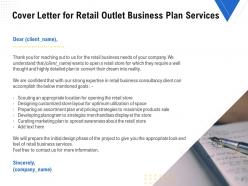
Slide 2: This slide displays Cover Letter for Retail Outlet Business Plan Services
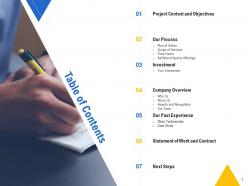
Slide 3: This slide displays Table of Contents of the presentation.
Slide 4: This slide showcases Table of Contents with Projects Context and Objectives.
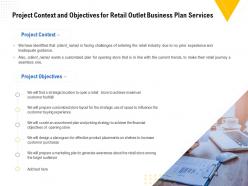
Slide 5: This slide shows Project Context and Objectives for Retail Outlet Business Plan Services
Slide 6: This slide presents Table of Contents with Our Process, Plan of Action, Scope of Services, Time Frame, Additional Service Offerings.
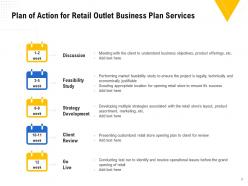
Slide 7: This slide displays Plan of Action for Retail Outlet Business Plan Services.
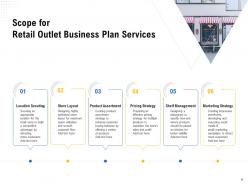
Slide 8: This slide displays Scope for Retail Outlet Business Plan Services.
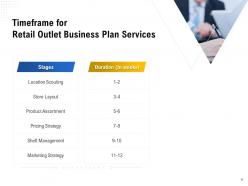
Slide 9: This slide shows Timeframe for Retail Outlet Business Plan Services
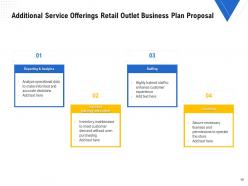
Slide 10: This slide showcases Additional Service Offerings.
Slide 11: This slide displays Table of Contents contaning- Your Investment.
Slide 12: This slide depicts Investment details.
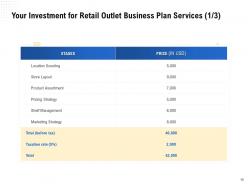
Slide 13: This slide shows Investment Details.
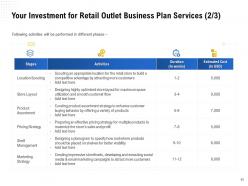
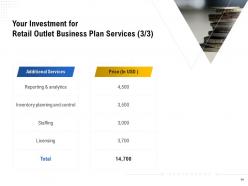
Slide 14: This slide shows Investment Details with- Additional Services, Price (In USD ).
Slide 15: This slide displays Table of Contents with- Company Overview, Why Us, About Us, Awards and Recognition, Our Team.
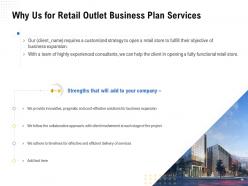
Slide 16: This slide explains Why Us for Retail Outlet Business Plan Services.
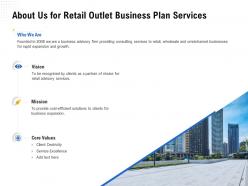
Slide 17: This is About Us slide to showcase Company specifications.
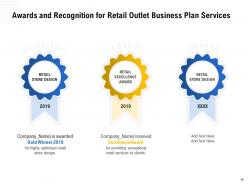
Slide 18: This slide represents Awards and Recognition.
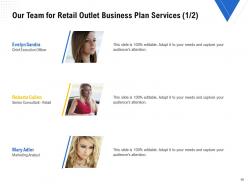
Slide 19: This is Our Team slide with Names and Designations.
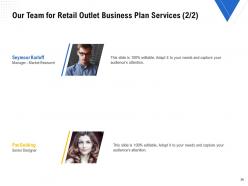
Slide 20: This is Our Team slide with Names and Designations.
Slide 21: This slide displays Table of Contents with- Our Past Experience, Client Testimonials, Case Study.
Slide 22: This slide displays Client Testimonials.
Slide 23: This slide displays Client Testimonials.
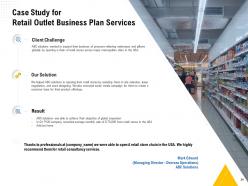
Slide 24: This slide showcases Case Study.
Slide 25: This slide shows Table of Contents contaning- Statement of Work and Contract.
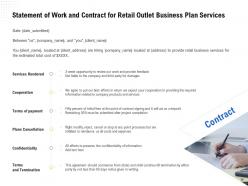
Slide 26: This slide describes Statement of Work and Contract for Retail Outlet Business Plan Services.
Slide 27: This slide shows Table of Contents with Next Steps.
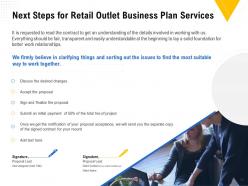
Slide 28: This slide shows Next Steps.
Slide 29: This is Contact Us slide with Address, Email address and Contact number.
Slide 30: This is Icons Slide for Retail Outlet Business Plan Proposal.
Slide 31: This slide is titled as Additional Slides for moving forward.
Slide 32: This is About Us slide to showcase Company specifications.
Slide 33: This slide displays Our Vision Mission and Goal.
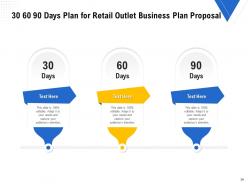
Slide 34: This is 30 60 90 Days Plan slide.
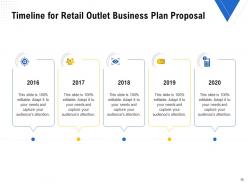
Slide 35: This slide shows Timeline process.
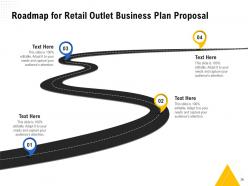
Slide 36: This slide shows Roadmap process.
Retail Outlet Business Plan Proposal Powerpoint Presentation Slides with all 36 slides:
Use our Retail Outlet Business Plan Proposal Powerpoint Presentation Slides to effectively help you save your valuable time. They are readymade to fit into any presentation structure.




FAQs for Retail Outlet Business Plan Proposal
So you'll need the usual suspects: executive summary, market analysis, competitive research, marketing strategy, operations plan, and financial projections. The executive summary is honestly make-or-break since investors bail if that part sucks. Also throw in your store concept and target customers. If you're doing brick-and-mortar, location analysis is huge. Don't skip the tedious stuff like inventory management and staffing - I know it's boring but you need it. Financial section should cover startup costs, cash flow, and break-even for three years minimum.
Look, market analysis stops your business plan from being total fantasy. You need to actually research who's gonna buy your stuff and scope out the competition - otherwise you're just throwing money around hoping something sticks. It helps you pick the right spot, set decent prices, figure out what to stock. Honestly, I've seen too many people skip this step and wonder why they're struggling. Survey people in your area first, then go check out similar stores nearby. Takes some time but way better than guessing what'll work. Think of it as your cheat sheet before jumping in.
Honestly, knowing your target customer is everything in retail - it literally shapes every decision you make. Think about it: selling skate gear to teens vs luxury bags to professionals? Totally different game. Your customers determine your inventory, pricing, store location, even which social media you should bother with. Like, no point being on TikTok if you're targeting 50-year-olds, you know? Create detailed customer personas first. Then let those guide your brand voice, marketing approach, and staffing choices. I can't stress this enough - get this right and everything else falls into place way easier.
Look, competitive analysis basically shows you where the money is. Find 5 direct competitors and dig into their pricing, marketing, customer reviews - the whole deal. You'll catch what they're screwing up (trust me, everyone has blind spots) and figure out how to do it better. Honestly, this stuff makes your business plan look legit to investors too. They want proof you actually know your market, not just some half-baked idea. Plus it helps nail down realistic pricing and find what makes you different. I spent way too much time on this part when I started, but man, it paid off. Your financial projections will actually make sense instead of looking like wishful thinking.
Honestly, start by checking out your competition and figuring out who's actually gonna shop there. Industry benchmarks help too - see what similar stores are doing in your area. I'm always like, be conservative with your first guesses because disappointing yourself sucks way more than being pleasantly surprised! Do the math both ways: estimate foot traffic times how many actually buy something, then compare to other stores. Make three versions - worst case, realistic, and best case scenarios. Oh and definitely track everything monthly so you can tweak as you go. These aren't permanent predictions anyway.
Look, you've gotta bake inventory planning straight into your financial projections from the start. Map out your ordering schedules, supplier deals, and stock targets - all that boring but crucial stuff. ABC analysis works great for figuring out which products deserve your attention (honestly saved my butt more than once). Don't forget seasonal swings and dead stock strategies because yeah, it's gonna happen. Track metrics like turnover rates and carrying costs so you'll know if you're actually succeeding or just burning cash.
So you'll need the three main ones - income statement, cash flow, and balance sheet. Cash flow is honestly the one I'd obsess over most since retail can be brutal with seasonal swings and you're constantly buying inventory before you sell it. Income statement shows your revenue and profit margins (which yeah, are usually pretty tight in retail). Balance sheet gives you the whole picture with assets and liabilities. Project everything out three years, but break down year one monthly. Oh and don't forget to be realistic about those holiday spikes - they can make or break you.
Okay so basically you need three things sorted: who's buying your stuff, how you'll reach them, and actual numbers. Figure out your customers first - like what they're into, where they hang out, what problems you're solving for them. Marketing channels come next. Social media's obvious but be specific - don't just throw "Instagram" in there. Explain why your people are scrolling there and what it'll cost you. Same goes for local ads, email, whatever. Honestly, investors eat up the financial details way more than you'd think. Wrap it up with real goals you can measure, like boosting foot traffic 25% or whatever makes sense for your business.
Look at your actual market data first - don't just throw out numbers that sound impressive. I made that mistake once with a ridiculous 300% growth target lol. Monthly milestones work better than just annual ones since you can pivot faster. Think about your seasonality and local competition too. Your goals should push the team but still be doable with what you've got - staff, budget, inventory, all that. Oh and track stuff like foot traffic and conversion rates. Revenue's great but those other metrics tell you what's actually happening before it hits your bottom line.
Your operations plan is basically proof that your retail idea can actually work day-to-day. Map out inventory management, staffing, suppliers, customer flow - all that stuff. Honestly? This is where most "brilliant" ideas crash and burn because the logistics are way harder than expected. But get it right and you'll show investors (plus yourself) that you can handle Black Friday madness, keep costs under control, and not disappoint customers. Oh, and start with your absolute worst-case busy day scenario - like when everyone's shopping and two people called in sick. Work backwards from there.
Oh man, retail has so many legal hoops to jump through. First figure out your business structure - LLC versus corp, all that fun stuff. Then there's licensing and permits which change depending on your state and what you're selling (seriously such a headache). Sales tax registration is mandatory obviously. If you're hiring people, employment laws kick in too. Product liability insurance is critical, especially if someone could get hurt using your stuff. Your lease and zoning rules can bite you if you're not careful. Honestly? Just pay for one lawyer consultation upfront. Way cheaper than fixing mistakes later.
Dude, location is everything - seriously can't stress this enough. Bad spot = dead business, even with an amazing concept (I've watched it happen, it's brutal). You've gotta look at foot traffic, where your customers actually live, what competition's around, plus practical stuff like parking. Cheap rent sounds tempting but it'll bite you later if nobody can find you or there's zero walk-by traffic. Map out maybe 3-5 spots and crunch the numbers properly - don't just go with your gut on this one. It affects everything from daily sales to your monthly costs.
Don't just slap technology onto your retail plan at the end - weave it throughout everything. Your market research should include data analytics for tracking customer habits. Operations needs POS systems, inventory software, plus e-commerce if you're doing online too. Security and payment processing are super boring but you can't skip them. Budget for all the tech costs upfront AND the monthly subscriptions that add up fast. Be specific about actual tools you'll use - vague "technology solutions" won't impress anyone. Show how each one either makes money or saves it.
Honestly, inventory issues will probably be your biggest headache - overstocking ties up cash and theft is just constant. Competition's rough too, especially with Amazon crushing everyone. Economic downturns kill consumer spending fast, and supply chain problems can blindside you. Location matters more than people think - if foot traffic dies or your rent doubles, you're screwed. Staff turnover in retail is absolutely insane and messes everything up. Oh, and seasonal swings plus changing trends can tank sales overnight. I'd make backup plans for your top 3-4 risks and definitely pad those financial projections.
So basically you want to hit three main spots: where you buy stuff, how you run things, and getting customers involved. Find suppliers who actually care about the environment - local ones are great since shipping costs are insane anyway. LED lights will save you money long-term, and honestly solar panels aren't as crazy expensive as they used to be. Set up some kind of recycling thing for customers or let them trade old products in. The cool part is you can actually market all this green stuff instead of just eating the costs. Waste reduction helps your bottom line too.
-
Awesome presentation, really professional and easy to edit.