


Business plan proposal powerpoint presentation slides






Try Before you Buy Download Free Sample Product
 Impress Your
 Audience
 100%
100% Editable
 Save Hours
 of Time


To increase the chances of success, it is important to design a full-fledged business plan. When you are about to start a new venture and further diversify your business, you need advanced ideas or concepts to reach out to more customers. Conducting market planning to explore the market size and customer segments is the first step towards reaching your business goal. If you want to engage more audience members, you should create a proper marketing & sales strategy. By using the readymade proposals, you can choose the best service providers that prepare the initial design phase for your business plan. Understand your client’s upcoming business structures and goals and provide them with a proper solution with the help of our Business Plan Proposal PowerPoint Presentation Slides. You can show how you conduct an in-depth market analysis to determine the market’s size and value. In this template, you can develop an outline of an organizational structure containing details of human resources required for your client’s business. Take advantage of this outwardly engaging business plan proposal presentation template to prepare a detailed description of the funds required for multiple business activities. Included here are high-quality icons and graphics to make your proposal even more impactful. You can showcase your proposed plan of actions that consists of research, economic & industry analysis, review & approval, and strategic recommendations. Define the scope of services clearly like market analysis, financial plan, workforce plan, competitive analysis, and marketing & sales plan. You can describe how you procure funds for your client’s business ventures through banks and financial institutions. Use this eye-catching business plan proposal PPT slide to outline the roles and responsibilities of various job positions and help your clients increase their manpower.Therefore, you can also download our full editable and ready-to-use Business Proposal ppt and launch your product at right time .
People who downloaded this PowerPoint presentation also viewed the following :
Content of this Powerpoint Presentation
Slide 1: This slide introduces Businss Plan Proposal. State Client name, Submission date and User assigned.
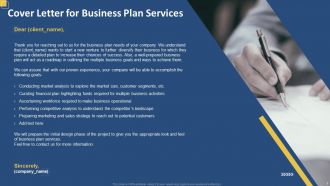
Slide 2: This slide displays Cover Letter for Business Plan Services.
Slide 3: This slide depicts Table of Contents
Slide 4: This slide also shows Table of Contents
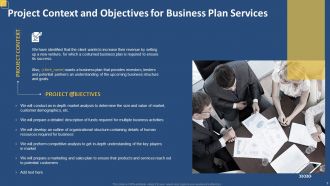
Slide 5: This slide displays Project Context and Objectives for Business Plan Services
Slide 6: This slide showcases Table of Contents.
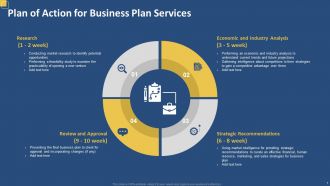
Slide 7: This slide depicts Plan of Action for Business Plan Services
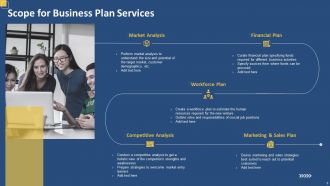
Slide 8: This slide represents Scope for Business Plan Services. Create a workforce plan to estimate the human resources required for the new venture
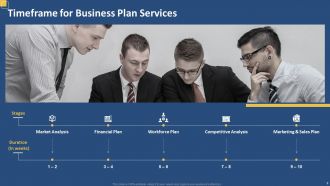
Slide 9: This slide displays Timeframe for Business Plan Services.
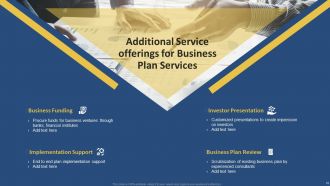
Slide 10: This slide showcases Additional Service offerings for Business Plan Services.
Slide 11: This slide displays Table of Contents
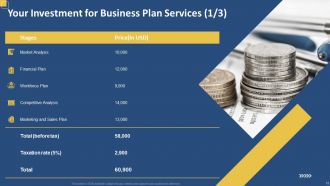
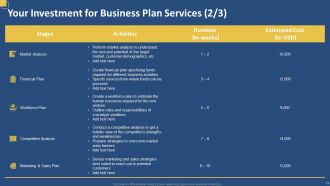
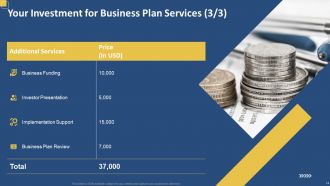
Slide 12: This slide depicts Your Investment for Business Plan Services.
Slide 13: This slide shows Your Investment for Business Plan Services.
Slide 14: This slide showcases Your Investment for Business Plan Services.
Slide 15: This slide displays Table of Contents.
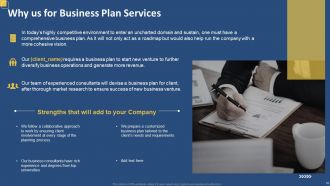
Slide 16: This slide highlights the reasons for Choosing us for Business Plan Services.
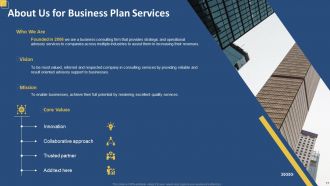
Slide 17: This is About Us slide with Company specifications.
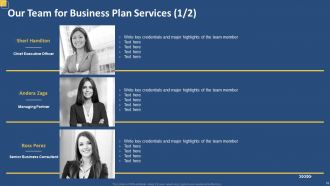
Slide 18: This is Our Team slide. Write key credentials and major highlights of the team member.
Slide 19: This is also Our Team slide. Write key credentials and major highlights of the team member
Slide 20: This slide displays Table of Contents.
Slide 21: This slide showcases Client Testimonials for Business Plan Services.
Slide 22: This slide displays Client Testimonials for Business Plan Services.
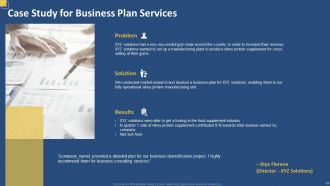
Slide 23: This slide showcases Case Study for Business Plan Services.
Slide 24: This slide displays Table of Contents.
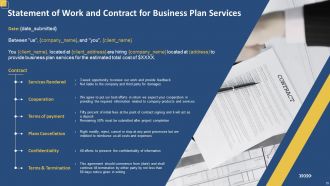
Slide 25: This slide depicts Statement of Work and Contract for Business Plan Services.
Slide 26: This slide displays Table of Contents.
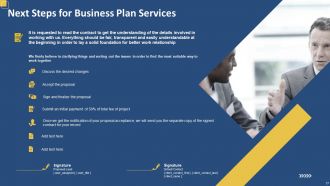
Slide 27: This slide showcases Next Steps for Business Plan Services.
Slide 28: This is Contact Us slide with Address, Email address and Contact number.
Slide 29: This slide is titled as Additional Slides for moving forward.
Slide 30: This is Icons Slide for Business Plan Proposal.
Slide 31: This is About Us slide with Valued clients, Targets Audiences.
Slide 32: This is Vision and Mission slide.
Slide 33: This is 30 60 90 Days Plan slide.
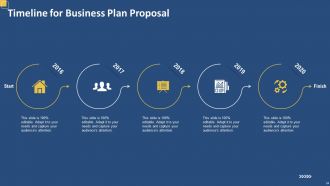
Slide 34: This is Timeline slide.
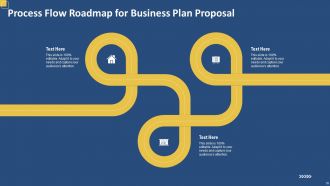
Slide 35: This slide shows Process Flow Roadmap for Business Plan Proposal
Business plan proposal powerpoint presentation slides with all 35 slides:
Use our Business Plan Proposal Powerpoint Presentation Slides to effectively help you save your valuable time. They are readymade to fit into any presentation structure.










FAQs for Business plan proposal
Look, you'll need the basics: executive summary, market analysis, product description, marketing plan, operations, team bios, and financials. Plus funding request if you're asking for cash. Honestly, most investors barely skim past the executive summary, so nail that part first. Your market research can't just be educated guesses - actually know your competition and customers. Financial projections? Be realistic, not delusional about making millions year one. I'd start by outlining each section, then fill in real data. The whole thing's tedious but worth doing right.
Look, investors see tons of pitches every day, so you need something that shows you're not just throwing ideas at the wall. Your business plan proves you've actually researched the market and thought through the numbers. Make your executive summary really grab them - that's what they'll read first. Financial projections should be realistic, not some crazy optimistic fantasy (I've seen so many people mess this up). Show them you get the risks and have backup plans. Honestly, it's all about proving you can actually execute your idea, not just dream about it.
Look, market analysis proves your business idea isn't complete BS. You're showing investors you actually get who your customers are and what they'll pay. Plus you need to know your competition – though honestly, researching competitors can become this weird time suck if you're not careful. Without decent market analysis? Your financial projections are basically made-up numbers. I'd start with figuring out your target market size first, then work backwards from there to justify whatever revenue you're expecting. Makes the whole thing way more believable.
Dude, charts and graphs are a lifesaver for business plans. Investors can actually understand your financial stuff without getting lost in paragraphs of numbers. I've sat through presentations where it's just endless bullet points – honestly brutal. Break down your processes with simple infographics instead. One thing that works really well is having that one killer visual that shows your main value prop. People remember pictures way better than text anyway. Just don't go overboard with fancy designs. Clean and simple beats cluttered every time. Oh, and timelines work great for showing your roadmap too.
Honestly, the worst thing you can do is be super vague about your numbers and who you're actually selling to. Like, don't just throw out "we'll make $5M in year two" without showing how you got there. Keep your executive summary short too - most investors bail after page one if you're boring them. Oh, and I see this all the time: people get obsessed with listing every cool feature instead of explaining what problem they're fixing. Nobody cares about your fancy dashboard if it doesn't solve anything real. Show the problem first, then your solution, then why people will pay. Don't forget realistic timelines and what could go wrong.
Look, you gotta actually know who you're competing with - both the obvious players AND the indirect ones (seriously, everyone forgets those). Map out their strengths, weaknesses, pricing, the whole deal. Then figure out why someone would choose you instead. Don't just throw around vague claims about being "better." Back it up with real examples and numbers. Honestly? Most people wing this part and it shows. You need concrete proof that you've studied the competition and have a legit strategy to win customers over, not just crossed fingers.
Look, your exec summary can literally make or break everything - most investors won't even bother reading past it if it sucks. You've got like 30 seconds to grab them before they toss your plan in the "no" pile. Keep it to 1-2 pages and hit the big stuff: what you're selling, who's buying it, your money projections, and how much funding you need. I've honestly watched solid business ideas get rejected just because the summary was a mess or buried the good parts. Front-load your best points right away. Think elevator pitch but on paper.
Look, your financial projections are what make investors take you seriously - they prove you actually understand how you'll make money instead of just having a cool idea. Don't go crazy with overly optimistic numbers though. I've watched so many pitches crash because the founder clearly pulled revenue forecasts out of thin air. You need conservative estimates backed by real market research. Break down your expenses, map out cash flow, and honestly? Practice explaining every single number until you could do it in your sleep. That's how you show you're not just another dreamer with a business plan.
Honestly, it's all about knowing your audience. Investors want to see the money stuff - ROI, market size, all that financial jazz. Banks? They're super conservative, so hit them with cash flow projections and collateral. Partners care more about how you'll work together and what's in it for them. I'd just make your business plan modular - keep the same core but swap out sections depending on who you're talking to. Like, customers don't care about your investor pitch, they want proof you can actually deliver. Makes the whole process way easier once you get the hang of it.
Start with your founding story - what problem made you think "there's gotta be a better way." Paint the customer journey so investors can actually picture it. Then describe where you'll be in 3-5 years, but make it feel real, not like some fantasy. Honestly, most business plans are boring AF because they just dump features everywhere. Instead, show how you're changing people's lives. Got any early wins? Those make perfect mini-stories. Numbers matter, but investors need to *feel* your vision first. That emotional hook is what separates the maybes from the hell yes responses.
Honestly, you'll know pretty quickly if it went well. During the actual pitch, watch for real engagement - detailed questions, note-taking, people actually discussing specifics instead of just nodding politely. That stuff matters way more than generic "great presentation!" comments. Follow up within a week and see what happens. Are they scheduling next meetings? Asking for more info? The best indicator is concrete next steps, not just nice words. I've seen too many "successful" pitches that led nowhere because people were just being polite. Real interest shows up as action - follow-up meetings, funding discussions, partnership talks. That's your real scorecard.
Your core stuff should be revenue projections, cash flow, and break-even analysis. Customer acquisition costs and lifetime value matter too - shows you get the unit economics. If you're fundraising, definitely include burn rate and runway (investors hate companies about to go broke in 3 months, obviously). Monthly recurring revenue is huge for SaaS companies. Keep projections realistic though - I've seen so many pitches with crazy optimistic numbers that just scream "amateur hour." Show 3-5 year forecasts with conservative, optimistic, and realistic scenarios. That covers your bases.
Definitely add a whole risk section - don't just mention problems in passing. Figure out your biggest threats first: market shifts, competitors, money running out, whatever. Then get specific about how you'd handle each one. Honestly, I hate seeing plans that just say "we'll keep an eye on things" - that's basically nothing! Show actual backup plans, emergency budgets, or different approaches you could take. Be realistic about how much longer stuff takes when it goes wrong (and how much more it costs). Oh, and throw in a risk matrix ranking everything by how likely it is vs. how badly it'd hurt.
Dude, you absolutely need feedback on your business plan. Get it from mentors, potential investors, industry people - honestly anyone who can spot weak points you've missed. I'd even ask friends to read it since they'll catch confusing parts. The thing is, you've been staring at this thing forever so you can't see the obvious problems anymore. Each person who reviews it helps you fix your financials, make your value prop clearer, stuff like that. Oh and don't wait until it's "perfect" - share rough drafts now. Trust me, you'll save yourself so much time later when you're not doing massive rewrites.
Honestly, templates are lifesavers because you're not sitting there going "okay, what the hell do I put first?" They've got all the stuff investors want to see - exec summary, market research, money stuff - already laid out in order that makes sense. You can skip the whole "reinventing the wheel" thing and just focus on making your content actually good instead of stressing about formatting. I mean, why waste time figuring out section headers when you could be working on your pitch? Grab a solid template, then tweak it for your industry. Way easier.
-
Presentation Design is very nice, good work with the content as well.