


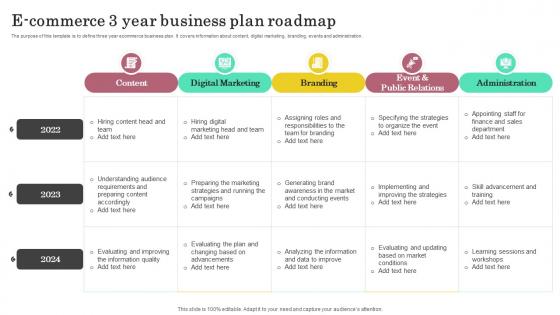
E Commerce 3 Year Business Plan Roadmap




Try Before you Buy Download Free Sample Product
 Impress Your
 Audience
 100%
100% Editable
 Save Hours
 of Time


The purpose of this template is to define three year ecommerce business plan. It covers information about content, digital marketing, branding, events and administration.
People who downloaded this PowerPoint presentation also viewed the following :
E Commerce 3 Year Business Plan Roadmap with all 6 slides:
Use our E Commerce 3 Year Business Plan Roadmap to effectively help you save your valuable time. They are readymade to fit into any presentation structure.





FAQs for E Commerce 3 Year
Honestly, you gotta do your homework first - figure out who's actually gonna buy from you. Map out how customers will find and buy your stuff, then pick the most basic features that'll get you sales. Skip the fancy extras for now! Get your product pages, checkout, and payments working smoothly before anything else. Budget more time than you think you'll need because something always goes wrong (trust me on this one). Once you launch, you'll probably want to change half of what you built anyway based on real feedback. Short sentences help. Keep it simple until you know what actually works.
Dude, market research is basically your roadmap for not wasting money. Shows you what customers actually want instead of what you're guessing they want. Plus it reveals those sweet market gaps you can jump on. I swear, half the startups I know built random features because they totally skipped this part. Use your research to pick product priorities, nail your pricing, figure out who to target. Even tells you which marketing channels are worth your cash. Just start simple - survey your current customers and dig through competitor reviews. That's where you'll find the good stuff.
Honestly, UX should drive pretty much everything on your e-commerce roadmap. I always tell people to ask "does this actually help customers buy stuff easier?" before adding features. Look at your customer journey first - where do people get stuck or frustrated? Those friction points become your top priorities. Way too many teams I've worked with get obsessed with cool features that sound impressive but don't move the needle. Skip the flashy stuff for now. Focus on basics like checkout flow and search that actually impact conversions. Your analytics and customer complaints will show you what's really broken. Start there and you'll see results way faster.
First thing - figure out where your customers actually hang out. Website, Instagram, your physical store, whatever. Then comes the fun part (and by fun I mean headache-inducing): getting your inventory, customer service, and marketing people to actually work together. Good luck with that one, honestly. The whole point is letting someone browse on their phone during lunch, then swing by the store later to grab it without starting over. I'd say pick maybe 2 channels max to start. Get those running smooth before you go crazy adding more - otherwise you'll just create a bigger mess.
Track your conversion rate, average order value, and customer acquisition cost - those are your money metrics. Cart abandonment rate too, obviously. Then add page load times and mobile conversion rates for the user experience side. Return customer rate is honestly the most telling metric though, way more than people realize. Customer lifetime value rounds it out nicely. Don't go crazy with too many - maybe 6 tops or you'll just get overwhelmed by all the numbers. Set up a weekly dashboard and actually look at it before you change anything major on your roadmap.
Look, data analytics shows you what's actually moving the needle vs what you assume is working. Track how customers behave, where they convert, sales patterns - all that stuff reveals trends and bottlenecks. Heat maps are crazy useful btw, you'll see exactly where people click before they bail. Use all this to fix your product pages, tweak pricing, make better recommendations. Honestly, checkout optimization alone can boost conversions like 20%. Start with Google Analytics if you're not already using it, then add fancier tools later as you scale up.
Honestly, start with mobile-first design - that's where everyone's shopping anyway. AI personalization and chatbots are pretty solid investments right now too. Progressive web apps are clutch because they're crazy fast and work even when your connection sucks. I'd also keep an eye on voice commerce, though it's still kinda early for that. Headless architecture is smart if you want to add new stuff later without rebuilding everything. AR for trying on clothes or seeing furniture in your room is getting really good, but mobile and AI will probably give you the best bang for your buck first.
Dude, you HAVE to get your mobile stuff sorted out. Like 70% of people shop on their phones now, and Google basically punishes sites that suck on mobile. I had this one client - their checkout was a nightmare on phones and they lost 40% of sales. Brutal. Your site needs to load fast and work with just your thumb, you know? People get impatient real quick on mobile. Honestly, just grab your phone right now and try buying something from your own site. I bet you'll find at least three things that annoy you. Fix those first.
Look, you've got to get your email game tight first - segment those lists and send personalized stuff based on what people actually bought. That's your quickest win right there. Loyalty programs work too, but honestly they're kind of a pain to set up initially. Points, exclusive deals, whatever gets people coming back. Oh, and retargeting ads are clutch for catching the ones who bounced without buying. Don't underestimate good customer service either - I've seen businesses tank from one terrible support experience going viral. Start with the email thing this week though, seriously.
Start by mapping out when you're busy vs. slow - that's your foundation. Save the big updates and site overhauls for quiet months. Nobody wants to deal with broken checkout during Black Friday (learned that one the hard way). Peak seasons should be about tweaking what works - performance boosts, marketing tools, stuff like that. Don't mess with core functionality when everyone's watching. Oh, and pad some extra time before each busy period for testing. I always think I need two weeks but really need four. Basically treat your seasonal patterns like they're set in stone when planning development.
Dude, going international is like opening Pandora's box - but in a good way? You're looking at crazy revenue potential, just with way more headaches. Different currencies, payment systems, shipping nightmares. Then there's taxes and regulations for every single country, which honestly makes my brain hurt just thinking about it. Don't forget language stuff and cultural quirks your customers will expect you to nail. Customer service becomes a 24/7 juggling act across time zones. My advice? Pick one or two similar markets first. Test everything twice, make sure your margins can handle the extra costs, then scale from there.
Honestly, think of social media more like discovery than just pushing your stuff. Real content works way better - like actual customers using your products, not staged photos. Instagram and TikTok are where people find new things now, Facebook's still decent for retargeting though. Keep your brand voice consistent but actually talk WITH people, not AT them. Instagram Shopping is getting pretty solid too - I've been seeing more brands nail that lately. My advice? Pick one platform first, get good at it, then branch out. Don't try to be everywhere at once or you'll burn out.
Look for partners that cover what you're missing - payment stuff like Stripe is obvious, but think shipping companies, inventory software, maybe some influencers in your space. Affiliate programs are honestly underrated - basically free advertising if you set them up right. I'd start by listing your biggest headaches operationally, then find partners who solve multiple issues at once. Target people with your same customers but who aren't competing directly. Marketing collabs with complementary brands work really well too. Just don't overthink it initially.
Yeah, you really need to bake supply chain stuff right into your roadmap – not just the usual product launches. I'd map out inventory system upgrades, supplier integrations, warehouse expansions, all with actual dates. Companies always treat this as an afterthought and then wonder why they're scrambling later. If you're promising same-day delivery by Q3, your warehouse automation better be ready by Q2, you know? Don't forget vendor onboarding timelines and backup plans for when things inevitably go sideways. Start by figuring out what's broken now and fix it piece by piece.
Think of content marketing like a magnet that pulls people to your store. Blog posts, how-to videos, product guides - all that stuff helps you show up in Google when people search for answers. Way cheaper than constantly running ads (though honestly, you'll probably need some of those too). The trick is actually helping people first, then casually mentioning your products as the solution. I'd start by writing down the questions customers always ask you. Then just create content around those topics. It's pretty straightforward once you get going.
-
I have been using SlideTeam for the past six months. Very happy and satisfied!
-
Professionally designed slides with color coordinated themes and icons. Perfect for enhancing the style of the presentations.