


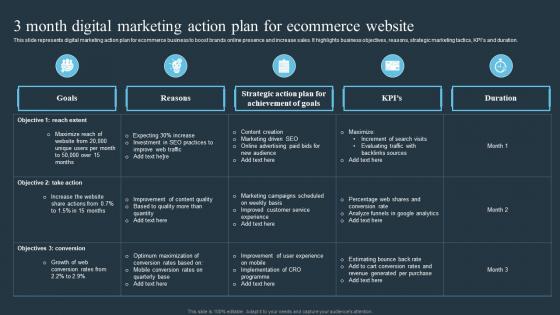
3 Month Digital Marketing Action Plan For Ecommerce Website




Try Before you Buy Download Free Sample Product
 Impress Your
 Audience
 100%
100% Editable
 Save Hours
 of Time


This slide represents digital marketing action plan for ecommerce business to boost brands online presence and increase sales. It highlights business objectives, reasons, strategic marketing tactics, KPIs and duration.
People who downloaded this PowerPoint presentation also viewed the following :
3 Month Digital Marketing Action Plan For Ecommerce Website with all 6 slides:
Use our 3 Month Digital Marketing Action Plan For Ecommerce Website to effectively help you save your valuable time. They are readymade to fit into any presentation structure.





FAQs for 3 Month Digital Marketing Action Plan
Okay so first thing - set actual goals, not just "get more customers." Like 30% more leads or whatever makes sense. Most people totally bomb the audience part though. Don't just say "millennials with money" lol. You gotta dig into who they really are and what problems you're solving. Map out your content, budget, and how you'll track results. I'd honestly pick one channel first - maybe Instagram or email - and get really good at that before spreading yourself thin. Use analytics to see what's working so you can adjust quickly. The measurement part is huge because you'll definitely need to pivot.
Honestly, start with the data you already have - customer demographics, what they're buying, how they engage with your stuff. Google Analytics and social media insights are super helpful here. Build out those buyer personas based on age, interests, what problems they're trying to solve. I always tell people to actually survey their customers too because sometimes the data doesn't tell the whole story, you know? Also peek at where your competitors are hanging out online. Once you've got this figured out, you can actually aim your campaigns at real people instead of just posting random content and hoping for the best.
Think of social media as where you actually connect with people and get your stuff seen. Pick maybe 2-3 platforms where your customers actually spend time - don't spread yourself too thin trying to be everywhere. LinkedIn's great for business stuff, Instagram for pretty visuals, TikTok for younger crowds (though my mom's on there now so whatever). Each one works differently but they all help you chat directly with customers and see what they actually care about. Honestly, the data you get from these platforms is super helpful for figuring out what's working and what isn't.
Don't treat SEO like this separate thing you do on the side - weave it into everything. Your keyword research should match up with your content calendar and paid ads (that's honestly where you see the best results). Social posts, emails, blog stuff - make them all naturally support your target keywords. Oh, and your landing pages need to work for both SEO and conversions because what's the point of traffic that doesn't actually convert? Regular content audits help keep everything on track. The whole idea is making SEO inform your other channels instead of fighting against them.
Mix awareness stuff with engagement and conversions to get the real picture. Reach and impressions show if people see your content. Then dive into engagement rates, click-throughs, and how long they stay on your site. Obviously the money metrics matter most - cost per acquisition, conversion rates, ROI. Honestly, don't waste time on follower counts and that vanity nonsense, it's pretty much meaningless for business. Pick maybe 5-7 metrics that actually match your goals and check them weekly. Trust me, you'll go crazy if you try tracking everything.
Look, stop creating content just to fill your calendar - that's basically burning cash. Every piece should tie back to what you're actually trying to achieve. Want more brand awareness? Make stuff people will share that shows you know your shit. Planning a product launch? Build content around that timeline. Honestly, most teams I see are just throwing spaghetti at the wall. Map everything to your real KPIs - conversions, traffic, whatever actually matters for your business right now. If you can't draw a line from that blog post to moving the needle, don't publish it.
Honestly, save about 20-30% just for testing new stuff. Don't dump everything into one platform - I've seen too many people get burned when Facebook tweaks their algo overnight. Spread it across maybe 2-3 channels tops. Oh, and those "little" costs? Design, copy, analytics tools - they sneak up on you fast. Track your cost per acquisition for each channel religiously. That's how you figure out what's actually working vs. what just looks pretty on paper. Start small, see what converts, then throw more money at the winners.
Honestly, segmentation is where it's at - you gotta send different stuff to new subscribers vs your actual customers. Set up those welcome sequences first, then build out campaigns based on where people are in your funnel. Automation is a lifesaver here because doing it manually will burn you out quick. I always connect my email with social and website traffic too. Oh and here's the thing - provide value before you pitch anything. People can smell a sales email from miles away. A/B testing subject lines is clutch, even though it's kinda tedious. But seriously, drip campaigns will change your life.
Google Analytics is your best starting point - it's free and handles most of what you need. Search Console is clutch for SEO stuff, and Buffer or Hootsuite work great for social tracking. The free tiers honestly go pretty far before you hit paywalls. Facebook and Google Ads have decent built-in reporting if you're running paid campaigns. Start with GA4 though, it's kind of a pain at first but worth learning. Give it a week to click, then see what other data you're missing. I always end up adding tools one by one instead of trying to set everything up at once.
Dude, you HAVE to get your mobile stuff sorted out. Most people browse on their phones now - like 60%+ of all web traffic. Your site looks terrible on mobile? You're losing tons of potential customers. Plus Google ranks mobile-friendly sites higher, so your SEO takes a hit too. I've watched campaigns completely bomb because landing pages were impossible to use on phones. Super frustrating. Make sure everything loads quickly, buttons aren't tiny, and people can actually fill out forms without wanting to throw their phone. Oh and test it yourself first - use your own phone to check how it actually feels.
Okay so first thing - make your headline super specific about what you're actually giving people. One goal per page, that's it. Break up your text with bullet points because honestly, who has time to read paragraphs anymore? Hide the navigation menu so they can't bounce, and put that CTA button where they'll see it right away - bright color, can't miss it. Testimonials are gold for making people trust you. Oh and make sure it loads fast on mobile since everyone's on their phones. Test different headlines too, you'd be surprised how much that stuff matters for getting people to actually convert.
Look for creators who actually match your vibe and have audiences that fit your target demo. Micro-influencers are where it's at honestly - like 10K-100K followers. Their engagement kills it compared to huge celebrities, plus you won't go broke. I've seen way better ROI from smaller accounts than mega-famous people, which surprised me at first. Make sure they actually use your stuff though. Track engagement and conversions, not just follower counts - that's vanity metrics. Oh, and set clear expectations upfront about what you want and when you need it. Trust me on the disclosure requirements too.
Honestly, the best thing you can do is set up Google Alerts for your industry and peek at what competitors are up to maybe once a month. Analytics become your best friend here - check them regularly to catch trends before everyone else jumps on them. But here's what I wish someone told me earlier: always test small first! Don't dump your entire budget into some shiny new trend that might flop. I made that mistake last quarter and it stung. Once you see what's actually working, then you can slowly move more money toward those campaigns. Quarterly check-ins help too.
So A/B testing is basically splitting your audience in half and showing each group a different version of your campaign. Test one thing at a time though - subject lines, images, button colors, whatever. I learned this the hard way after testing like 5 things at once and having no clue what actually moved the needle. The results honestly blow my mind sometimes. Half your people see version A, half see version B, then you compare clicks, conversions, all that good stuff. Oh and don't jump the gun - give it enough time to actually mean something before you decide which one wins.
Honestly, customer feedback is like getting cheat codes for your marketing. It tells you what's actually landing vs what you *think* is working. Use it to tweak your messaging and figure out which channels your people actually hang out on. Way better than those generic demographic reports, trust me. The cool thing is it shows you where there's a disconnect - like when you think you're being super clear but customers are totally confused. Just grab feedback from surveys, social media, reviews, whatever. Then actually do something with it instead of letting it sit in a spreadsheet somewhere.
-
It makes easy work of my work presentations. I’ve never had to be nervous about my presentations for meetings.
-
Excellent Designs.