Digital Marketing Strategies For Ecommerce Business

Rating:
90%
Digital Marketing Strategies For Ecommerce Business
Slide 1 of 6
Favourites Favourites

Try Before you Buy Download Free Sample Product

Audience Impress Your
Audience
Editable 100%
Editable
Time Save Hours
of Time
The Biggest Sale is ending soon in
0
0
:
0
0
:
0
0
Rating:
90%
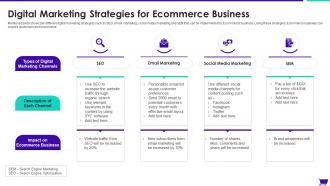
Mentioned slide showcase different digital marketing strategies such as SEO, email marketing, social media marketing and SEM that can be implemented by Ecommerce business. Using these strategies, Ecommerce business can acquire customers and brand value. Presenting our set of slides with Digital Marketing Strategies For Ecommerce Business. This exhibits information on four stages of the process. This is an easy to edit and innovatively designed PowerPoint template. So download immediately and highlight information on Email Marketing, Social Media Marketing, Customers.

FAQs for Digital Marketing Strategies

Honestly, start with figuring out who you're actually talking to - that's your audience research. Then nail down what you want to say and where these people hang out online. I swear, everyone jumps straight into Facebook ads without understanding their customers first. Big mistake. SEO matters too, but focus on the basics before throwing money at ads. Oh, and set up your tracking from the beginning or you'll hate yourself later. Map out how people find you and what makes them actually buy. Those touchpoints are everything.

Stop just posting and start actually talking to people! Reply to comments fast, show some messy behind-the-scenes stuff. I always stalk my followers' posts and engage with theirs too - sounds weird but it works. Stories and lives are golden because they're not perfect. Ask questions in your posts to get conversations going. Post when your people are scrolling, not just whenever. Oh, and track what gets real engagement - not just likes but actual comments. Then do more of that type of content. Honestly, consistency beats perfection every time.

SEO and content marketing work together like crazy well. Search engines love fresh content to crawl, so when you're posting regularly, your rankings naturally improve. Good content pulls in backlinks too - honestly, people would way rather share an interesting article than some boring sales page. It keeps visitors reading longer, which tells Google your stuff is worth showing others. Oh, and make sure you're writing about things people actually search for (keyword research helps here). The key is answering real questions your audience has. It's not rocket science, but it works.

Ditch the basic "Hi [First Name]" stuff - segment your list by what people actually buy or how they behave instead. Dynamic content blocks are clutch for showing different products to different groups in the same email. Subject lines work way better when you throw in their location or recent purchases. Honestly, optimal send times are such a headache to nail down, but timing still matters. A/B test your personalization tactics to see what clicks. Even just splitting people by how engaged they are will bump up your metrics pretty noticeably.

Honestly, forget about vanity metrics like likes and shares - they look pretty but won't pay your rent. Focus on what actually matters: conversion rates, cost per acquisition, and ROAS. Those are your bread and butter. Click-through rates are decent to track too, but don't obsess over them. Customer lifetime value is huge (took me way too long to realize this). Also check which channels are actually driving sales, not just traffic. Start small with maybe 3-5 metrics max. You can always add more later once you've got the basics down.

Dude, you've actually got some serious advantages over the big guys. They're stuck in endless meetings while you can pivot instantly. Speed is your superpower. Focus on being genuine - their massive budgets often make everything feel super corporate and fake, which honestly just turns people off. Go after niche audiences they ignore. Local SEO is huge for smaller businesses. Engage directly on social media instead of posting generic corporate fluff. User-generated content works great too. Having a tight budget forces you to get creative, and that creativity usually beats their expensive but boring ads anyway.

Honestly, AI personalization is where it's at right now - that and voice search stuff. Interactive content kills it too. Polls, quizzes, those AR things everyone's obsessed with. Micro-influencers are actually crushing celebrities these days for real engagement, which is kinda wild if you think about it. Community building's huge now instead of just shouting into the void. Brands that actually talk WITH people instead of AT them are winning. I'd probably start by checking what personalization you're already doing (or not doing lol) and maybe test some interactive formats. See what sticks with your audience first.

So basically, people trust influencers way more than regular ads. When someone you follow recommends something, it feels like getting advice from a friend rather than being sold to. It's honestly word-of-mouth but supercharged. You're getting access to audiences who already trust that person's judgment and taste. The trick is finding influencers who actually match your brand vibe and target the same people you want to reach. I'd start with smaller influencers in your space - they usually get way better engagement than the mega-famous ones anyway. Plus they're probably cheaper too.

Dude, here's what actually works - match your headline to whatever got them there in the first place. Ad promised a free trial? That better be the first thing they see. One goal per page, ditch everything else that's just noise. Keep forms stupidly short (seriously, I've seen conversion rates tank over asking for a phone number). Your CTA button needs to pop with contrast, throw some testimonials up top, and compress those massive images because slow pages kill everything. Honestly though? Just A/B test your headlines and button copy. That's where you'll see the crazy jumps in conversions.

Honestly, just focus on conversion rates, customer acquisition costs, and engagement stuff first - those tell you what's actually working. Platforms dump way too much data on you anyway. A/B test your ad creatives and landing pages, but here's the thing - behavioral data is where you'll find the real insights. See where people are dropping off in your funnel? Fix those spots first. I'd pick maybe 3-5 metrics max and check them weekly. Don't overthink it though - you'll spot the trends pretty quickly once you get into a rhythm with it.

Honestly, AI and machine learning are crushing it right now - predictive analytics, personalized recommendations, all that stuff. Marketing automation is getting scary smart too. Chatbots actually hold decent conversations now (when they're not being weird). Voice search is blowing up since we're all basically talking to our phones 24/7. Oh, and attribution modeling finally works across different touchpoints, which is huge. Programmatic advertising makes media buying so much cleaner. I'd probably just figure out what's driving you crazy right now and see which tech fixes that first.

Honestly, good graphics are a game-changer because people's brains just eat up visuals way faster than text - like 60,000 times faster, which is wild. They make your stuff more shareable and help people actually remember your brand. Plus scrolling through nothing but text blocks is painfully boring. You'll want to keep everything consistent though - same colors, fonts, that whole vibe. I'd make a quick style guide so you're not reinventing the wheel every time. Oh, and batch create a bunch at once instead of scrambling for content daily. Trust me on that one.

Just be upfront about what data you're grabbing and actually ask permission - none of that tiny text nonsense. Give people a simple way out and only take what you genuinely need. Companies are getting burned left and right for the whole "grab everything" approach. Follow GDPR, CCPA, whatever applies to your crowd. Honestly though, here's the easiest test: would you be cool with some random company collecting that same info about you? If you're hesitating even a little, that's your answer right there. Don't overthink it.

Honestly, mobile marketing hits different because people are glued to their phones all day. Your ads need to be super short and make sense for where someone is - like location stuff or quick push notifications. Desktop banner ads? Forget it, they look terrible on phones. I've noticed mobile users (including me lol) have zero patience, so if your site takes forever to load, people bounce immediately. The creative has to work on tiny screens too. I'd start by checking where people are dropping off in your current campaigns - that's usually where you'll find the biggest wins hiding.

Honestly, start with getting your messaging consistent everywhere - that's like step one. QR codes on your print stuff work great for sending people to specific pages. Then blast your offline events all over social media. Oh, and create a unique hashtag for in-person events - I've seen companies crush it with that approach. Definitely grab email addresses when you meet people IRL so you can follow up digitally later. Track everything with UTM codes and unique promo codes though, otherwise you're just guessing what actually works.

Ratings and Reviews

90% of 100
Review Form
Write a review
Most Relevant Reviews
  1. 80%

    by Dominick Pierce

    Much better than the original! Thanks for the quick turnaround.
  2. 100%

    by Darnell Tucker

    Top Quality presentations that are easily editable.

2 Item(s)

per page: