

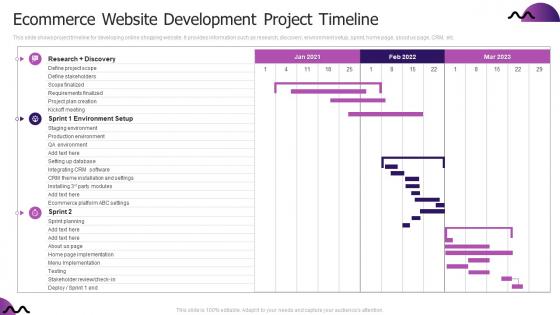
Ecommerce Website Development Project Timeline




Try Before you Buy Download Free Sample Product
 Impress Your
 Audience
 100%
100% Editable
 Save Hours
 of Time


This slide shows project timeline for developing online shopping website. It provides information such as research, discovery, environment setup, sprint, home page, about us page, CRM, etc.
People who downloaded this PowerPoint presentation also viewed the following :
Ecommerce Website Development Project Timeline with all 6 slides:
Use our Ecommerce Website Development Project Timeline to effectively help you save your valuable time. They are readymade to fit into any presentation structure.





FAQs for Ecommerce Website
So you've got five main phases to think about: planning where you map everything out, design mockups, development (that's the brutal part - all your product pages, checkout, payments, etc.), testing to catch bugs, then launch. Planning and design are pretty straightforward. Development is where things get messy and take forever, honestly. QA testing comes after - both the technical stuff and getting real people to click around. Each phase runs about 2-4 weeks depending on how complex you're going. Oh, and definitely pad your timeline because ecommerce projects always expand beyond what you initially planned.
Honestly, just work backwards from your launch date. Block out discovery/planning (2-3 weeks), then design and prototyping (3-4 weeks). Development takes 6-10 weeks depending on how complex things get. Testing and QA need 2-3 weeks, plus a week for deployment prep. Here's the thing though - design revisions always drag on forever, so add 20% buffer time. Payment gateways will screw you over, guaranteed. Map out when you need client feedback because they'll disappear right when you need them most. Make a visual timeline showing what's blocking what so everyone stops asking dumb questions.
Honestly, it depends on a bunch of stuff. How big is your store? Like, 50 products is way different than building some crazy marketplace with custom features. Platform choice makes a huge difference too - Shopify's obviously faster than building from scratch. The biggest slowdown I've seen? Teams that can't make decisions quickly or take forever to send over content. So frustrating. Payment stuff and integrations will add time no matter what. Oh, and custom design work always takes longer than you think. My take - figure out what you absolutely need vs what would be cool to have, then get all your product info and content ready before you even start.
Honestly, your platform choice is gonna make or break your timeline. Shopify gets you up in like 2-4 weeks since everything's already there - you're just tweaking themes and adding your stuff. WooCommerce takes way longer, maybe 6-12 weeks, because you're basically building from scratch plus dealing with hosting headaches. Custom builds? Forget about it - we're talking 3-6 months minimum. I learned this the hard way on my last project. If you need to launch quickly, just go with Shopify or BigCommerce. Save yourself the stress and only do custom when you absolutely have to.
From my experience, you're looking at about 20-30% of your total project timeline for UX/UI work. Wireframing and user mapping usually eat up 2-4 weeks, then visual design and prototyping take another 2-3 weeks on top of that. Here's the kicker though - solid design work actually speeds up development later. Messy handoffs? Total nightmare for your developers. I always tell people not to rush this part because fixing UX problems after launch costs way more than doing it right the first time. Budget for at least two revision rounds or you'll hate yourself later.
Honestly, I'd start with a solid discovery session to figure out their must-haves vs nice-to-haves. Saves you from scope creep hell later. MoSCoW framework works great here - Must have, Should have, Could have, Won't have. Pretty basic but it does the job. Throw everything in a shared doc so everyone can see what's actually prioritized. Oh, and definitely hash out technical feasibility early. I've seen too many "quick wins" turn into three-week debugging marathons. The real trick is getting stakeholders to commit upfront instead of flip-flopping halfway through your sprint.
Dude, scope creep will absolutely destroy you - clients always want "just one more thing." Third-party stuff is brutal too. Payment systems, shipping APIs, they're all a nightmare and take forever. Stakeholders changing their minds about design constantly? Super annoying. Content is another killer - getting product photos and descriptions takes way longer than anyone thinks. Plus last-minute feature requests are the worst. Honestly, I learned this the hard way on my last project. Lock your scope down first, give yourself extra time for integrations, and get content sorted before you even touch code.
Honestly, Agile's a game-changer for ecommerce stuff. You break everything into 2-week sprints instead of waiting forever for some massive launch. Requirements always change anyway - at least this way you can pivot without losing your mind. The feedback happens way faster since you're constantly shipping working features. Your team actually stays engaged because they see real progress regularly. I'd start with core functionality first, then worry about the fancy bells and whistles later. Way better than finding out everything's broken at the very end.
So payment gateway stuff usually takes about 1-2 weeks, then you're looking at another week or two for all the security features. The coding part honestly goes pretty fast - it's all the tedious testing and compliance crap that kills your timeline. You've got PCI compliance, SSL setup, fraud detection testing, tons of transaction scenarios to test. Oh and the payment processors? They can be super slow approving sandbox access - like annoyingly slow. I'd definitely start that application process way earlier than you think you need to, because those third-party approvals will definitely mess with your launch if you're not careful.
Honestly, testing can't be an afterthought - you've gotta plan for it from the start. I usually set aside like 25-30% of dev time just for testing stuff. Do unit tests while you're coding, then block out time for QA rounds covering functionality, UX, performance. Mobile testing is huge too since that's where everyone browses now. Always pad your timeline because bugs will pop up (they just do). Oh and start user acceptance testing at least 2-3 weeks before launch. Trust me, you'll need that buffer when weird issues surface at the last minute.
Dude, don't wait until after launch to think about maintenance - that's a recipe for disaster. I learned this lesson when plugin updates completely broke my checkout page last year, ugh. Budget around 10-15% of what you spent on development every year. Weekly security patches are non-negotiable. Monthly performance checks keep things running smooth. Your SSL certs and hosting need attention too, plus all those third-party tools you're probably using. Honestly, just make a monthly checklist so you don't forget the important stuff. Quarterly updates for features and bug fixes should cover the rest.
Don't make my mistake and leave SEO until the end - start with keyword research right away since it'll shape your whole site structure. During development, handle the technical stuff like page speed and mobile optimization. Content writing is honestly the biggest time suck, so plan for that. I'd budget at least 2-3 weeks just for SEO implementation and testing. Oh, and set up Google Search Console early on - you don't want to be figuring that out when you're trying to launch. The whole process runs smoother when you're not rushing through optimization at the last minute.
Honestly, give yourself like 2-4 weeks for all the content stuff and uploading products. Every 100 products usually takes me about 3-5 days - writing descriptions, fixing photos, organizing categories, the whole thing. Photography always eats up way more time than I expect. If you've already got decent content, maybe cut that in half? The copywriting part is brutal if you're trying to nail the SEO too. Don't wait until your site's done though - start this early and work on it while they're building everything else. Seriously saves your sanity later.
Dude, project management tools will save your sanity. Break everything into smaller tasks with actual deadlines - suddenly those massive development phases don't feel impossible. I'm obsessed with how tools like Asana show you dependencies, like you can't test checkout until payment stuff is done, which seems obvious but trust me you'll forget. Your team stops sending a million "wait what's due when?" emails too. Oh and set up those automated reminders or you'll definitely space on key milestones. Map out your critical path first though - that's the backbone of everything.
Honestly, feedback loops will save your butt. Regular check-ins catch problems while they're still small - way better than discovering everything's broken at the end (been there, not fun). I always do weekly stakeholder reviews and bi-weekly user testing right from the start. You'll spot misaligned expectations, tech issues, weird design stuff before it becomes a whole thing. Projects without this? They go sideways fast. Plus you can actually adjust your timeline instead of panic-fixing everything later. Oh, and make sure developers are in those loops too - they see problems coming before anyone else does.
-
Very unique and reliable designs.
-
World-class PowerPoint designs that are fully customizable!