

Task management powerpoint slides




Try Before you Buy Download Free Sample Product
 Impress Your
 Audience
 100%
100% Editable
 Save Hours
 of Time


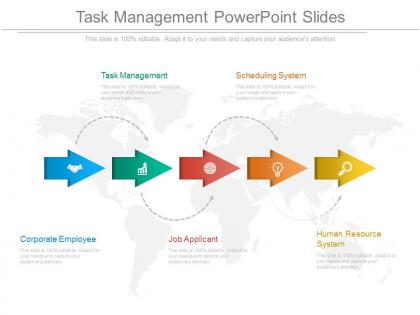
Browse through our task management PowerPoint diagram slide. The Presentation template has been designed by our passionate designers to meet your business requirements. Our PPT design is accessible with five different stages in the process such as task management, scheduling system, corporate employee, job applicant and human resource system. The linear arrow process PowerPoint Template is useful for business people as by incorporating this into their PPT Presentation they can track a task throughout its life cycle and makes decisions based on the progress. Task management helps in proper schedules, continuous uninterrupted workflow with no delays and finish projects in time. It also saves time and reduces stress by being more focused and better organized. Nowadays customizes products are more popular among consumers as it gives them opportunity to tailor made it as per their preference. Our Presentation Slide Design comes with the matching icons which makes it possible for you to just download and insert it in your working presentation. Make your presentation more professional with this amazing design.Get a firm guarantee from our Task Management Powerpoint Slides. They are committed to your constant growth.
People who downloaded this PowerPoint presentation also viewed the following :
Task management powerpoint slides with all 7 slides:
Our Task Management Powerpoint Slides are designed for economy of effort. They allow you to function efficiently.


FAQs for Task
Effective task prioritization methods include the Eisenhower Matrix for urgency assessment, ABC ranking for importance levels, time-blocking for focused execution, deadline mapping, and impact-based scoring systems. These approaches streamline workflow management by reducing decision fatigue, minimizing context switching, and maximizing productive output, with many organizations finding that strategic prioritization ultimately delivers enhanced operational efficiency and improved project completion rates.
Task management tools enhance team collaboration by centralizing project visibility, streamlining communication channels, and providing real-time progress tracking across all team members. These platforms enable teams to coordinate workflows more effectively, reduce email overload, and maintain transparency in project timelines, with many organizations finding that integrated task management ultimately delivers faster project completion and improved accountability.
Delegation enables project leaders to optimize resource allocation, prevent bottlenecks, and leverage team expertise while maintaining strategic oversight of deliverables. Through strategic task distribution, leaders can focus on high-level planning and stakeholder management while empowering team members, ultimately accelerating project timelines and building organizational capacity for handling increasingly complex initiatives.
Time-blocking improves individual productivity by dedicating specific time slots to focused work, eliminating multitasking distractions, and creating structured accountability for task completion. This approach enables professionals to minimize context switching, enhance deep work sessions, and maintain realistic scheduling expectations, with many finding that dedicated blocks ultimately deliver better work quality and reduced stress levels.
Effective anti-procrastination strategies include time-blocking specific tasks, breaking large projects into smaller actionable steps, using the two-minute rule for quick tasks, implementing accountability systems, and creating distraction-free work environments. These approaches streamline focus by eliminating decision fatigue, reducing overwhelming feelings, and building momentum through quick wins, ultimately delivering improved productivity and reduced stress across professional responsibilities.
Different industries adapt task management practices to their specific operational needs, regulatory requirements, and customer expectations. Healthcare organizations utilize task management for patient care coordination and compliance tracking, while manufacturing companies focus on production scheduling and quality control workflows, and financial services prioritize risk management tasks and regulatory reporting, ultimately enabling each sector to optimize efficiency while meeting industry-specific demands.
Key task management metrics include completion rates, time-to-completion, quality scores, resource utilization, and team productivity indexes. These measurements enable organizations to streamline workflows, identify bottlenecks, and optimize resource allocation, with many project-driven teams finding that tracking these metrics ultimately delivers improved efficiency, enhanced collaboration, and measurable competitive advantage in deadline-critical environments.
Technology and automation streamline task management processes by eliminating manual scheduling, providing real-time progress tracking, and enabling seamless collaboration across teams. Through AI-powered platforms and workflow automation tools, organizations can reduce administrative overhead, minimize human error, and accelerate project delivery, with many companies finding significant improvements in operational efficiency and resource allocation.
Mindset shifts enhance task management effectiveness by embracing growth perspectives, viewing challenges as opportunities, prioritizing progress over perfection, and focusing on outcomes rather than activities. These mental frameworks enable professionals to streamline workflow decisions, reduce procrastination through reframed thinking, and ultimately deliver improved productivity, with many organizations finding that mindset-trained employees demonstrate significantly enhanced project completion rates.
Common task management pitfalls include unclear priorities, poor deadline setting, inadequate progress tracking, insufficient resource allocation, and lack of team communication. These challenges often lead to missed deadlines and reduced productivity, with many organizations finding that implementing structured frameworks, regular check-ins, and clear accountability measures significantly enhances project outcomes and operational efficiency.
Visual task management tools like Kanban boards enhance project progress tracking by providing real-time visibility into work stages, identifying bottlenecks quickly, and enabling seamless team collaboration through drag-and-drop functionality. These systems streamline workflow management by displaying task status at a glance, facilitating resource allocation, and ultimately delivering improved project transparency and faster completion rates across organizations.
A well-defined scope establishes clear boundaries, deliverables, timelines, resource requirements, and success criteria for each task, preventing scope creep and misaligned expectations. This clarity enables teams to prioritize effectively, allocate resources strategically, and maintain focus on core objectives, with many organizations finding that defined scope reduces project delays by up to 40% while enhancing overall productivity.
Regular reviews and adjustments enhance task management by identifying bottlenecks, realigning priorities with changing business needs, and optimizing resource allocation across projects. Through systematic evaluation cycles, organizations streamline workflows, reduce inefficiencies, and adapt strategies based on performance data, with many teams finding that consistent review processes ultimately deliver improved productivity and better project outcomes.
Task management principles enhance personal work-life balance by establishing clear boundaries, prioritizing activities based on personal values, and creating structured routines that separate professional and personal time. Through techniques like time-blocking and priority matrices, individuals streamline daily responsibilities, reduce decision fatigue, and allocate dedicated time for family, hobbies, and self-care, ultimately delivering greater life satisfaction.
Best practices include establishing clear communication protocols, setting defined deadlines with regular check-ins, utilizing collaborative features for transparency, implementing standardized workflows, and tracking progress through visual dashboards. These approaches streamline coordination by reducing miscommunication, enhancing accountability, and maintaining team alignment, with many organizations finding that structured digital frameworks ultimately deliver improved productivity and stronger remote team cohesion.
-
Informative presentations that are easily editable.
-
Design layout is very impressive.