


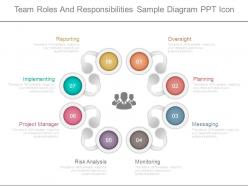
Team roles and responsibilities sample diagram ppt icon





Try Before you Buy Download Free Sample Product
 Impress Your
Audience
 100%
Editable
 Save Hours
of Time


Ensure the interim is interesting with our Team Roles And Responsibilities Sample Diagram Ppt Icon. Enable folks to enjoy the breaks.
People who downloaded this PowerPoint presentation also viewed the following :
Team roles and responsibilities sample diagram ppt icon with all 7 slides:
Handle errant folk with our Team Roles And Responsibilities Sample Diagram Ppt Icon. Inspire them to improve their attitude.


FAQs for Team roles and responsibilities sample
You need a leader calling the shots, obviously. Then get your subject matter experts - people who actually know their stuff in whatever area you're working on. Don't forget a project coordinator (trust me, someone needs to track all those deadlines). Beyond that, you want solid contributors doing the heavy lifting. Oh, and there's always that one person who's weirdly good at getting everyone to communicate - they're worth their weight in gold. The trick is mapping out who does what upfront. Nobody wants to be three weeks in wondering whose job something actually was. Make sure everyone gets how their work connects to the big picture too.
Honestly, clear roles are a game changer. No more of that "wait, whose job is this?" chaos that just kills everything. People know their stuff and aren't tripping over each other or missing things completely. Decisions happen way faster too since everyone knows who calls the shots on what. You get to actually focus on what you're good at instead of scrambling around confused. I'd start by just writing down who does what in your current projects - bet you'll find some weird overlaps or things nobody's handling. It's pretty obvious once you see it written out.
So you'll be doing the usual stuff - planning projects, handing out tasks, making sure deadlines don't completely fall apart. You're basically the go-between for your team and the higher-ups (those status meetings are as exciting as they sound). Coaching people and sorting out drama when it happens is part of it too. But honestly? The real job is just making sure everyone feels supported and has what they need. I'd start with regular check-ins - like actually sit down with each person and figure out what's blocking them or what they're trying to achieve.
Think of it like putting together a good playlist - everyone brings something different to the mix. Your data person crushes the numbers while your creative friend comes up with wild ideas that actually work. I learned this the hard way trying to make everyone do everything (spoiler: disaster). Start by figuring out what each person's actually good at. Maybe do a quick round in your next meeting where people share their strengths? You'd be amazed what comes up. Once you know who's who, just match tasks to talents. Way less headaches, way better results. Your team ends up being this well-oiled machine instead of everyone struggling with stuff they hate.
Honestly, start with a RACI matrix - maps out who's Responsible, Accountable, Consulted, and Informed for everything. Catches overlap before it gets messy. Then do workshops where people write down what they think they own vs what others think they own. The gaps are always wild! Oh, and regular check-ins are clutch when projects shift and boundaries get blurry. Document it all somewhere people actually check - not buried in some random wiki. I learned this the hard way lol. Short sentences work better than long explanations nobody reads anyway.
Ugh, role confusion is the worst. Map out who's responsible for what and write it down somewhere visible - I know it sounds obvious but you'd be surprised how many teams skip this. Check in regularly too since things shift constantly. What worked last month probably doesn't now, honestly. The handoff points between people? That's where everything goes sideways usually. You'll need to overcommunicate at first until it clicks for everyone. Once you get into a groove though, you can back off a bit. Trust me, being super clear upfront saves so much headache later.
Oh man, yeah this stuff can really mess with your team dynamics. Some cultures are super hierarchical while others want everyone pitching in equally. Communication styles vary wildly too - like direct feedback versus the more roundabout approach. Don't even get me started on how differently people view deadlines! I honestly had to learn this the hard way with our Tokyo office situation. My advice? Hash out expectations right from the start instead of assuming everyone's on the same page. Figure out roles early. Then just... let different work styles exist together rather than pushing one way of doing things on everybody.
Write up a proper role document first - seriously, don't just rely on verbal explanations because people will tell them conflicting things. Give them a buddy for the first few weeks and schedule regular check-ins. Small wins early on are huge for confidence building. Oh, and make yourself available for questions without them feeling like they're being annoying - that's key. Set up quick intro meetings with the main people they'll be working with regularly. The whole "figure it out as you go" approach never works well.
Honestly, monthly check-ins are a game changer for this stuff. I do quick 15-minute chats with each person to ask what's working and what isn't. You'd be surprised how often what you think is going smoothly... isn't. People will tell you when they're drowning or bored out of their minds, which helps you shuffle responsibilities around. It's way easier to catch role confusion early than deal with the mess later. Plus you can adjust things as projects change or people's strengths become more obvious. Super simple but it actually works.
RACI matrices work great for this - maps out who's Responsible, Accountable, Consulted, and Informed. Just don't go overboard like my last team did with this insane spreadsheet nobody touched after week one. Miro's good for visual stuff, or honestly? Just use a Google Doc with clear role descriptions. My friend swears by Lucidchart but seems overkill to me. Whatever your team's already comfortable with is probably your best bet. Getting people to actually use it matters way more than picking the perfect tool.
Honestly, don't get stuck with your original role assignments - that's a rookie mistake I see all the time. Check in weekly about who's actually good at what and whether people have bandwidth. Priorities change constantly, so your roles should too. Maybe your best coder suddenly needs to talk to clients (scary but usually goes better than expected). Just be upfront about capacity and skills during those check-ins. When something's not working, pivot fast instead of waiting around. Quick honest conversations beat formal reviews every time.
Oh man, clear roles are a game-changer for avoiding team drama. No more of that "I thought you were handling it" nonsense or people stepping all over each other's work. You know what I mean? When everyone knows their lane, conflicts get way easier to sort out too - you can actually focus on fixing stuff instead of playing the blame game. Just make sure you update role definitions as things change (learned that one the hard way). Honestly, it's one of those simple things that saves so much headache down the road.
Honestly, just write everything down somewhere everyone can see it. Google doc, Slack channel, whatever works. List out who's doing what and how decisions happen - I know it sounds boring but trust me on this one. Different timezones make everything harder and people will get confused about roles. Have those awkward "wait, whose job is this?" conversations regularly. Short sentences work better than long explanations. When someone's responsibilities change, update the docs immediately. You'll thank yourself later when there's no confusion about who dropped the ball.
Honestly, your team's probably struggling because nobody's actually accountable for their work. When people don't follow through, you end up picking up the slack - which sucks. Trust falls apart fast when you can't rely on teammates. Here's what works: make roles super clear from day one. Who's doing what? By when? Then check in regularly (not micromanaging, just staying connected). I've seen brilliant teams completely implode because everyone assumed someone else would handle things. Short version - if people own their responsibilities and you track progress together, everything flows way better. Clear expectations + regular touchpoints = sanity.
So agile teams are way more flexible than old-school project management. Roles shift constantly based on what each sprint needs. Like, you could be coding one week then doing UX stuff the next if that's where the team's stuck. Honestly, it felt weird at first but now I love it. Cross-training is huge - your scrum master might facilitate meetings then jump into development work. We do retrospectives to see what role swaps actually worked. Oh, and map out everyone's backup skills early on. That way you're not scrambling when someone's swamped or out sick.
-
Easily Editable.
-
Good research work and creative work done on every template.