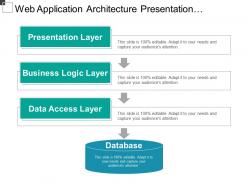
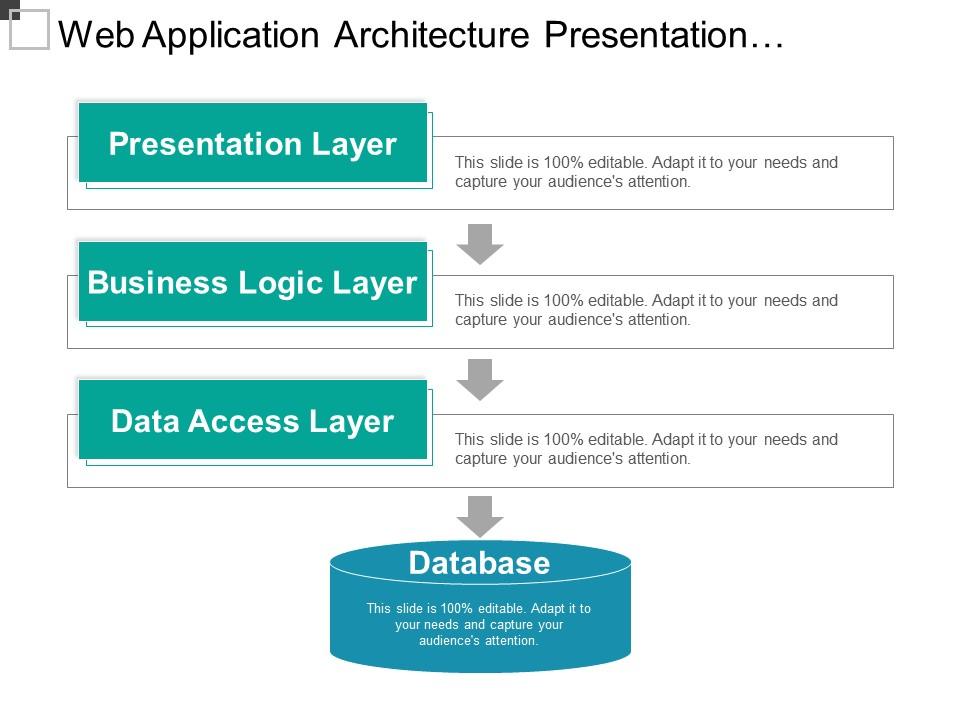
Web application architecture presentation business data layers
Try Before you Buy Download Free Sample Product
Audience
Editable
of Time
Adjudicate disputes with our Web Application Architecture Presentation Business Data Layers. Bring about better cohesion.
People who downloaded this PowerPoint presentation also viewed the following :
Web application architecture presentation business data layers with all 5 slides:
Convince folks to accept the error in their assessment with our Web Application Architecture Presentation Business Data Layers. It helps address the inflexible.
FAQs for Web application architecture presentation
Key components of web application architecture include the presentation layer, business logic layer, data access layer, database layer, and web server infrastructure. These components work together by separating user interfaces from backend processing, enabling scalable data management, and facilitating secure communication between systems, with many organizations finding that this layered approach significantly enhances development efficiency and system maintainability.
Microservices break applications into independent, smaller services that communicate through APIs, while monolithic architecture bundles all functionality into a single deployable unit. This modular approach enables organizations to scale individual components independently, deploy updates faster, and utilize different technologies per service, with many enterprises finding that microservices deliver greater flexibility and operational efficiency.
The front-end handles user interface presentation, user interactions, data visualization, and client-side processing, while the back-end manages server logic, database operations, security protocols, and API integrations. This strategic separation enables development teams to optimize user experiences and system performance independently, with many organizations finding that specialized front-end and back-end teams deliver faster deployment cycles and more scalable applications.
APIs serve as crucial communication bridges in web application architecture, enabling seamless data exchange between different systems, services, and platforms while facilitating integration with third-party services, databases, and microservices. Through strategic API implementation, organizations streamline development processes, enhance scalability, and accelerate time-to-market, with many enterprises finding that well-designed APIs ultimately deliver competitive advantage and operational efficiency.
Ensuring scalability involves implementing load balancers, microservices architecture, database optimization, caching strategies, and cloud-based infrastructure that can dynamically adjust resources. These approaches streamline performance by distributing traffic efficiently, isolating system components, and minimizing bottlenecks, with many organizations finding that strategic architectural planning ultimately delivers faster response times and competitive advantage.
Common web application design patterns include Model-View-Controller (MVC), microservices, layered architecture, repository pattern, and singleton pattern. These architectural approaches streamline development by separating concerns, enhancing code maintainability, and enabling scalable solutions, with many organizations finding that strategic pattern implementation delivers faster deployment cycles, reduced technical debt, and improved system reliability across complex applications.
Cloud computing transforms web application architecture by enabling scalable, distributed systems through microservices, containerization, and serverless computing models. These cloud-native approaches streamline resource allocation, enhance fault tolerance, and minimize infrastructure management, with organizations across retail, finance, and healthcare finding that migration delivers reduced operational costs, improved performance, and greater competitive agility.
Web application security best practices include implementing robust authentication and authorization systems, encrypting data transmission through HTTPS, validating and sanitizing all user inputs, securing APIs with proper access controls, and maintaining regular security updates. These measures streamline protection by preventing unauthorized access, minimizing data breaches, and ensuring compliance standards, with many organizations finding that comprehensive security architectures ultimately deliver enhanced customer trust and competitive advantage.
Performance optimization spans multiple architectural layers, including database indexing and query optimization, server-side caching and load balancing, content delivery networks for static assets, and client-side code minification. These strategies work synergistically across presentation, business logic, and data layers, with many organizations finding that implementing comprehensive optimization delivers faster response times, reduced infrastructure costs, and enhanced user experiences that ultimately provide significant competitive advantages.
Serverless architecture challenges include vendor lock-in, cold start latency, debugging complexity, limited runtime environments, and monitoring difficulties. While these present implementation hurdles, many organizations find that proper planning, multi-cloud strategies, and specialized serverless monitoring tools effectively address these concerns, ultimately delivering reduced operational overhead and enhanced scalability.
Data management in web application architecture involves selecting appropriate database technologies, implementing efficient data modeling, establishing robust backup strategies, and ensuring scalability through caching mechanisms and data partitioning. Organizations across industries like e-commerce, healthcare, and financial services increasingly leverage cloud-based storage solutions, distributed databases, and real-time analytics platforms, ultimately delivering faster query performance and enhanced user experiences while maintaining data integrity.
Common tools and technologies include React, Angular, and Vue.js for front-end development, Node.js, Django, and Spring Boot for back-end services, PostgreSQL and MongoDB for databases, Docker for containerization, and AWS, Azure, and Google Cloud for deployment. These technologies streamline development workflows, enhance scalability, and enable faster deployment cycles, with many organizations finding that strategic combinations ultimately deliver improved performance and reduced operational costs.
User experience influences web application architecture design by prioritizing fast loading times, responsive interfaces, and seamless navigation across different devices and platforms. Architects must balance performance optimization with user accessibility, implementing caching strategies, content delivery networks, and microservices architectures that enhance responsiveness, while ensuring scalability supports growing user demands without compromising interface quality.
Key performance metrics include response time, throughput, error rates, CPU and memory utilization, database query performance, and user experience indicators like page load speed. These metrics enable organizations to identify bottlenecks, optimize resource allocation, and maintain competitive advantage, with many enterprises finding that proactive monitoring ultimately delivers improved customer satisfaction and operational efficiency.
Ensuring maintainability requires modular design, comprehensive documentation, consistent coding standards, automated testing, and regular code reviews. Through strategic layering and microservices architecture, development teams streamline updates, minimize technical debt, and accelerate feature deployment, with many organizations finding that systematic refactoring and monitoring ultimately delivers reduced development costs and enhanced scalability.
-
Visually stunning presentation, love the content.
-
Amazing product with appealing content and design.