

Project manager roles and responsibilities sample of ppt




Try Before you Buy Download Free Sample Product
 Impress Your
 Audience
 100%
100% Editable
 Save Hours
 of Time


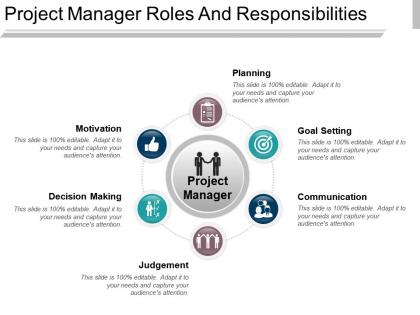
Project manager roles and responsibilities sample of PPT is a predesigned slide template required for professional as well as educational purposes. The role of the project manager PowerPoint visual is a very BeAutifully etched PPT diagram which helps illustrates the overall responsibility of the project head at the construction, petrochemical, architecture, information technology and many different industries that produce products and services. Make use of this project manager job description PowerPoint slide template to understand and make others understand the key duties that impact the likelihood of success throughout the lifetime of the project. Planning, goal setting, communication, judgment, decision making and motivation are the responsibilities as mentioned by our team of expert designers in this importance of project manager PowerPoint presentation infographic. Cater for fast changing demands with our Project Manager Roles And Responsibilities Sample Of Ppt. Acquire across the board flexibility.
People who downloaded this PowerPoint presentation also viewed the following :
Project manager roles and responsibilities sample of ppt with all 5 slides:
Get them to act in your favor with our Project Manager Roles And Responsibilities Sample Of Ppt. Galvanize them into following your directions.



FAQs for Project manager roles and responsibilities
So there are five main phases: initiation, planning, execution, monitoring, and closure. First you define your scope and goals, then map out timelines and resources. Execution is where stuff actually gets built - and yeah, it's usually messier than you'd expect. While you're executing, you're constantly checking progress and pivoting when things go sideways. Closure wraps it all up with lessons learned and getting everyone to sign off. Here's the thing though - these phases aren't really linear. You'll bounce between monitoring and planning constantly as requirements shift. Seriously, don't rush past the planning stage just because you want to dive in.
Good communication stops your team from stepping on each other's toes constantly. You'll catch problems before they explode if everyone's upfront about deadlines and when stuff goes sideways. People actually give a damn when they feel heard instead of just showing up to collect a paycheck. Honestly, half the battle is just deciding how you'll communicate - like what goes in Slack vs email, when you'll do check-ins, that kind of thing. Clear documentation helps too, but don't overthink it. The whole point is avoiding those awkward "I thought you were doing that" conversations.
Honestly, start with just one good project management tool - I'm obsessed with Asana but Monday.com and Trello work great too. They handle all your task tracking and timeline stuff in one spot. Slack is amazing for team chat so you're not drowning in emails all day. You'll need somewhere to dump files like Google Drive or Dropbox. Oh, and if you bill by the hour, grab a time tracker early - learned that one the hard way! Don't go crazy with like 10 different tools though. Your team will hate you for it.
Start with a detailed scope statement - write down exactly what you're delivering and what's off-limits. Get everyone to sign off on it before you begin anything. Here's the thing though: people will still try to sneak in "quick additions." That's why you need a formal change process. When they ask for that "tiny feature" (spoiler alert - never actually tiny), point back to your documented scope. Make them go through proper approval channels with budget and timeline impacts spelled out. I learned this the hard way on my last project. Set those boundaries early and don't budge.
Look, you basically need a backup plan for when stuff inevitably goes sideways on your project. Start by thinking through what could mess things up - budget issues, team problems, whatever. Then figure out how to either stop those things from happening or deal with them if they do. Honestly, I've watched so many projects completely fall apart because people just assumed everything would go perfectly (spoiler: it never does). Don't just do this once either - keep checking throughout the project. It's like having insurance but actually useful. Trust me, your future stressed-out self will thank you when you're not scrambling to fix disasters you could've seen coming.
Break your project into 1-2 week chunks and have everyone deliver working stuff regularly. Those daily 15-minute check-ins? They're actually worth it - saves so much headache later when people aren't confused about what others are doing. After each sprint, do a quick retrospective to spot what's slowing you down and fix it right away. Don't wait months to get feedback from stakeholders or you'll end up building something nobody wants (learned this the hard way). Start small with one project first before going crazy with it everywhere.
First thing - map out your stakeholders so you know who actually matters. Then figure out how each group likes to communicate. Some people want weekly updates, others just care about the big milestones. Video calls beat email every time for relationship building, trust me on that one. Ask for feedback constantly instead of just dumping status reports on everyone. Oh, and be proactive about problems before they blow up. Set expectations early about when and how you'll communicate. That way nobody's left wondering what's happening or when they'll hear from you next.
Oh man, this stuff trips up so many teams. Direct communicators clash with people who hint at problems instead of just saying them - creates a mess during updates. Time zones suck but honestly? The bigger issue is how cultures handle deadlines and hierarchy differently. What you think is good debate might come across as totally disrespectful to someone from a more formal culture. Set up clear communication rules from day one. Also check in with people one-on-one regularly - you'll catch the weird tension before it blows up your whole timeline.
Honestly, just break everything down into bite-sized chunks first. Don't lowball your estimates either - we both know that never works out lol. I always throw in like 15-20% buffer time because something random will definitely go wrong. Your team probably has way better insight on timing than you do, so actually ask them. Set up check-ins along the way so you're not scrambling at the end. Oh and if deadlines start slipping? Tell people immediately. Trust me, they'd rather know now than get blindsided later when everything's on fire.
Dude, analytics basically replaces all that guesswork with actual data. Track your progress in real-time and you'll catch problems way before they tank your timeline. Historical patterns show you exactly what resources you'll need too. Honestly, once you get into it, going back to gut feelings seems crazy. Budget overruns? You can pinpoint where money disappears instead of wondering what went wrong. Plus stakeholders love concrete numbers over those awkward "everything's fine" updates. My advice - start with something basic like task completion rates and just track it consistently. Don't overthink it at first.
You definitely want to watch schedule performance and budget variance - basically are you on time and not bleeding money. Scope creep is huge too. Quality stuff like defect rates matter, but honestly? Sometimes keeping stakeholders happy trumps perfect metrics. I've watched projects hit every target but still bomb because everyone hated the process. Resource utilization tells you if your team's actually productive or just busy. Don't go crazy though - pick maybe 3-4 metrics that actually help you fix problems when they pop up. More data doesn't always mean better decisions.
Talk to your team WAY more than usual and celebrate the tiny wins - seriously, everything counts. People need to understand why things suck right now and what you're working toward. I've watched teams completely implode because nobody bothered explaining the reasoning behind all the stress they were dealing with. Check in more often, ask how they're actually doing, then listen. Set up casual hangouts, even if it's just virtual coffee breaks or whatever. Oh, and call out the struggle publicly - don't pretend everything's fine. Thank people for sticking it out. Costs you nothing but makes a huge difference.
Honestly, daily standups are a game changer - way better than just weekly status calls. Get everyone on Slack or Teams for the random stuff that comes up (sometimes that's where the real work happens, you know?). Document everything in shared spaces so people aren't constantly asking "wait, what was the deadline again?" Trust them to handle their own schedules. But here's the thing - you probably need MORE check-ins than you think, not fewer. Maybe try those quick pulse surveys too. Being available when they're stuck is huge.
Honestly, I always go for the critical path stuff first - if those tasks slip, your whole timeline's screwed. Dependencies are obvious but easy to overlook when you're rushing (like trying to set up software before the actual servers show up, been there). The impact vs effort thing works great for quick wins early on. Your team will catch bottlenecks you totally miss from up top, so definitely loop them into these conversations. Resource availability matters more than people think. I review weekly since everything changes anyway - might as well roll with it.
Dude, those failed projects? They're actually super valuable if you dig into them properly. Most failures aren't some big mystery - it's usually stuff like vague requirements, terrible communication, or completely insane deadlines. Look for what keeps happening over and over again. The trick is making sure people can talk about screwups without getting thrown under the bus. Nobody's gonna be honest if they think they'll get blamed. Do a quick "what went wrong" chat after every project (even the good ones, honestly). Just write this stuff down somewhere your team will actually look at it later, not buried in some random folder.
-
Best way of representation of the topic.
-
Perfect template with attractive color combination.
-
Colors used are bright and distinctive.
-
Wonderful templates design to use in business meetings.